

A guide steps off the coach at a hillside old town, thirty guests trailing behind, and within two minutes the group has split into three clusters: the ones who caught the last sentence, the ones straining to hear over a passing scooter, and the ones already wandering toward a gelato stand. The guide raises their voice. It doesn’t help. By the third stop, half the group is asking a neighbor what was just said.
Any operator running walking tours, city excursions, or multi-stop day trips has watched some version of this play out. It isn’t a training problem or a guide problem. It’s an acoustics problem, and it’s one that digital tour guide systems were built to solve.

The Real Cost of a Group That Can’t Hear
When a group loses the thread of what the guide is saying, the effects show up in places that don’t always get traced back to the cause. Tour ratings drop for reasons guests describe vaguely — “felt rushed,” “hard to follow” — when the actual issue was volume. Guides end up repeating themselves at every stop, which slows the itinerary and leaves less time at each site. Groups drift and re-cluster in traffic, near ledges, or in crowded market alleys, which is where safety incidents tend to happen.
For agencies running back-to-back departures, there’s also a quieter cost: guides who strain their voice all day burn out faster, and turnover among experienced guides is expensive to replace.

What a Tour Guide System Actually Changes
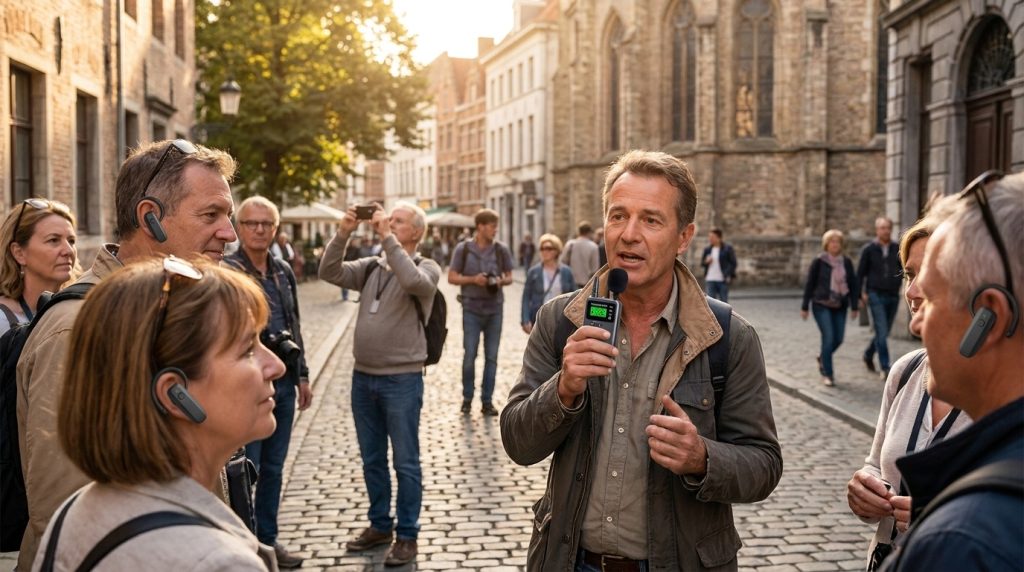
A tour guide system gives the guide a wireless microphone and gives each guest a small receiver with an earpiece. The guide speaks at a normal, conversational volume — no shouting, no repeating — and every guest hears the same clear audio whether they’re standing at the front of the group or lagging fifteen meters behind to take a photo.
The practical result is a group that moves as one unit instead of three. Guests can hear from a market stall, a passing bus, or the back of a cathedral without missing detail. Guides can speak while walking rather than stopping to gather everyone within earshot, which shortens transit time between stops without cutting content.
For agencies evaluating systems, two things tend to matter more than any spec sheet: how the equipment holds up across a full season of daily use, and how much staff time it takes to hand out, collect, and recharge units between tours.
Matching the System to the Tour, Not the Other Way Around
Not every itinerary has the same demands, and this is usually where agencies get the most value from talking to an equipment provider directly rather than picking off a catalog.
For compact city-walking tours — museum districts, old town alleys, food tours — Yingmi’s 008A tour guide system is built around exactly this use case: light receivers guests barely notice they’re wearing, quick handout and collection between stops, and a charging case that keeps a full day’s units ready without the guide having to think about battery levels mid-route.
For agencies running larger or more varied groups — coach tours with a walking segment, factory or winery visits combined with outdoor stops, multi-day itineraries where the same units need to perform across very different environments — the L8 Tour Guide System is designed with a bit more range and battery headroom, so the same set of equipment covers an indoor briefing, an outdoor walk, and a longer transfer without swapping gear.
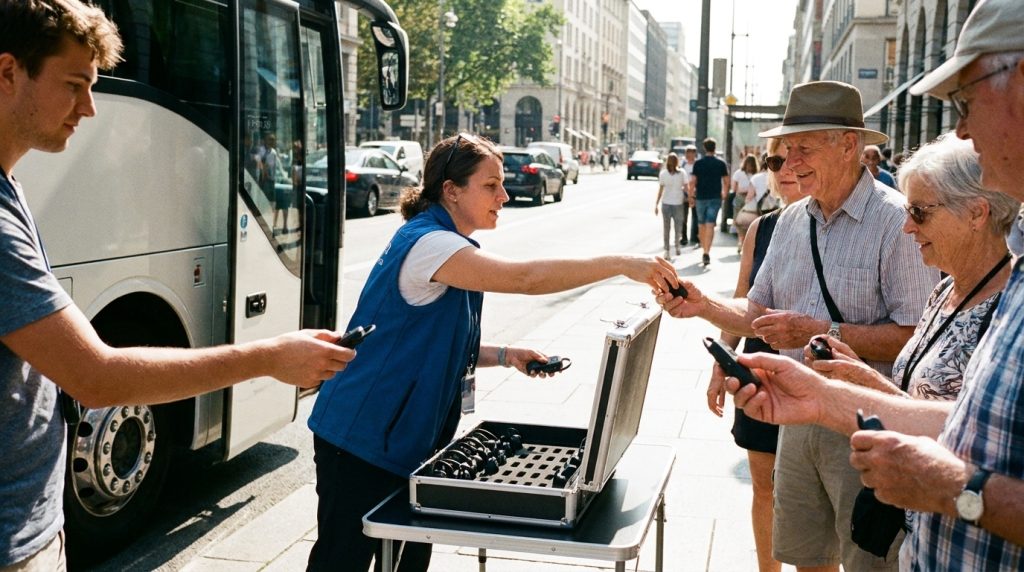
Neither system requires guests to download an app or pair a device themselves, which matters more than it sounds like for groups with a wide age range or limited familiarity with tech.
Where This Leaves Agencies Planning Ahead
Guest experience on a group tour is decided less by the itinerary on paper and more by whether people could actually hear what they came to see explained. Equipment that solves this quietly — without guests noticing the technology at all — tends to be the equipment that shows up in good reviews without ever being mentioned by name.
Agencies weighing an upgrade for the coming season are usually better served by describing their actual routes and group sizes to a supplier than by comparing spec sheets in isolation. The right system for a two-hour old town walk and the right system for a full-day multi-site tour aren’t always the same one.
FAQs
Do guests need any technical setup?
No. Receivers are handed out already paired to the guide’s transmitter, and guests only need to adjust volume or put in the earpiece. There’s nothing to install and nothing that requires a smartphone.
How many units does a typical group tour need?
Most operators order in blocks that match their largest recurring group size plus a small buffer for spares or last-minute additions — commonly 15 to 40 units per guide, though this varies by tour type and how many groups run in parallel.
What happens if a unit gets lost or damaged mid-season?
This is worth asking any supplier directly, since replacement lead times and spare-parts availability vary. Agencies running frequent departures should factor this into their initial order rather than treating it as an afterthought.
Can one system work across very different environments — indoors and outdoors, quiet rooms and busy streets?
Yes, though performance depends on the specific model. This is exactly the kind of detail worth confirming against your actual itinerary rather than assuming any system handles every setting equally well.