

A curator in Lisbon and a procurement officer in Ontario are asking the same question this year, even if they’d never phrase it the same way: should our visitors carry a device and move at their own pace, or should they stay clustered around a live guide with a receiver clipped to their collar? The answer shapes everything downstream — content length, staffing costs, exhibit flow, even how a gallery measures success. It’s also a decision that’s easy to get wrong if it’s made around hardware specs before it’s made around visitor behavior.
Why This Decision Comes Before the Equipment List
Most institutions start shopping for audio guide systems the way they’d shop for projectors — by comparing range, battery life, and price per unit. That’s backwards. The more useful starting point is visitor flow.
A contemporary art gallery with rotating installations and no fixed route tends to favor self-guided audio, where visitors punch in a number or tap a device at each piece and listen on their own schedule. A historic house museum or a facility running timed, docent-led sessions usually needs group-guided tour equipment instead, where one guide’s voice reaches everyone in the group cleanly, even in noisy rooms or across multiple floors.
Neither approach is superior. They solve different operational problems, and many mid-sized institutions end up running both — self-guided for general admission, group-guided for school programs and VIP walkthroughs.
Self-Guided Audio: Built for Open-Ended Exploration
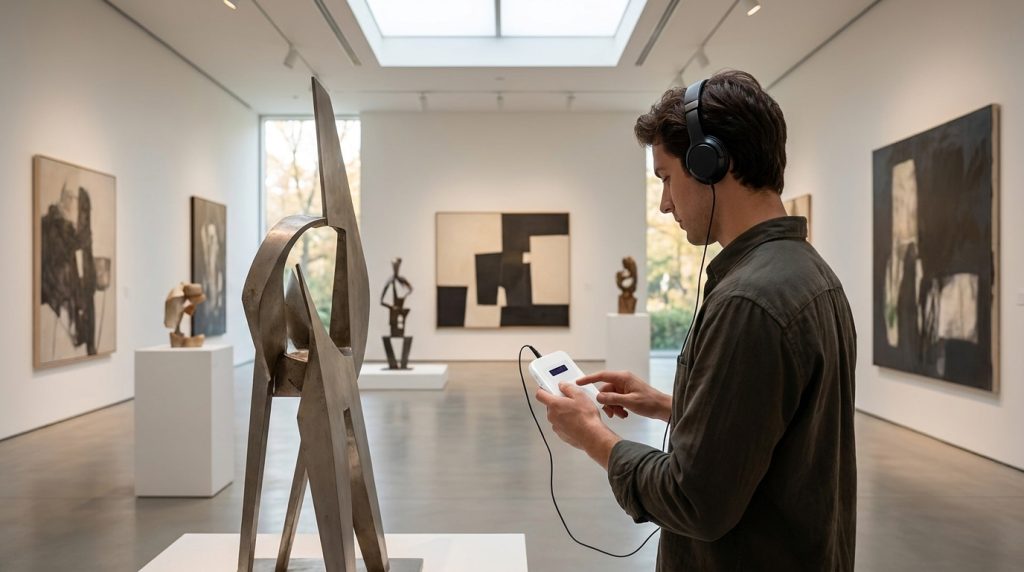
Self-guided systems work well anywhere visitors set their own pace: galleries, botanical conservatories, heritage trails, and exhibits without a strict sequence. The visitor picks up a handset or scans a code at an artifact, and the corresponding track plays. There’s no live narrator to manage, which lowers staffing costs and lets one system serve non-native speakers in a dozen languages without hiring interpreters.
The tradeoff is content preparation. Every stop needs a recorded script, and galleries with frequently rotating exhibitions have to budget time to keep the library current. For institutions that update their layout seasonally rather than daily, that overhead is manageable and often pays for itself in reduced guide labor.
Group-Guided Audio: Built for Live Narration at Scale

Group-guided setups keep a human guide in the loop. The guide wears a transmitter and speaks normally; every visitor in the group hears a clear signal through a lightweight receiver, regardless of ambient noise or physical distance within a reasonable range. This matters most in facilities where the story changes with each tour — a curator answering questions, a factory host adjusting commentary to the audience, a docent responding to what visitors are looking at in real time.
The many-to-many tour guide system for museums is a common fit here, since it supports simultaneous transmission and reception across a full group without the crosstalk that cheaper consumer-grade radios introduce in adjacent gallery rooms. For institutions dealing with concrete walls, metal detectors, or dense exhibit hardware, transmission stability tends to matter more than any other spec on the sheet — a system that drops out near a security checkpoint creates more visitor frustration than one with slightly shorter range.
Where Frequency and Interference Actually Matter
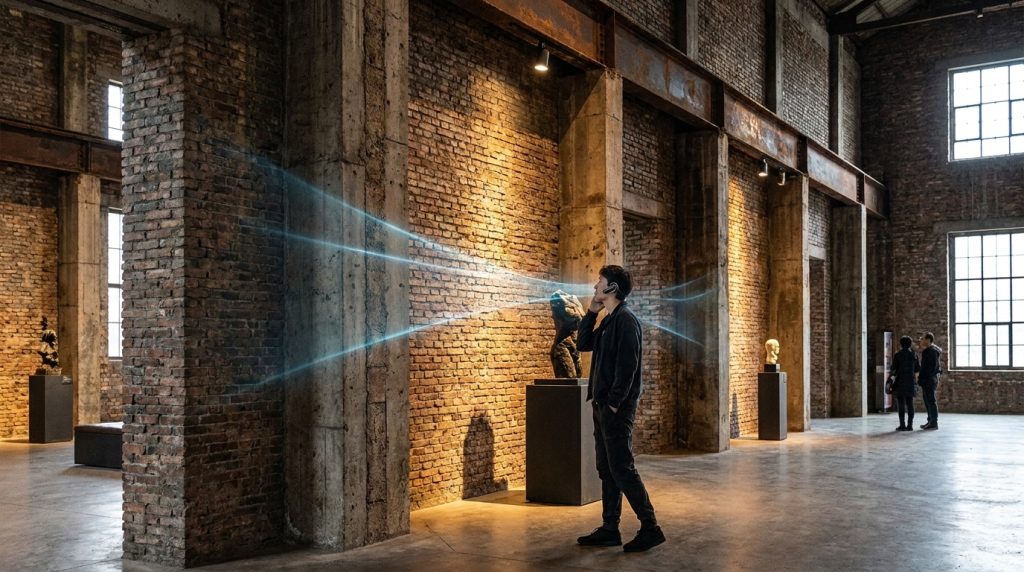
A detail that rarely makes it into a shortlist but should: many older museum buildings and historic properties have thick masonry, steel reinforcement, or nearby broadcast equipment that degrades weaker signals. A UHF tour guide system for museums handles this better than standard 2.4GHz consumer devices, which is why institutions housed in century-old buildings or converted industrial spaces gravitate toward UHF hardware even when their budget would allow for flashier alternatives.
This is also where OEM and ODM flexibility becomes relevant for larger networks or franchised museum groups. A single procurement standard — same frequency band, same charging case, same firmware — across five branch locations saves IT staff from supporting five different vendor ecosystems.
A Practical Way to Decide
For institutions still weighing the two models, a few questions tend to settle it quickly:
- Does content change often, or is the collection relatively fixed? Frequent rotation favors group-guided; fixed collections favor self-guided.
- Is multilingual support a requirement? Self-guided libraries scale language coverage more cheaply than hiring guides per language.
- Does the building interfere with signal (thick walls, metal, crowding)? This pushes toward UHF over standard consumer bands.
- Is the visitor experience meant to feel personal or programmed? Live guides create a sense of occasion that pre-recorded tracks can’t fully replicate, which matters for premium ticketed experiences.
Institutions that serve both casual daytime visitors and scheduled group bookings often don’t have to choose — a shared receiver fleet can support both modes depending on the day’s programming, which is worth asking any manufacturer about before committing to single-purpose hardware.
What to Ask Before Signing a Purchase Order
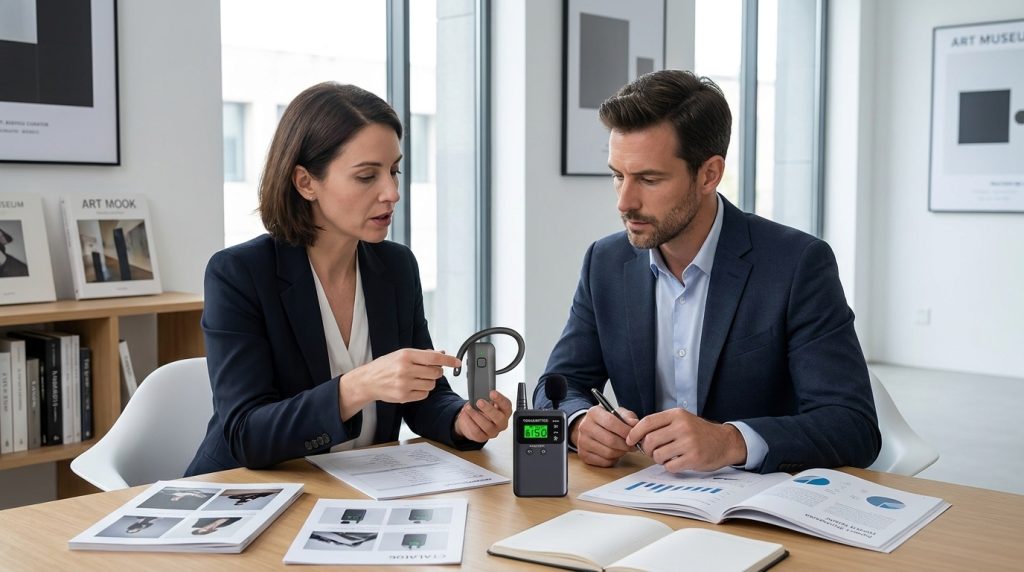
Beyond the transmitter and receiver specs, a few procurement questions separate a smooth rollout from a frustrating one: What’s the battery life across a full operating day, not a lab test? Can the case charge the full fleet overnight without staff intervention? Is firmware updatable remotely, or does every unit need to be shipped back to the factory? And critically for institutions outside China — what does post-sale support actually look like once the container has cleared customs?
Manufacturers with in-house R&D and over a decade of export experience tend to answer these questions faster and with more specificity than resellers repackaging someone else’s hardware, largely because they control the firmware and tooling rather than waiting on a third party.
FAQ
What’s the difference between self-guided and group-guided audio tour systems?
Self-guided systems let visitors trigger pre-recorded content at their own pace, usually by entering a number or scanning a code at each stop. Group-guided systems transmit a live guide’s voice to a group in real time through wireless receivers, which suits docent-led tours, school groups, and facility walkthroughs where commentary changes tour to tour.
Do museums in older buildings need special equipment?
Buildings with thick stone, concrete, or steel reinforcement can weaken standard wireless signals. A UHF-based system generally penetrates these obstacles more reliably than standard consumer-grade transmitters, which is why many historic properties and converted industrial museums specify UHF hardware.
Can one system support both self-guided and group-guided tours?
Some hardware platforms support both modes on the same receiver fleet, switching between pre-recorded playback and live transmission depending on the program. This is worth confirming directly with the manufacturer, since not all consumer-grade systems offer it.
How long does it typically take to source and receive audio guide equipment from a Chinese manufacturer?
Timelines vary by order size and customization level, but factories with standing inventory and in-house SMT production generally quote faster lead times than trading companies sourcing from multiple third-party assemblers.