

On a sightseeing bus, boat, or tram, the ride is the product. Passengers are not there to get from one place to another; they are there to see a city, a coastline, or a scenic area from a comfortable seat and to understand what is passing the window.
That makes commentary the most important part of the trip, and also one of the hardest to get right. The story has to arrive at the right moment, in a language the passenger understands, over the sound of an engine, wind, or water. Location-based audio guides were built for exactly this kind of journey.
Why Commentary on the Move Is Hard
A guide speaking over a vehicle’s loudspeaker reaches everyone on board at once, which sounds efficient until you look at who is actually listening. A single spoken language rarely suits a mixed group of passengers. Open-top buses and boat decks add wind and engine noise. Passengers seated on different sides of the vehicle may be looking at different things when a landmark is announced.
Timing is the other problem. Commentary only works when it matches what is outside the window. A guide has to know the route and the moment, repeat it on every trip, and do it all day. Operators who cannot place a guide on every departure are left with gaps in the experience.
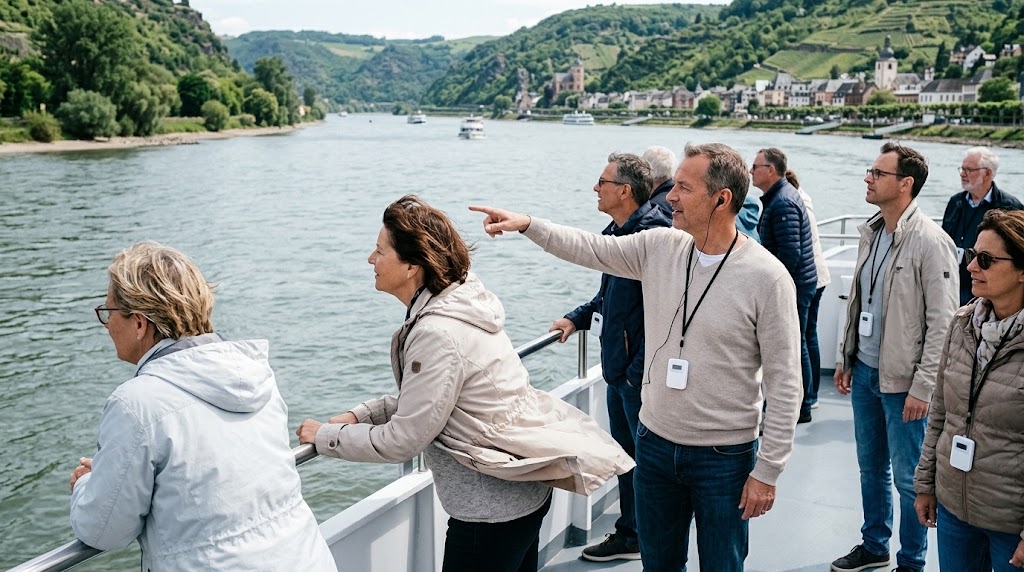
What Location-Based Audio Changes
The Story Matches the View
With an automatic induction guide, commentary is tied to a place rather than to a person’s memory of the route. When the vehicle reaches a landmark, the passenger’s device detects it and plays the matching story. The passenger hears about the building as it comes into view, not a minute after it has passed.
Every Passenger Hears Their Own Language
Because each passenger wears their own receiver and headphones, one vehicle can carry travelers who speak several different languages, each hearing the same commentary in the language they chose. Nobody has to listen to a version in a language they only half understand.
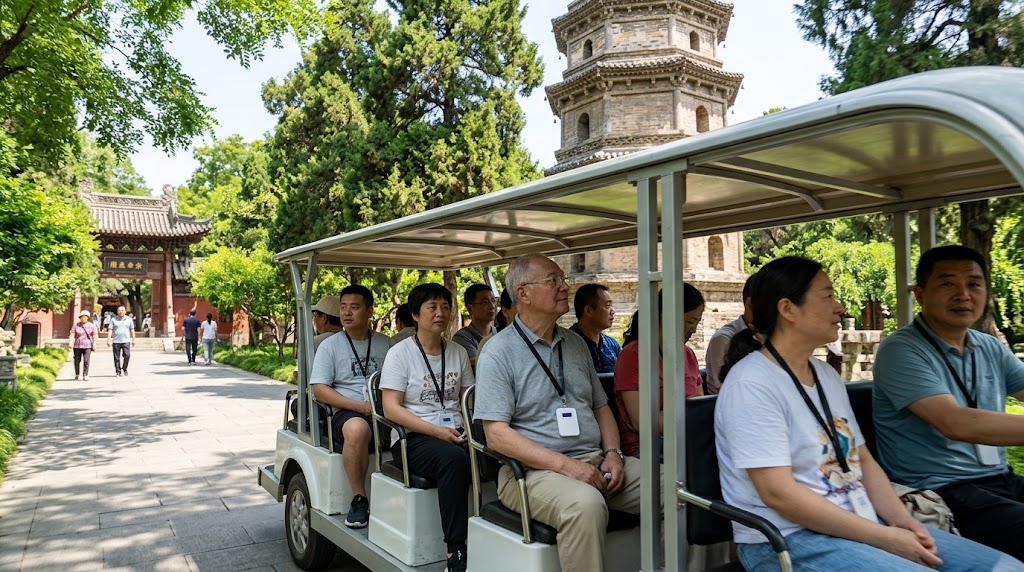
Commentary That Stays Clear on Open Decks
Individual headphones put the commentary directly in the passenger’s ear instead of asking a speaker to compete with the surroundings. This matters most on open-top buses, boat decks, and open-sided trams, where wind and engine sound would otherwise take over.
Where This Matters Most
Routes with long stretches between landmarks, scenic coastal or riverside journeys, and vehicles that carry international travelers all benefit the most, since the commentary has to hold up over distance, noise, and a mix of languages.
Coverage Without a Guide on Every Trip
A recorded, location-triggered experience means the quality of the commentary does not depend on who is on board that day. Operators can offer the same well-prepared story on every departure, including early and late trips where a live guide is hard to schedule.
A Ride, Stop by Stop
Here is how a typical journey looks from the passenger’s seat when location-based audio is in place:
Boarding
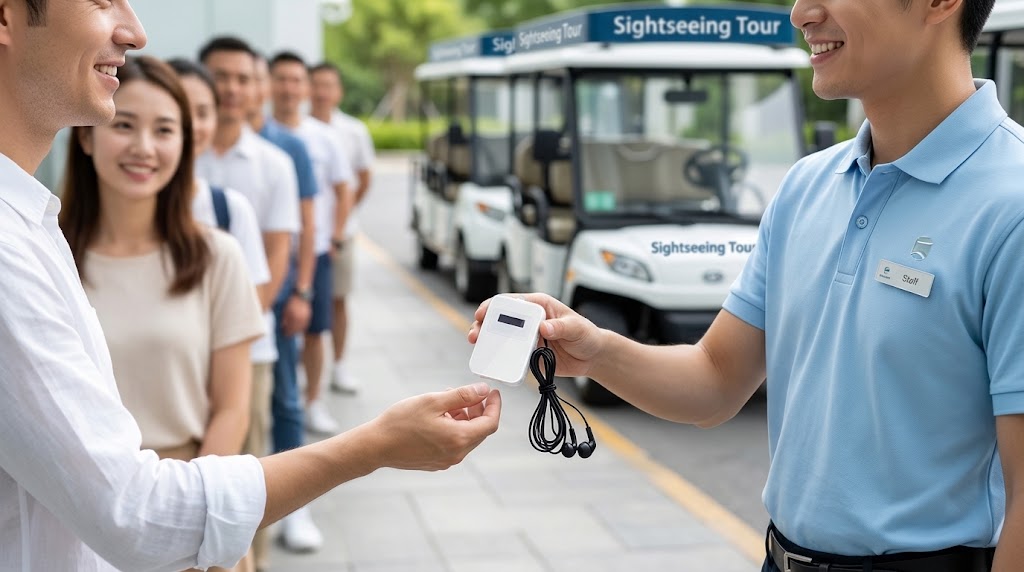
The passenger receives a receiver and headphones at the boarding point and chooses a language. No app and no setup are needed.
First landmark
As the vehicle reaches a trigger point, the device senses it and plays the commentary for that place automatically.
Between landmarks
Without a stream of constant announcements, passengers can simply look, take photographs, and enjoy the route.
Next landmark
The next trigger point plays the next story. Passengers who are in a different seat, or facing a different direction, still hear the same commentary.
Return
At the end of the trip, devices are handed back, ready to be charged and cleaned for the next departure.
The Equipment Behind It: YingMi M7
The YingMi M7 is an automatic induction guide system. Passengers put on the receiver and headphones; once they reach an RFID trigger point, the device detects it and plays the commentary for that location automatically. There is no need for manual instructions or button presses. Sightseeing buses, boats, and trams are among the applications the M7 is designed for, where the guide device plays location-based commentary as visitors move along the route.
| Trigger method | RFID automatic sensing |
| Audio capacity | Up to 9,999 pre-stored audio segments |
| Languages | 8 languages |
| Receiver | 800mAh battery, working hours of 16 hours or more, 50 g, 82 × 59 × 12.5 mm |
| Transmitter (trigger point) | 2.4GHz, 16 signal strength levels, 40 m coverage, 27 g, 40 × 40 × 20 mm, battery operating time of 15 months or more |
| Customization | OEM/ODM available: logo, frequency, battery capacity, material, and functions |
For a sightseeing operator, the large audio capacity means a long route can carry detailed commentary at many points, and the eight languages let one fleet serve a mixed international clientele. The OEM/ODM option lets operators match the equipment to their own branding and requirements.
What Operators Should Plan For
- Route mapping: decide where the trigger points go so that each story plays at the right place.
- Commentary content: prepare the script and recordings for every language the route will offer.
- Handling at the boarding point: hand out and collect devices quickly so departures are not delayed.
- Charging and cleaning: plan the time between trips so devices are ready for the next group of passengers.
- Customization needs: confirm logo, battery capacity, and functions early if the equipment needs to match a specific brand or setup.
Frequently Asked Questions
How does an automatic induction guide know when to play commentary on a moving vehicle?
Trigger points are placed along the route. When a passenger’s receiver reaches one, it senses the signal through RFID and plays the matching audio automatically, with no manual input.
Can passengers on the same vehicle listen in different languages?
Yes. The M7 supports 8 languages, and since each passenger has their own receiver and headphones, each can listen in the language they prefer on the same trip.
How much commentary can the M7 store?
The M7 can store up to 9,999 pre-recorded audio segments, which allows a long route to carry detailed commentary at many points.
Can the M7 be customized for a specific operator?
Yes. OEM/ODM options are available, including logo, frequency, battery capacity, material, and functions.
Is the M7 only for sightseeing vehicles?
No. It is also designed for museums, art galleries, heritage sites, science and technology museums, and automotive showrooms, wherever commentary should follow the visitor’s location.