

A good walking tour feels effortless to the guests on it. Behind that ease, the guide is solving a stream of small problems: a bus idling at the corner, a crowd spilling off a narrow pavement, a group of twenty strung out across two traffic lights. The story only works if people can hear it.
Street-level touring is one of the hardest environments for an unamplified voice, and it is where wireless tour guide systems have become a quiet standard for operators who run tours every day.
Why the Street Is a Difficult Classroom
Museums and galleries give a guide a controlled room. A city street gives a guide traffic, sirens, street performers, construction, and other tour groups doing exactly the same thing. Raising the voice to compete is tiring across a full day, and it still doesn’t reach the guests at the back of the group.
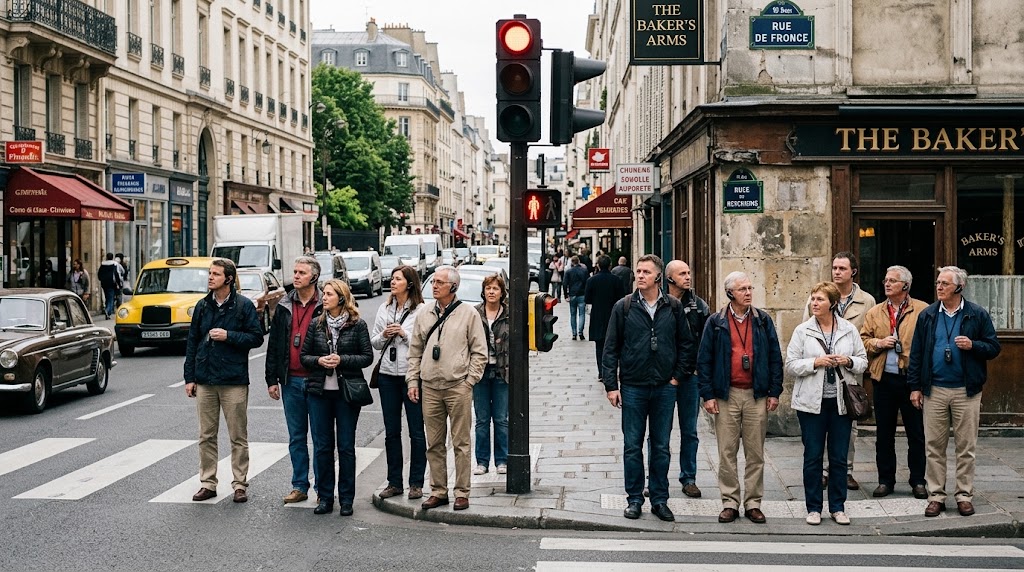
Crossings make it worse. A group that gets split by a traffic signal loses the thread of the story, and the guide has to either wait and repeat or press on and leave part of the group behind.
How Audio Systems Help on Foot
Keeping the Story Intact Across Gaps
With a transmitter and individual receivers, guests who fall a few steps behind to take a photograph or wait at a crossing still hear the commentary clearly. The group can stretch and compress naturally along a pavement without the narration breaking apart.
Lowering the Guide’s Volume
Historic districts are often residential. Residents and shopkeepers tend to notice a guide who projects over a crowd outside their windows, and some neighborhoods and venues have their own expectations about amplified or raised voices. A guide speaking at a conversational level into a transmitter is a lighter presence on the street than one calling out to a crowd.
A Practical Benefit for Operators
Quieter delivery also helps with the relationship between tour operators and the neighborhoods they depend on, since repeated routes through the same streets are more welcome when the groups are not noisy.
Running Several Groups on the Same Route
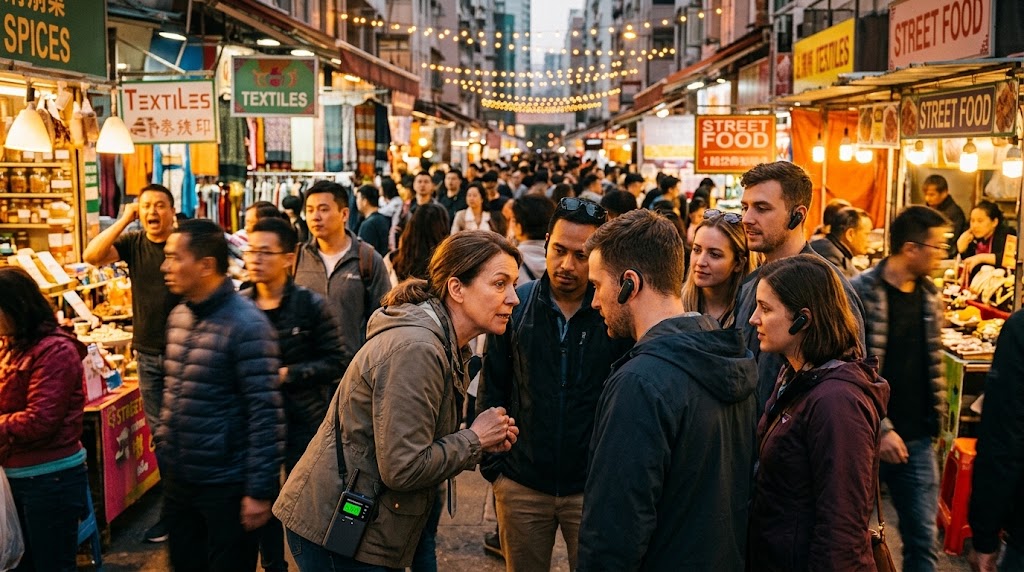
Popular routes often have more than one group passing the same landmarks within minutes. Separate channels keep each guide’s commentary with their own group, so two tours can share a square without the narration overlapping.
A typical half-day walking route, and where audio helps
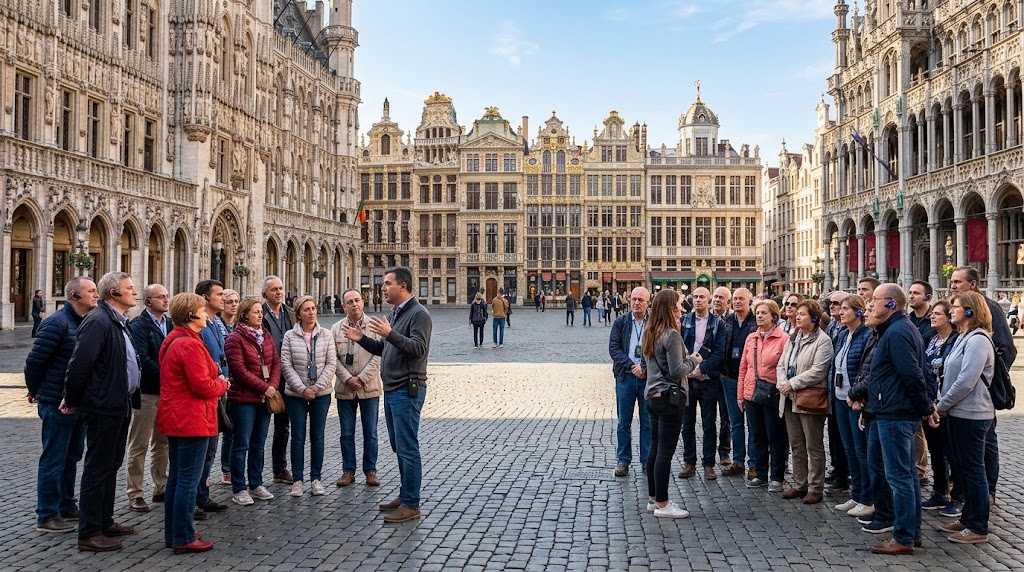
- Meeting point: a busy plaza where the guide briefs the group without shouting over the crowd.
- Old town lanes: narrow streets where the group lines up single file and the back of the line would normally miss the story.
- Main road crossing: a signal splits the group; guests on the far side keep hearing the commentary.
- Market area: loud, crowded, and full of competing voices.
- Riverside or square finish: a relaxed final stop where the group can spread out and still hear the closing story.
Practical Points for Walking Tour Operators
- Comfort over a full route — receivers and earpieces should stay comfortable for a tour that may run several hours.
- Quick handout and collection — equipment needs to be distributed at the meeting point and returned at the end without holding up the start time.
- Reliable coverage in dense streets — buildings, arches, and narrow lanes can behave differently from open ground, so it is worth testing on the actual route.
- Multilingual groups — street tours attract mixed international groups, and interpretation channels let one walking tour serve more than one language.
- Daily turnaround — operators running morning and afternoon tours need charging and sanitizing to fit between departures.
A Better Pace for Both Guide and Guests
Guides who no longer have to project over traffic tend to speak more naturally, pause for effect, and answer questions without straining. Guests, free from the pressure to stay within arm’s reach of the guide, can look up at an unfamiliar facade or stop to read a plaque. The tour becomes less about keeping everyone together and more about helping them notice what is around them.
Frequently Asked Questions
Are audio guide systems practical for tours that last several hours?
Yes, as long as the equipment is comfortable to wear and the battery covers a full touring session. Operators running multiple tours a day usually plan charging between departures.
Can two walking tours use audio systems on the same street at the same time?
Multi-channel systems allow separate groups to operate close to each other, so each guide’s commentary stays with their own group.
Do audio guides help with international groups on city tours?
They can. Systems that support interpretation channels allow guests to listen in their own language during a single guided walk, instead of splitting the group by language.
Will a guide still need to be physically close to the group?
The guide still leads the route, but the group no longer has to stay tightly clustered to hear. Guests can spread out comfortably, which is useful on narrow pavements and at busy crossings.