

Cultural tourism used to be organized around a simple trade: visitors came to a place, and a guide, a plaque, or a printed leaflet told them what they were looking at. That trade still exists, but it has quietly changed shape. Visitors now expect to choose how much they hear, in which language, and at what speed, and the places that welcome them are looking for ways to say more without crowding the room or raising anyone’s voice.
Audio guide technology sits at the center of that change. This overview looks at what is shifting, where it shows up across different kinds of cultural sites, and what operators should think about when they bring it in.
What Is Changing for Visitors
Visitors Set Their Own Pace
The most visible change is control. A visitor with an audio guide can stay at one exhibit for ten minutes, skip a room that doesn’t interest them, or double back to something they missed. The visit stops being a schedule imposed by the group and becomes a path chosen by the individual.
Stories Can Go Deeper
A guide speaking aloud has to pitch the story to the whole group at once. Recorded commentary can offer a short overview and a longer account of the same place, so visitors who want more can have it without slowing down those who don’t.
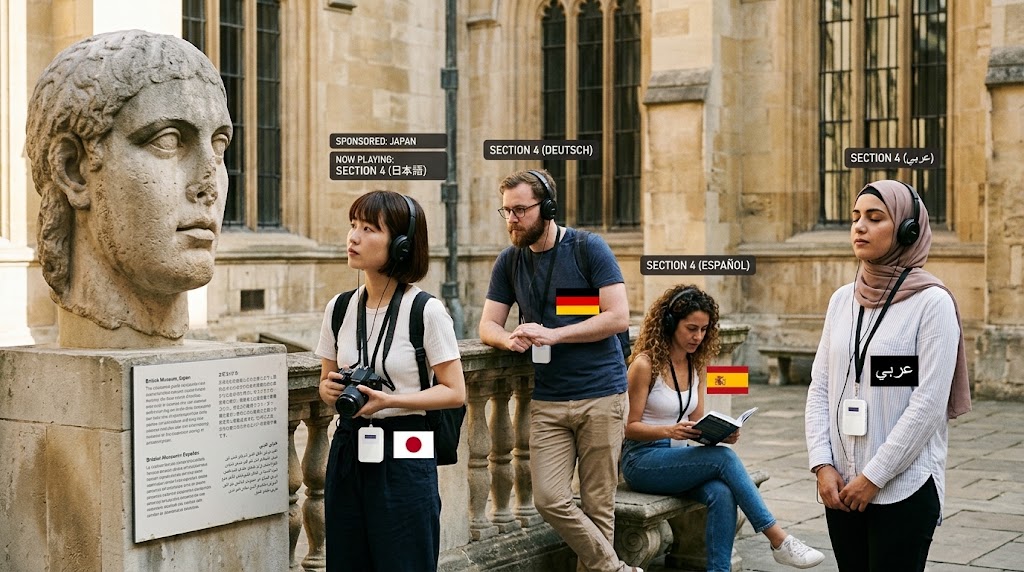
Language Stops Being a Barrier
International visitors are a large part of cultural tourism, and a single spoken language rarely serves all of them. Audio systems let a site offer the same story in several languages, so a visitor receives the full account rather than a shortened summary in a second language.
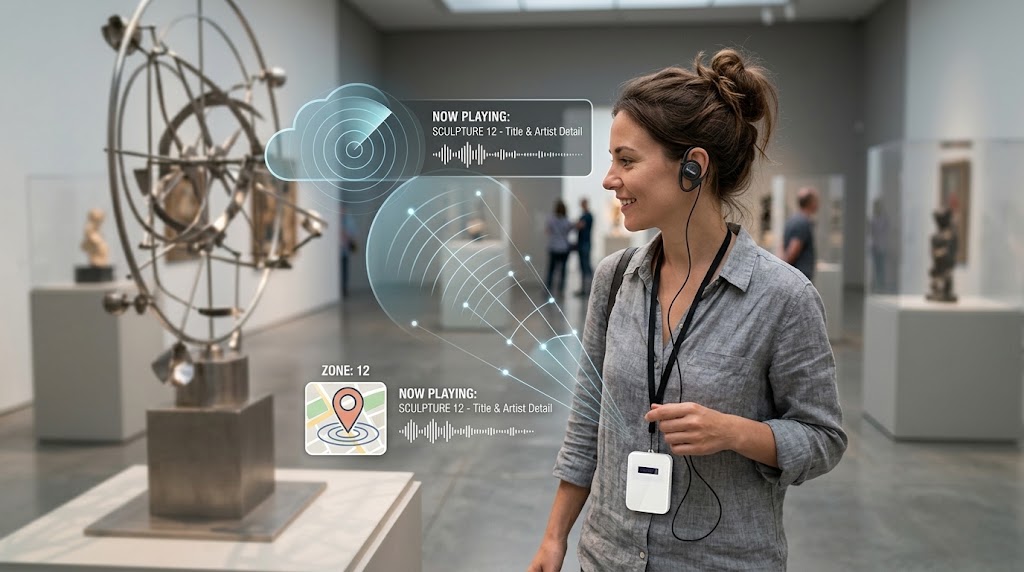
Sites Can Stay Quiet
Galleries, churches, and residential historic districts all have reasons to keep voices low. Individual audio lets visitors hear commentary clearly while the space itself stays calm, which protects both the atmosphere and the neighbors.
Before
One voice, one pace, one language, delivered to a group that has to stay close enough to hear.
With audio guides
Commentary reaches each visitor directly, in their language, at the depth they choose, wherever they are standing.
How It Shows Up Across Different Sites
The same technology solves different problems depending on the setting. A few of the clearest examples:
| Travel agency group tours | Guests hear the guide from anywhere in the group, and guides stop shouting across a full day. |
| National parks and nature sites | Visitors stay informed while spread along a trail, and self-guided options extend visiting beyond scheduled tour hours. |
| Art galleries | Commentary reaches visitors without disturbing a quiet room, and non-linear viewing is supported. |
| Heritage sites | Layered commentary tells more of a site’s history, and time spent in fragile spaces can be reduced. |
| City walking tours | Narration stays clear over traffic and across crossings, with lower voices in residential streets. |
Live Guiding and Self-Guided Visits Work Together
A common worry is that audio technology will replace guides. In practice, most sites use it to extend what a guide can do, and to serve the visitors a guide cannot reach at a given moment.
Where Live Guides Remain Essential
Guides read a group, answer unexpected questions, and bring a place to life in ways a recording cannot. For scheduled group tours, a guide with a wireless transmitter is still the strongest format.
Where Self-Guided Fills the Gap
Walk-in visitors, off-peak hours, and sites with limited guiding staff all benefit from a device the visitor can pick up and use alone. This is where self-guided equipment earns its place: it lets a site offer a guided-quality experience when no guide is available.
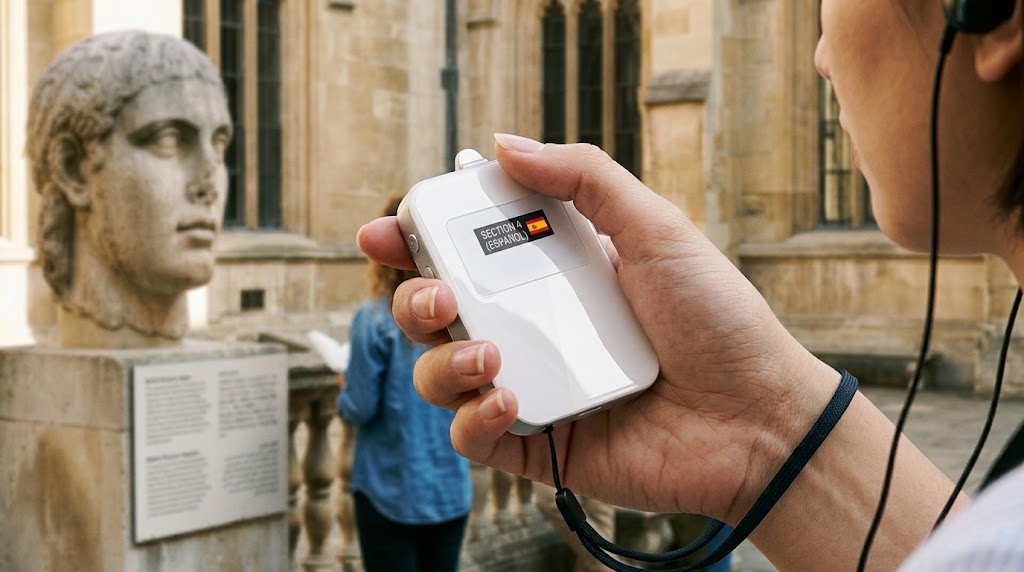
The YingMi M7 is an automatic induction guide system built for self-guided visits. Visitors put on the receiver and headphones and walk the site at their own speed. When they reach an RFID trigger point, the device detects it and plays the commentary for that spot automatically, so there is nothing to press or look up.
For cultural sites, that means the visitor who arrives at an unscheduled hour, or who simply prefers to wander, still gets a well-told account of each exhibit or location. It also lets operators serve more visitors across the day without assigning a guide to every slot.
| Trigger method | RFID automatic sensing, no manual selection needed |
| Audio capacity | Up to 9,999 pre-stored audio segments |
| Languages | 8 languages |
| Receiver battery | 800mAh, working time of 16 hours or more |
| Receiver size and weight | 82 × 59 × 12.5 mm, 50 g |
| Transmitter (trigger point) | 2.4GHz, 16 signal strength levels, 40 m coverage, 40 × 40 × 20 mm, 27 g, battery operating time of 15 months or more |
| Customization | OEM/ODM available: logo, frequency, battery capacity, material, and functions |
What Operators Should Consider
Whichever format a site chooses, a few practical questions tend to decide whether the technology works well in daily use:
- Who the visitors are: a site with mostly international walk-in visitors has different needs from one running scheduled group tours.
- How content will be maintained: stories change as research and restoration continue, so it helps if commentary can be updated without starting over.
- Handling at the front desk: distribution, return, charging, and cleaning need to fit the site’s busiest hours.
- The physical setting: indoor rooms, open trails, and dense streets all behave differently, so it is worth testing equipment where it will actually be used.
- The mix of formats: many sites combine live-guided tours with self-guided rental, using each where it fits best.
Frequently Asked Questions
Does audio guide technology replace human tour guides?
Generally not. Most cultural sites use audio to complement live guides, with guides leading scheduled group tours and self-guided devices serving visitors who explore independently.
What is the benefit of a self-guided audio guide for cultural sites?
It lets visitors explore at their own pace and receive commentary without waiting for a guided tour, which helps sites serve walk-in visitors and spread visits across the day.
How does an automatic induction guide like the YingMi M7 play the right commentary?
Trigger points are placed at exhibits or locations. When a visitor wearing the receiver reaches one, the device senses it through RFID and plays the matching audio automatically, with no buttons to press.
What kinds of cultural sites is the M7 suited to?
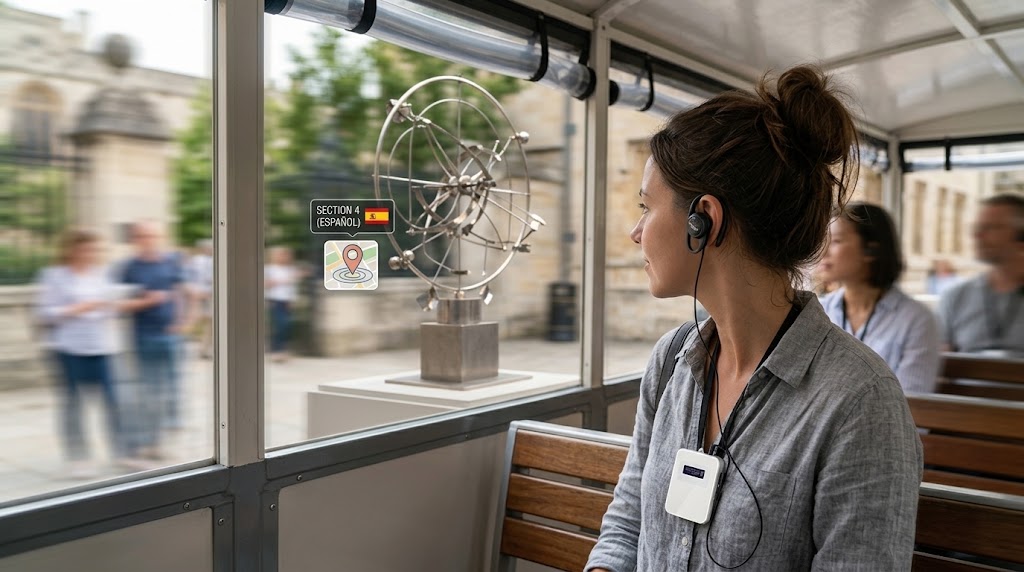
It suits natural history museums, art museums and galleries, historical and heritage sites, science and technology museums, automotive showrooms, and sightseeing buses, boats, or trams, where commentary should follow the visitor’s location.
Can one site offer both live-guided tours and self-guided audio?
Yes. Many cultural sites run both, using wireless systems for scheduled group tours and self-guided devices for individual visitors during open hours.
Is audio guide technology only suitable for large museums?
No. It is used across galleries, heritage sites, parks, city tours, and smaller venues. The deciding factors are visitor numbers, the setting, and whether the site wants to offer commentary in more than one language.