

A growing number of cultural destinations no longer consist of a single building with a single entrance. Heritage parks, cultural tourism zones, and destination-level attractions increasingly combine a museum wing, an open-air heritage trail, a temple or historic residence, and sometimes a working craft workshop — all under one ticket, one brand, and one visitor journey. For procurement teams at these destinations, the question is rarely “do we need an audio guide system,” but rather “how do we make one system work coherently across very different physical environments.”
This is where equipment selection becomes a strategic decision rather than a line-item purchase.
Why Comprehensive Destinations Present a Different Equipment Challenge
A single-hall museum and a sprawling cultural tourism destination place very different demands on tour guide technology.
Environmental diversity. A visitor journey might move from a climate-controlled indoor gallery, to an outdoor courtyard, to a wooded trail, and back into an enclosed pavilion — all within one guided session. Signal reliability has to hold across concrete walls, open sky, and dense foliage without the guide needing to swap equipment at each transition.
Group scale and staff turnover. Comprehensive destinations often run higher visitor volumes than single-venue museums, and many rely on seasonal or contract tour leaders during peak periods. Equipment that requires extensive training, or that is easily mishandled, becomes an operational liability rather than a convenience.
Multilingual, multi-department use. A destination-level site frequently serves independent domestic travelers, international tour groups, and school programs simultaneously, often with different guides operating in different zones at the same time. Interference between concurrent tours — a persistent complaint with older analog systems — becomes far more likely as the number of simultaneous groups increases.
Budget accountability. Because comprehensive destinations typically procure equipment in larger quantities, unit reliability and battery service life have an outsized effect on total cost of ownership over a multi-year deployment.
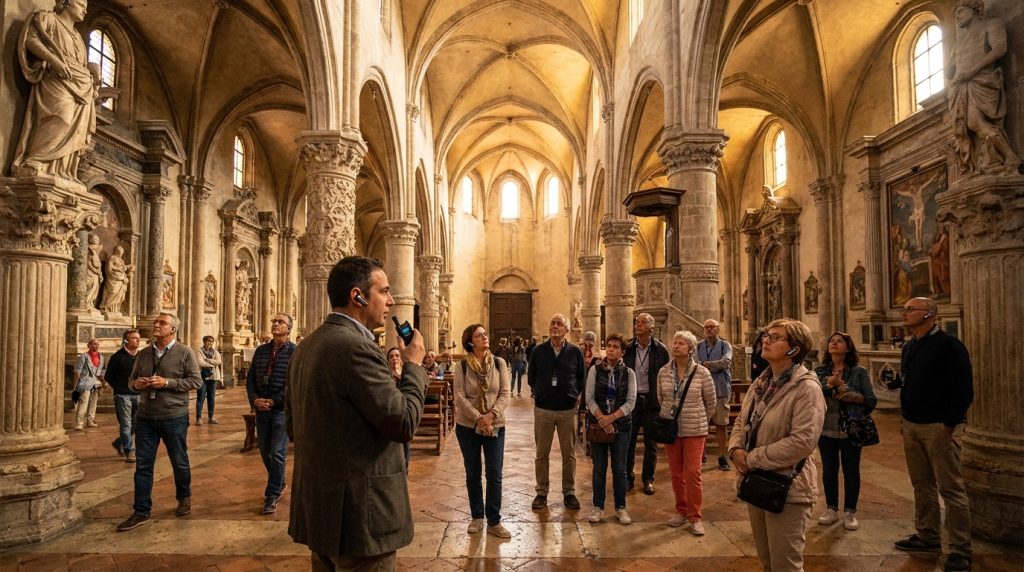
What to Look for When Evaluating a System for a Multi-Site Destination
Procurement teams evaluating wireless tour guide systems for this use case generally weigh four factors:
- Stable long-range transmission. UHF-band systems in the 935–955MHz range are engineered specifically to resist interference in crowded RF environments, which matters when multiple tour groups, Wi-Fi access points, and public address systems share the same physical space.
- Consistent battery performance across a full operating day. Destinations running back-to-back tour groups from morning to evening need receivers that comfortably outlast a full shift without a midday swap.
- Lightweight, durable receivers. Visitors wearing a receiver for two or three hours across varied terrain benefit from a compact, low-weight unit that doesn’t become a physical burden.
- Straightforward operation for non-specialist staff. Because comprehensive destinations often rotate staff across departments, systems with minimal setup steps reduce training overhead and onboarding friction for new tour leaders.
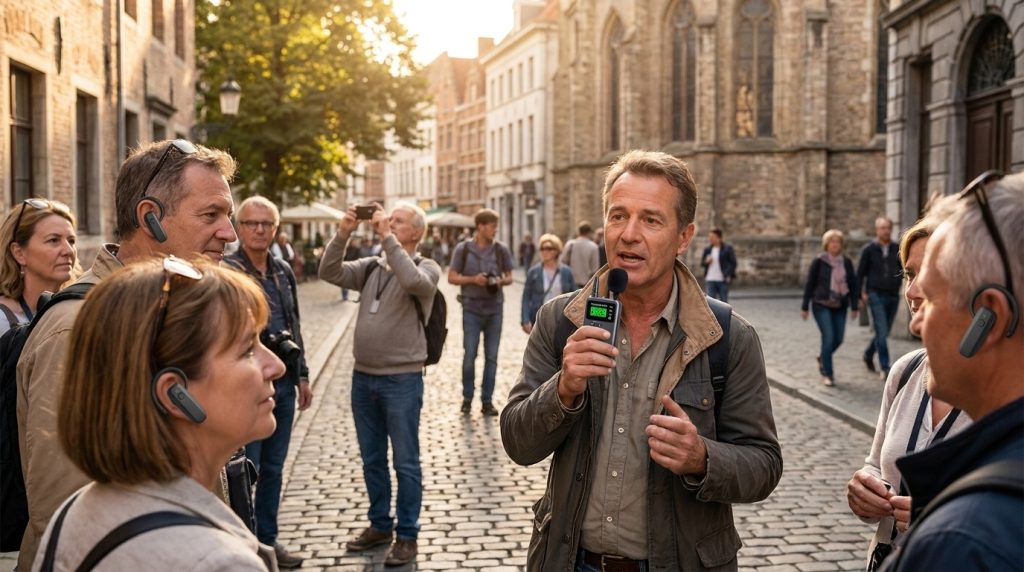
Matching Equipment to the Journey
For destinations that combine several environments into one guided route, a two-tier equipment strategy tends to work well in practice.
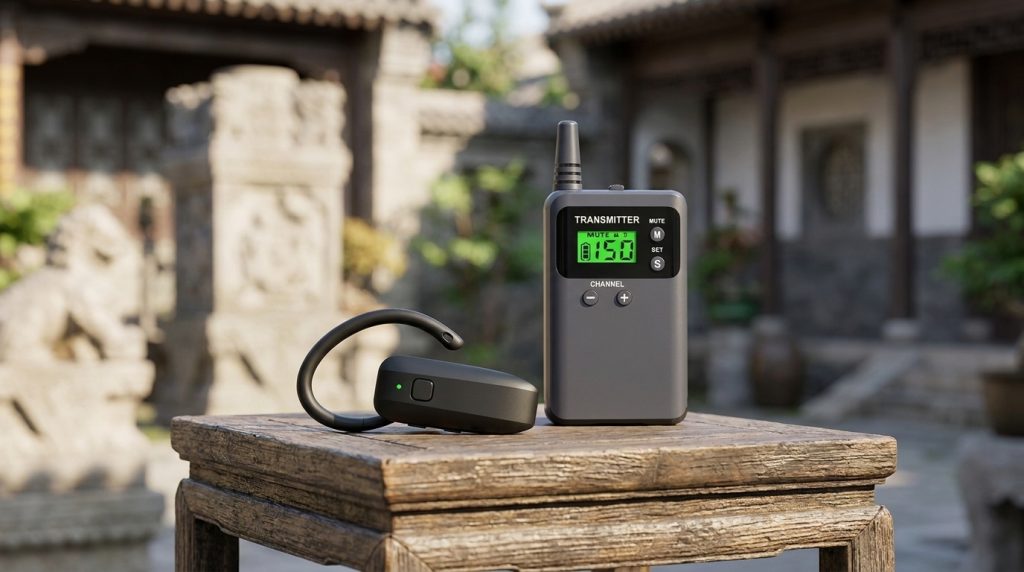
For the core guided tour across the full destination, a UHF wireless system such as the Yingmi 008A Tour Guide System is built for exactly this scenario. Operating in the 935–955MHz band with a working range of roughly 200 meters, it is designed to maintain a stable connection as a group moves between indoor halls and open outdoor sections — the kind of transition that causes weaker systems to drop signal or pick up interference from neighboring tours.
For specific zones where receivers need to be as unobtrusive as possible — a quiet gallery room, a meditation hall, or a section where visitors are asked to move independently while still receiving commentary — the Yingmi L8 Tour Guide System is a practical complement. Operating at 800MHz with a range of about 150 meters, it uses a single AAA battery and weighs approximately 35 grams, making it comfortable for extended wear without drawing attention to the equipment itself.
Deploying both within the same destination — the 008A for the primary route-based tour and the L8 for lighter, close-proximity use — lets procurement teams match equipment capability to the actual demands of each zone, rather than over-provisioning a single system for every scenario.
A Note on Interference and Signal Quality
Cultural destinations that have previously relied on older infrared or basic analog systems often cite cross-talk between simultaneous tour groups as their primary source of visitor complaints. Modern UHF and digital-band wireless systems are specifically engineered with anti-interference architecture to keep concurrent tours acoustically separated, which becomes increasingly important as a destination scales its group capacity. This is a detail worth confirming directly with any supplier, since interference resistance varies meaningfully between systems that appear similar on paper.
FAQs
How many tour guide receivers does a comprehensive cultural destination typically need?
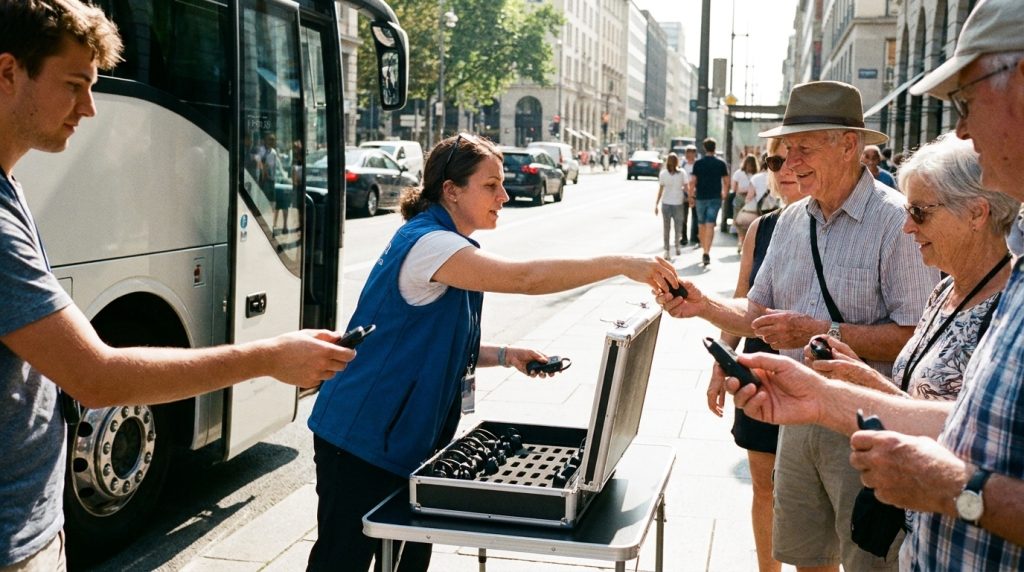
This depends on peak daily visitor volume and average group size, but destinations should plan for enough units to cover their busiest single hour, plus a maintenance buffer of roughly 10–15% to account for charging cycles and occasional repairs.
Can one wireless system cover both indoor galleries and outdoor trail sections?
Yes, provided the system operates on a frequency band engineered for range and obstacle penetration, such as UHF. Systems designed only for compact indoor use may lose reliable connection once a tour moves into open outdoor areas.
Do different receiver models need to match exactly, or can a destination mix models?
Mixing models across zones — for example, a longer-range transmitter/receiver pair for the main tour route and a lighter, shorter-range set for a specific gallery — is common practice and often more cost-effective than deploying a single model across every scenario.
What is the typical battery life expectation for a full operating day?
For a destination running continuous tours from opening to closing, receivers should be evaluated for their ability to last a full shift on a single charge or battery, since mid-day battery swaps interrupt tour flow and add staffing overhead.