

Walk through most contemporary art galleries and you’ll notice something curators worked hard to achieve: silence, or something close to it. That quiet is part of the experience — but it also creates a specific problem for anyone trying to explain a piece without disturbing the room around them.
Audio guide systems solve this in a way that speaking aloud simply can’t, and that’s part of why galleries have become one of the more consistent adopters of the technology, even in spaces that never intended to feel “high-tech.”
The Gallery Environment Is Different From Other Venues
Unlike a factory floor or an outdoor heritage site, galleries are usually quiet by design, and that quiet is functional — it lets visitors engage with the work without competing noise. A docent speaking at normal volume to a group of ten in a gallery room isn’t just disruptive to nearby visitors; it works against the atmosphere the space was designed to create.
At the same time, galleries often want visitors to move independently, spend variable amounts of time at each piece, and revisit works out of sequence — none of which fits a guide who has to keep a group moving together to stay within earshot.

How Audio Guides Fit Gallery Design Goals
Preserving the Room’s Atmosphere
With individual receivers, a docent can lead a group through the gallery while speaking at a near-conversational volume, and visitors elsewhere in the room are unaffected. The room stays quiet for everyone else, while the group still receives full commentary.
Supporting Non-Linear Viewing
Galleries increasingly design exhibitions to be explored in any order, letting visitors follow their own interest rather than a fixed path. Audio content tied to specific works — rather than a live guide’s sequence — supports this by letting each visitor trigger relevant commentary only when they stop at a piece.
Where This Matters Most
This approach tends to matter most in large group exhibitions and rotating contemporary collections, where visitor interest varies widely and a single guided pace doesn’t suit everyone in the room.
Accommodating Mixed Visitor Groups
A single gallery visit often includes casual browsers, art students taking notes, and visitors on a scheduled docent tour — all in the same space. Audio systems let a guided tour proceed without forcing every other visitor in the room to either listen in or feel excluded from a conversation happening near them.
The best gallery audio experience is the one visitors stop noticing they’re using — it should feel like the room is simply quiet, not like they’re wearing equipment.
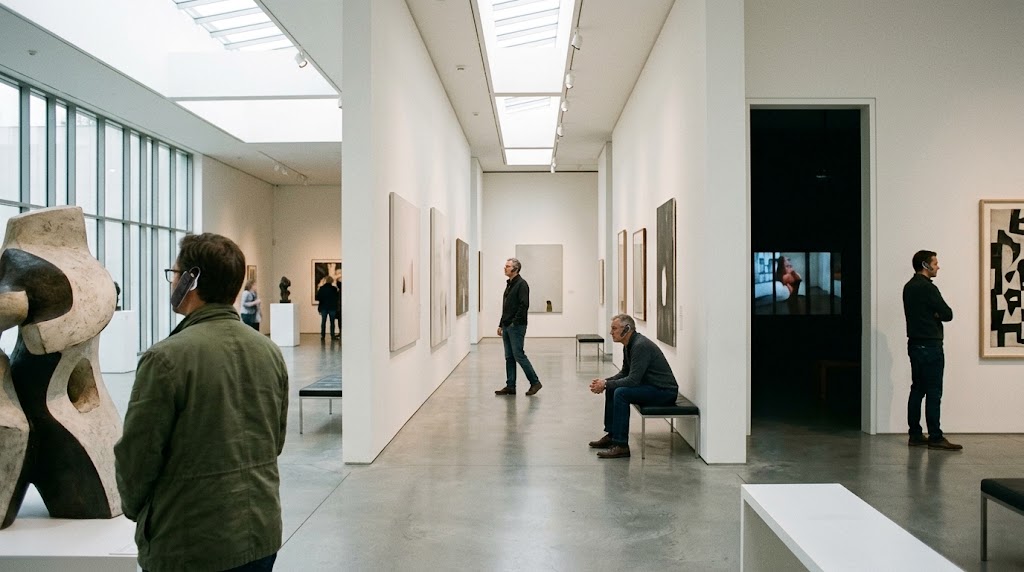
What Gallery Operators Weigh Before Adopting
Curatorial and operations teams tend to evaluate this differently than a travel agency would, since the priorities are about preserving the visitor experience rather than covering ground efficiently:
Common evaluation points
- Visual discretion — equipment shouldn’t visually compete with the art or the gallery’s design language.
- Ease of sanitizing and reuse — earpieces are shared across many visitors per day and need a simple cleaning process.
- Flexible content triggering — support for both docent-led live narration and self-guided, piece-specific audio.
- Quiet operation — no audible bleed from receivers that could disturb visitors nearby, even at close range.
- Simple checkout process — front desk or lobby distribution needs to be fast enough not to create a queue during busy hours.
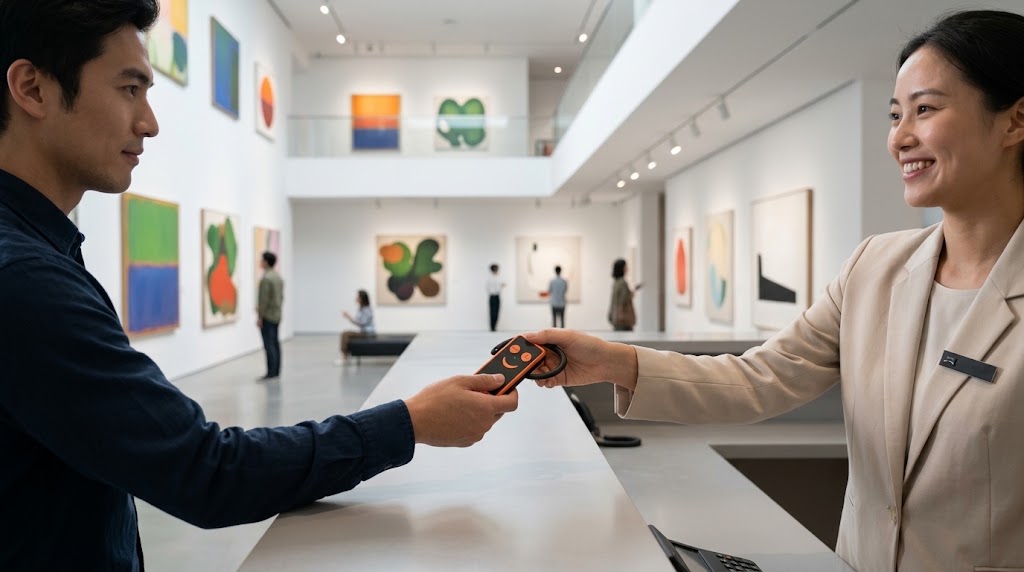
Beyond the Guided Tour
Many galleries now extend audio guides beyond scheduled docent tours, offering self-guided rental at any point during opening hours. This turns the system into a standing part of the visitor offering rather than a tool used only during specific tour slots — useful for galleries with steady walk-in traffic throughout the day, not just at scheduled tour times.
Frequently Asked Questions
Do audio guides work for galleries with rotating or temporary exhibitions?
Yes. Content can typically be updated or reassigned to new works as exhibitions change, without needing new hardware for each rotation.
Will visitors wearing earpieces disturb others nearby?
Properly fitted receivers and earpieces are designed to keep audio contained to the wearer, so nearby visitors in a quiet gallery room shouldn’t hear any bleed from someone else’s commentary.
Can a gallery offer both docent-led tours and self-guided audio at the same time?
Many systems support both modes simultaneously — a docent can lead a live group tour on one channel while other visitors access self-guided, piece-specific commentary independently.
How much staff training does gallery audio equipment usually require?
Front-of-house staff typically need only a short walkthrough on checkout, charging, and basic troubleshooting — the visitor-facing operation (wearing a receiver, adjusting volume) is generally intuitive without instruction.