

Recently, we’ve talked with many overseas partners in the cultural tourism industry, and they all ask the same question: For the same audio guide, why are the devices used in small venues completely different from those in large scenic areas? Some clients used venue-specific audio guides in scenic areas and encountered issues like failed sensing and insufficient battery life. Others used scenic-area devices in small venues, resulting in sound crosstalk and inaccurate triggering.
As the Yingmi brand with 19 years of deep experience in the audio guide industry, we’ve seen too many cases where poor device selection ruined visitor experience. In fact, choosing an audio guide is not that complicated. The core is to match the space size, visiting flow, and usage needs of the scene. Today, combined with our C7 and M7 models, we’ll clarify the differences in audio guide selection for small venues and large scenic areas to help overseas clients avoid detours.
I. First, Clarify the Core Characteristics of Small Venues and Large Scenic Areas
To choose the right audio guide, the first step is to distinguish the essential differences between the two scenarios, which is the foundation of selection.
1.1 Small Venues: Compact Space & Dense Exhibits
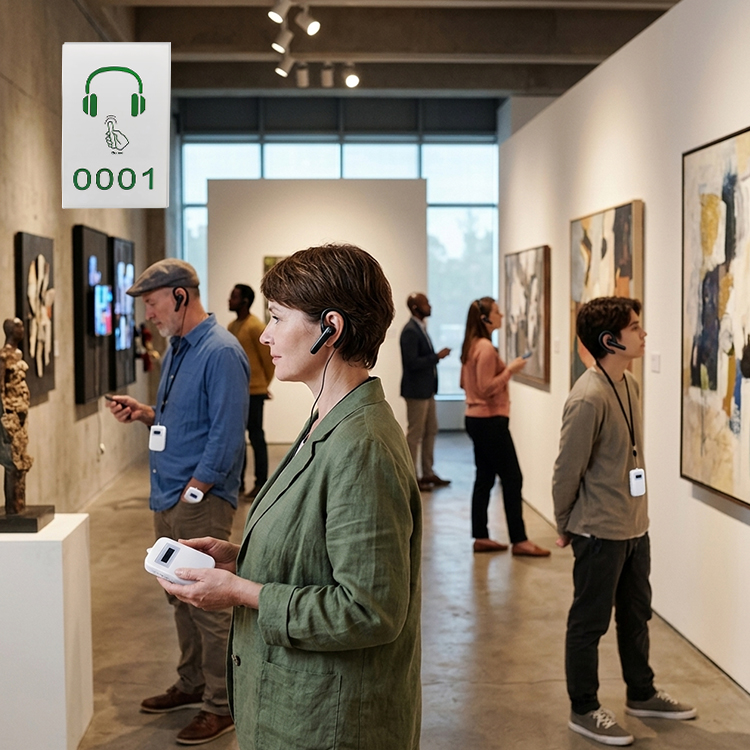
Small venues mainly refer to indoor venues such as museums, art galleries, art centers, and small science and technology museums. Their core characteristics are limited space, dense exhibit layout, and visitors mainly viewing exhibits statically at close range. In such scenarios, visitor flow is concentrated, exhibits are closely spaced, and extremely high precision is required for commentary triggering. Sound crosstalk or false triggering will directly damage the viewing experience.
1.2 Large Scenic Areas: Spacious Space & Dispersed Points
Large scenic areas include natural scenic spots, historical and cultural sites, large-scale cultural tourism parks, etc. Their core characteristics are vast land area, dispersed commentary points, and visitors mainly conducting large-scale dynamic tours. Visitors travel long distances and spend a long time visiting, with no need for manual device operation. They pay more attention to automatic commentary triggering, stable signal, and long battery life.
II. Exclusive for Small Venues: Yingmi C7 Audio Guide
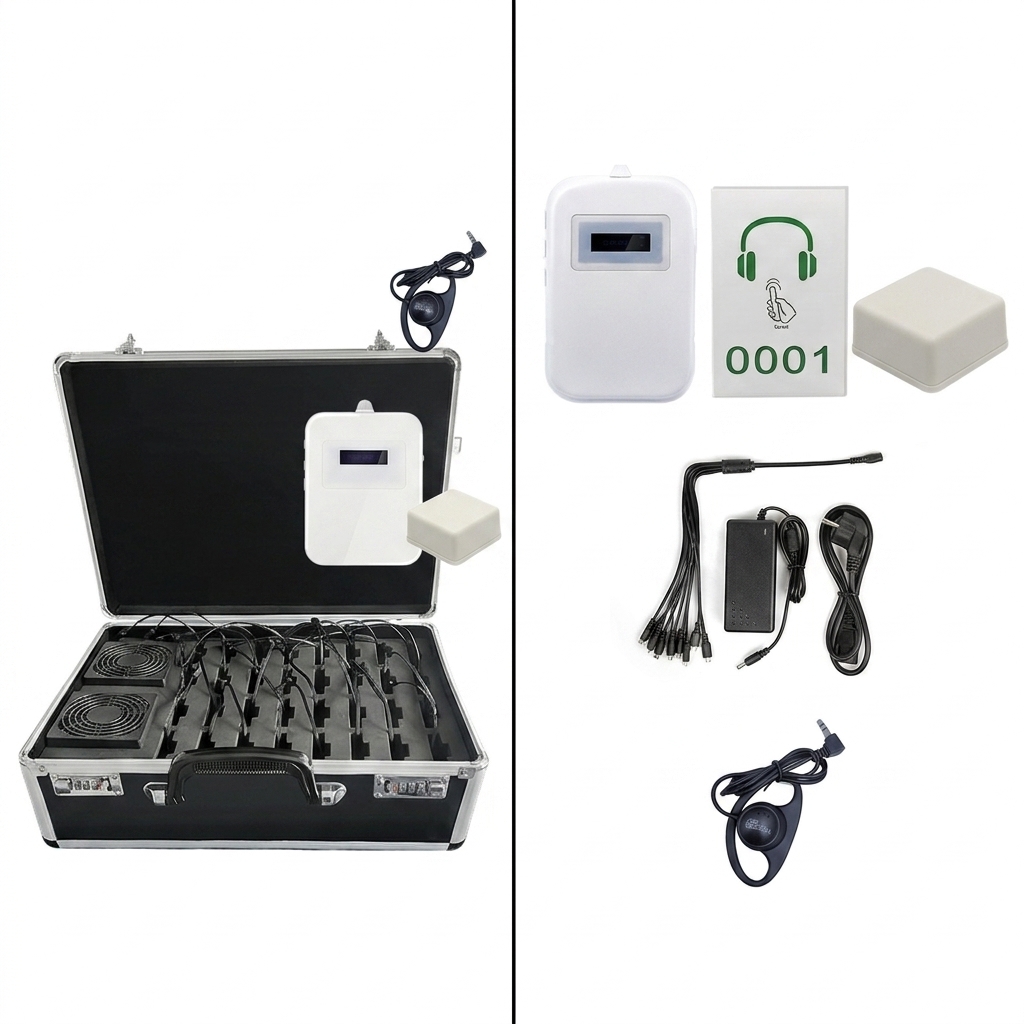
Targeting the scenario features of small venues, Yingmi has specially developed the C7 audio guide. This device is tailor-made for dense exhibits and small spaces, perfectly solving the core pain points of venue commentary.
2.1 Core Technology & Product Advantages
The Yingmi C7 adopts a dual mode of RFID automatic sensing + NFC tap-to-play. Visitors hold the receiver and simply tap the NFC tag at the bottom of the exhibit to instantly play the commentary for that exhibit. Triggering is precise to a single exhibit, completely eliminating sound crosstalk.
In terms of hardware configuration, the C7 weighs only 50g with dimensions of 104*65*13mm—light and portable, so visitors feel no burden when holding it for a long time. It has a built-in 800mAh battery that works continuously for 10 hours, meeting the all-day reception needs of venues. It supports pre-storing up to 9,999 audio commentary segments and is compatible with 8 languages, easily adapting to the needs of international visitors from different countries.
The matching transmitter weighs only 27g, with a coverage range of 40 meters and a battery life of up to 12 months, eliminating frequent battery replacement and reducing venue operation costs. It also supports OEM/ODM customization, including custom logo, frequency, battery capacity, functions, etc., to meet the personalized needs of different overseas venues.
2.2 Core Applicable Scenarios
The Yingmi C7 is the optimal choice for small venues, especially suitable for scenes with small exhibit spacing and high-precision commentary needs, such as various museums, art galleries, small science and technology exhibition halls, and corporate premium showrooms. In these scenarios, the precision of NFC tap-to-play allows visitors to obtain exhibit information one-on-one, delivering a purer viewing experience.
III. Exclusive for Large Scenic Areas: Yingmi M7 Automatic Sensing Audio Guide
For the spacious space and dynamic touring needs of large scenic areas, the Yingmi M7 automatic sensing audio guide is the top choice. It focuses on automatic triggering, long battery life, and strong anti-interference, adapting to large-scale outdoor usage scenarios.
3.1 Core Technology & Product Advantages
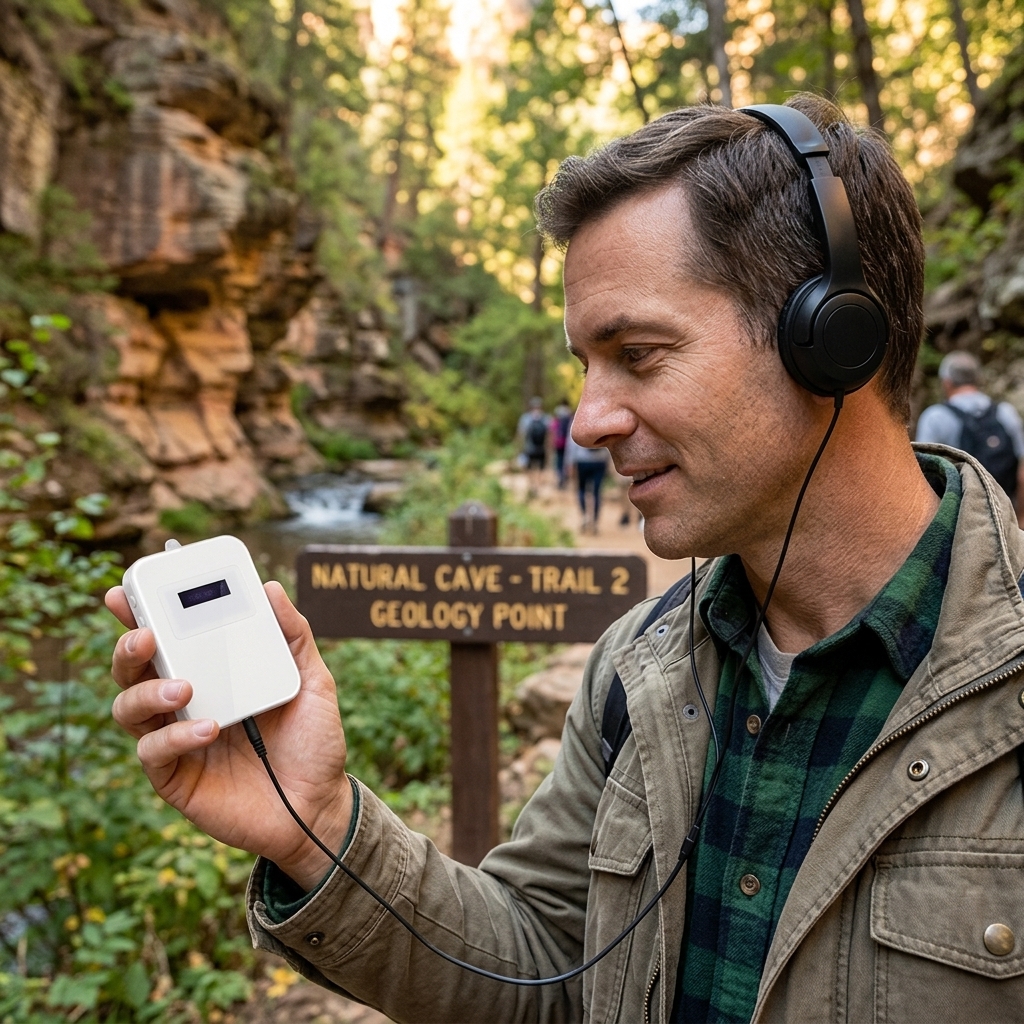
The Yingmi M7 adopts 2.4GHz RFID automatic sensing technology. When visitors wear the receiver and enter the scenic area, the device automatically detects and plays the commentary for the corresponding spot once they reach the triggering point. No manual operation is needed throughout the process, truly realizing “play commentary wherever you go”.
This device also supports storing 9,999 audio segments and switching between 8 languages. With a lightweight 50g body, it brings no pressure when worn. The 800mAh battery lasts up to 16 hours, far exceeding the daily touring time of scenic areas, completely solving the problem of inconvenient outdoor charging. The transmitter covers 40 meters with a battery life of up to 15 months. It features stable signal transmission and strong anti-interference, ensuring smooth and uninterrupted commentary even when used by many people simultaneously.
3.2 Core Applicable Scenarios
The Yingmi M7 is specially designed for large outdoor scenes, suitable for natural history scenic spots, cultural heritage sites, large-scale science and technology parks, sightseeing buses/boats, and other scenarios. Whether visitors tour on foot or by transportation, the device triggers commentary automatically, freeing visitors’ hands and improving touring convenience and comfort.
IV. Scenario-Based Selection Guide: Choose the Right One Without Mistakes
Combined with the features of the two devices, we’ve made a clear scenario matching for overseas clients, and you can choose directly by comparison:
4.1 Scenarios to Prioritize Yingmi C7
- Indoor small venues: museums and art galleries with compact space and dense exhibits;
- Cultural exhibition venues with high requirements for commentary precision, needing to avoid sound crosstalk and false triggering;
- Scenarios where visitors view exhibits statically and need manual precise triggering of commentary.
4.2 Scenarios to Prioritize Yingmi M7
- Outdoor large scenic areas: natural/cultural scenic spots with spacious space and dispersed commentary points;
- Scenarios with long visitor flow and long touring time, requiring fully automatic commentary;
- Mobile carriers such as sightseeing buses and boats, as well as large-scale cultural tourism projects with high requirements for signal stability and battery life.
V. 3 Practical Tips for Overseas Clients
Choose by space size
Select C7 for small indoor venues to avoid crosstalk via precise NFC tapping; choose M7 for large outdoor scenic areas to adapt to large-scale movement via RFID automatic sensing.
Choose by usage mode
Select C7 for static viewing and precise commentary needs; choose M7 for dynamic touring and fully automatic commentary needs.
Choose by battery life and operation
The 10-hour battery life of C7 is sufficient for daily venue reception; the 16-hour battery life of M7 is more convenient for long-time scenic area touring. Both devices support multi-language and customized services, with a 2-year main unit warranty and 24/7 English technical support, providing worry-free after-sales service.
Table–Comparison of Yingmi C7 (Small Venues) vs. Yingmi M7 (Large Scenic Areas)
| Feature | Yingmi C7 (Small Venues) | Yingmi M7 (Large Scenic Areas) |
| Primary scenario | Indoor museums, art galleries, small exhibition halls | Outdoor natural/cultural scenic areas, heritage sites, large parks |
| Space type | Compact space, dense exhibit layout | Spacious area, dispersed points of interest |
| Triggering method | NFC tap-to-play (manual) | 2.4GHz RFID automatic sensing |
| Triggering precision | Exhibit-level, zero crosstalk | Zone/point-level, automatic |
| User operation | Tap the NFC tag at each exhibit | Hands-free, no action required |
| Receiver weight | 50g (104×65×13mm) | 50g (similar compact design) |
| Battery life (receiver) | 10 hours (800mAh) | 16 hours (800mAh) |
| Battery life (transmitter) | Up to 12 months | Up to 15 months |
| Signal coverage | 40 meters | 40 meters |
| Audio capacity | Up to 9,999 tracks | Up to 9,999 tracks |
| Language support | 8 languages | 8 languages |
| Customization | OEM/ODM (logo, frequency, battery, functions) | OEM/ODM (logo, frequency, battery, functions) |
| Warranty & support | 2-year warranty, 24/7 English support | 2-year warranty, 24/7 English support |
| Best for… | Static viewing, precise commentary needs | Dynamic touring, long-duration auto-commentary |
VI. Summary
The core of audio guide selection for small venues and large scenic areas is scenario matching: Choose Yingmi C7 for small venues, featuring precise NFC tapping, crosstalk-free, and easy operation, adapting to indoor scenes with dense exhibits; choose Yingmi M7 for large scenic areas, featuring RFID automatic sensing, long battery life, and wide coverage, adapting to outdoor scenes with large-scale dynamic touring.
With 19 years of focus on R&D and production of audio guides, Yingmi has always refined products based on scenario needs, providing professional commentary solutions for overseas cultural tourism venues. Choosing the right audio guide can not only improve visitor experience but also reduce operation costs, making cultural tourism services more professional and convenient.
FAQs
Q1: What is the main difference between the Yingmi C7 and the Yingmi M7?
A: The C7 is designed for small indoor venues (museums, galleries) with dense exhibits, using NFC tap-to-play for precise, crosstalk-free triggering. The M7 is for large outdoor scenic areas (heritage sites, nature parks) with 2.4GHz RFID auto-sensing, offering longer battery life and wider coverage.
Q2: Why can’t I use a small-venue audio guide in a large scenic area?
A: Small-venue devices often lack sufficient battery life (outdoor touring takes longer) and may suffer from signal instability or inaccurate triggering over large, open spaces. The M7 solves these with 16-hour battery, 40m coverage, and strong anti-interference.
Q3: How do I trigger commentary on the C7 vs. the M7?
A: On the C7, visitors tap an NFC tag at each exhibit. On the M7, commentary plays automatically when the visitor approaches an RFID trigger point-no manual operation needed.
Q4: Can both devices support multiple languages and custom branding?
A: Yes. Both store up to 9,999 audio tracks, support 8 languages, and offer OEM/ODM customization (logo, frequency, battery, materials).
Q5: What is the battery life difference?
A: The C7 provides 10 hours (enough for daily venue reception). The M7 provides 16 hours-ideal for all-day outdoor touring without recharging.