

Cultural venues live or die on whether a visitor can actually hear the story being told. A docent speaking to twenty people in a stone-walled gallery, or a guide leading a group through a noisy heritage market, faces the same underlying problem: voice doesn’t travel evenly, and raising it damages both the experience and the guide’s throat by the end of the season. Wireless tour guide systems — sometimes called whisper systems, one-to-many audio guides, or tour guide devices — solve this by giving each visitor a private audio channel that follows the guide regardless of ambient noise or group spread.
For procurement teams at museums, heritage sites, tour operators, and cultural attractions, understanding how these systems actually work makes the difference between a purchase that fits the venue and one that gets shelved after a single busy season.
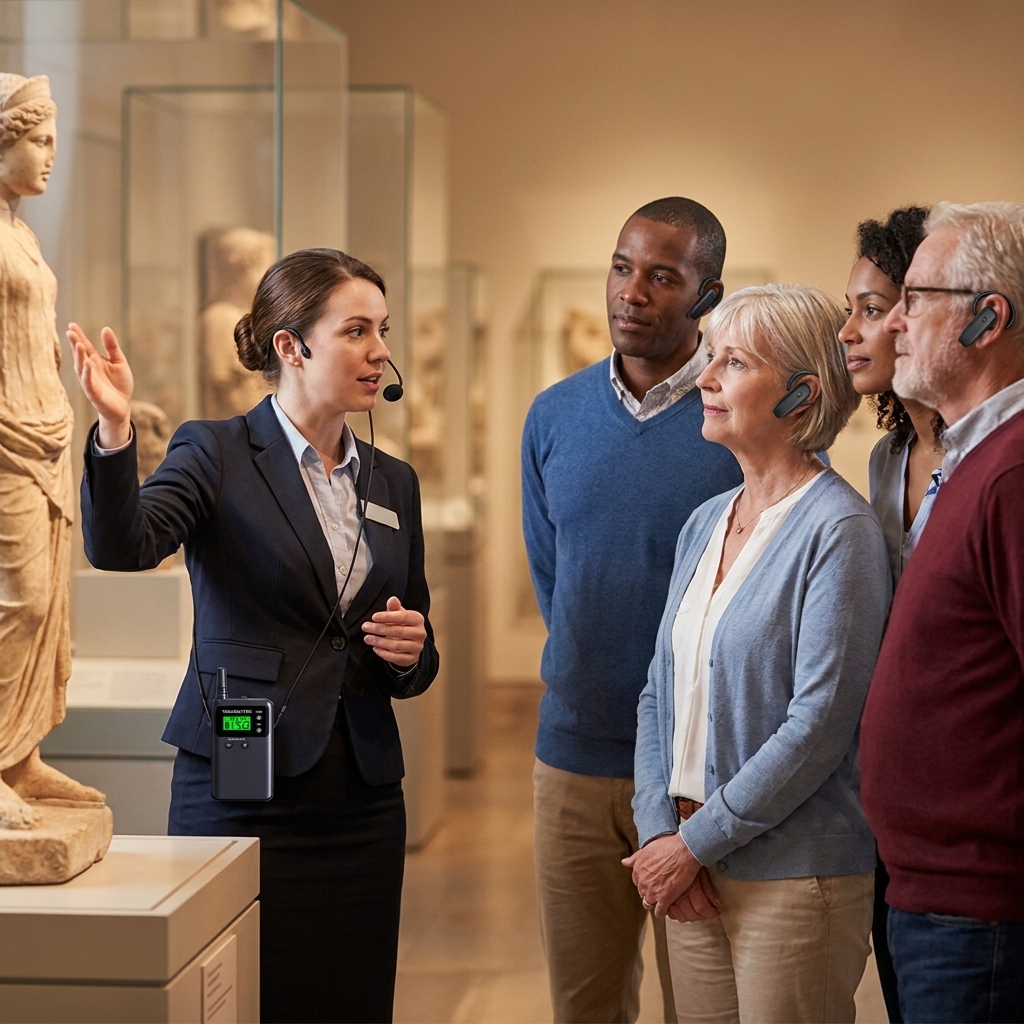
What a Tour Guide System Actually Does
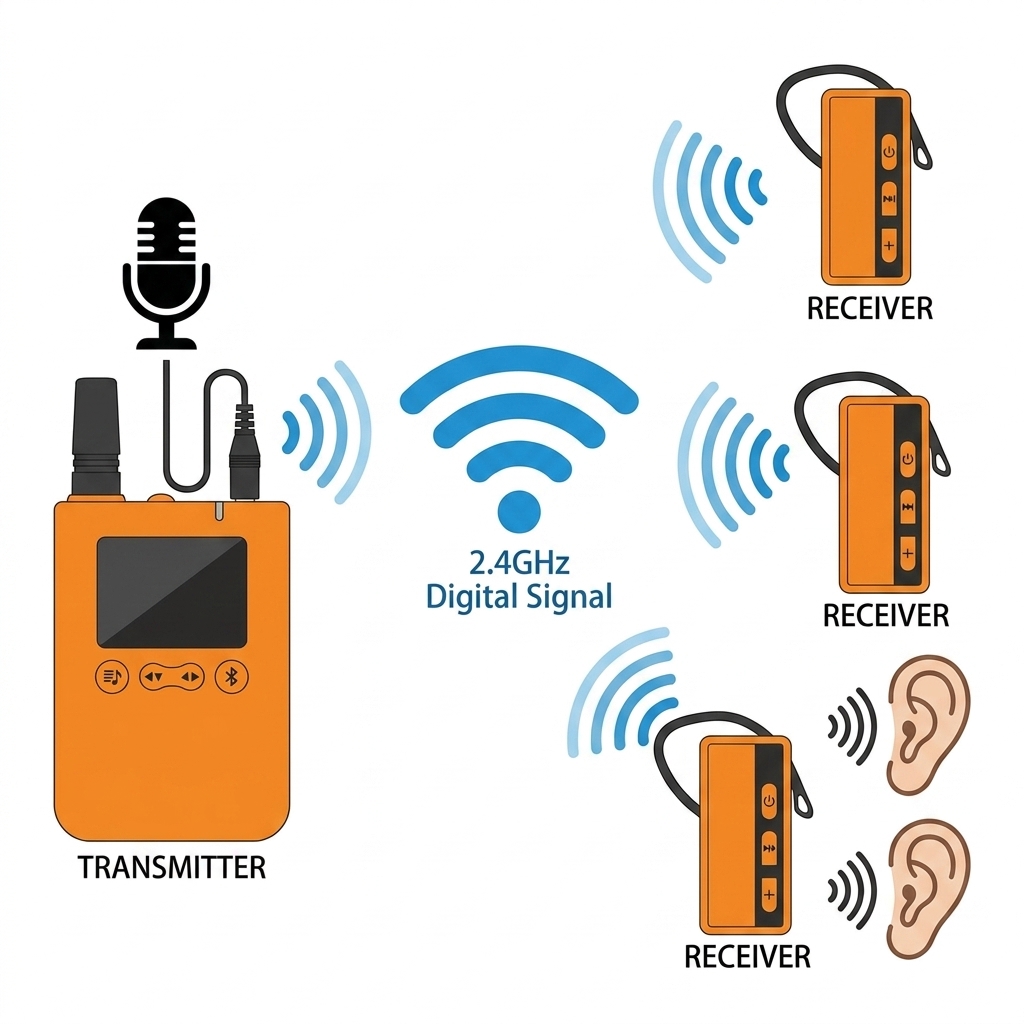
At its core, the system has three parts: a transmitter worn or held by the guide, a set of receivers distributed to visitors, and a charging/storage case that keeps everything ready between tours. The guide speaks into a microphone connected to the transmitter, and that audio is broadcast wirelessly to every receiver tuned to the same channel. Visitors wear an earpiece or hold the receiver, hearing the guide clearly at a comfortable volume no matter where they stand within range.
The technology sounds simple, but the transmission method underneath determines almost everything about how well a system performs in a specific environment — which is why venues comparing options should look past the marketing copy and focus on the radio technology itself.
2.4GHz Digital vs. Traditional Analog Transmission
Older analog tour guide devices transmit on a single shared frequency band, which means two guide groups working near each other can bleed into one another’s audio, and background electronics — Wi-Fi routers, other radios, even LED lighting drivers — can introduce static. Modern systems built on 2.4GHz digital transmission with frequency-hopping avoid this by constantly shifting between channels within the band, and by digitally encoding the signal so it resists interference from other electronic equipment in the building.
The practical difference shows up in busy venues: a museum running six simultaneous tours in adjoining galleries needs channel isolation that a basic analog system was never designed to provide. Digital systems using dedicated channel allocation — commonly built on schemes offering 100 to 200 independent channels — let each guide group operate without crosstalk even when standing a few meters apart.
RFID and NFC Triggering for Self-Guided Tours
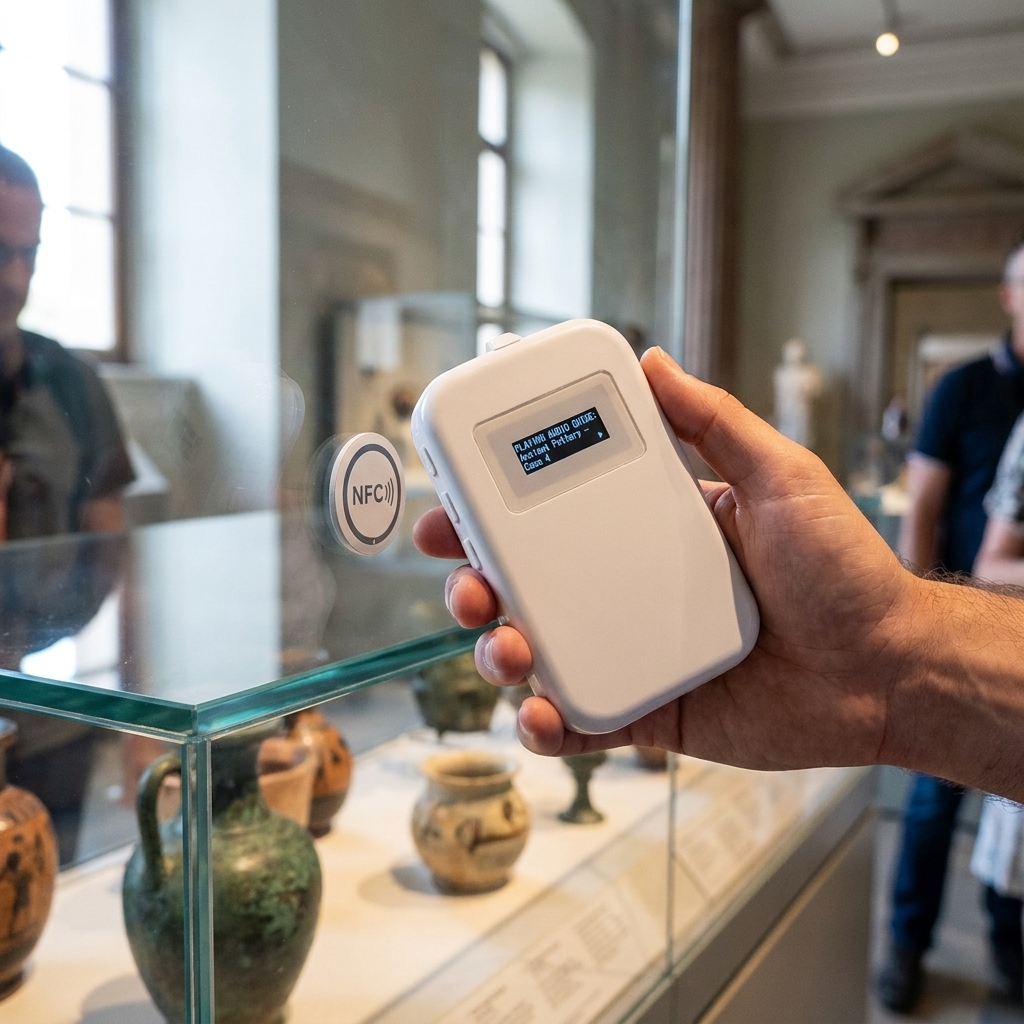
Not every cultural site uses a live guide. Self-guided audio tours rely on a different mechanism: RFID or NFC triggering, where a receiver automatically plays a pre-recorded track when it passes near a tagged exhibit or waypoint. RFID tags are typically used outdoors or across larger distances — a heritage trail, a botanical garden, a historic district — since the tag can be read from further away. NFC works at very close range and suits indoor exhibits where the visitor taps or holds the receiver near a specific object, ensuring the correct track plays only when intended.
Sites that mix both formats — a live guide for group tours during the day, and a self-guided RFID or NFC track for independent visitors after hours — need equipment that supports both trigger types rather than committing to a single-purpose device.
Specifications That Actually Matter for Procurement
Marketing pages for tour guide equipment tend to lead with language (“crystal-clear sound,” “premium design”) that doesn’t help a buyer compare products. The specifications worth checking are more concrete:
Channel capacity and modulation. Look for systems using digital modulation such as 4GFSK with encrypted channel separation, rather than analog FM, if multiple groups will operate concurrently.
Receiver weight and battery life. Receivers handed to visitors for hours need to be light — devices in the 16–20 gram range are common for this category — and battery life in the 7–16 hour range covers a full operating day without a midday swap.
Operating temperature range. Outdoor heritage sites and factory tours expose equipment to conditions indoor museum systems never face. A working range of roughly -20°C to 45°C, with sweat and dust resistance, matters for anything used outside a climate-controlled building.
Language support and audio recording quality. Systems intended for international visitor groups should support multiple pre-loaded languages recorded by native speakers rather than machine text-to-speech, particularly for sites hosting government delegations, academic groups, or overseas tour operators.
Certification. CE and RoHS certification are baseline requirements for equipment being imported or used across most international markets, and should be confirmed before purchase rather than assumed.
Matching the System to the Venue
Museums and indoor galleries generally favor a one-to-many wireless transmitter-and-receiver setup with NFC-triggered self-guided options as a supplement. Quiet indoor acoustics mean the priority is language variety, comfortable earpieces for repeat daily use, and a charging case that disinfects and stores dozens of receivers between tour groups.
Outdoor heritage sites and scenic areas need longer transmission range and RFID triggering across wider distances, along with weatherproofing that indoor-rated equipment doesn’t offer.
Factory and facility tours present a distinct challenge: industrial noise floors are far higher than a gallery, and visiting delegations often move through working production lines rather than a fixed route. A wireless tour guide system built for this environment, such as the YINGMI 008A, is designed specifically for mobile group reception in noisy plant settings, giving overseas buyers, government delegations, and distributor teams clear audio without the guide needing to shout over machinery.
Conferences, simultaneous interpretation, and multilingual delegations often use a similar one-to-many architecture but with an added interpretation channel, letting a translator’s voice reach a subset of the audience without disrupting the main tour feed.

A Note on Product Selection: Single-Model vs. Multi-Model Lines
One detail worth flagging for procurement teams comparing supplier catalogs: not every product family has multiple size or capacity variants, despite what a reseller listing might suggest. The YINGMI L8, for example, is offered as a single CE- and RoHS-certified transmitter-and-receiver model rather than a tiered “Mini” or “Pro” lineup — buyers should confirm exact model numbers and certifications directly with the manufacturer rather than relying on third-party marketplace listings, which can misrepresent variants that don’t actually exist.
Common Procurement Mistakes
The most frequent issue cultural venues run into isn’t equipment failure — it’s mismatched expectations set during purchasing. Buyers sometimes select the cheapest analog system without accounting for how many simultaneous groups the venue actually runs, only to discover channel interference during peak season. Others choose a system rated for indoor museum use and deploy it on an outdoor heritage trail, where temperature swings and range limitations cause early failures. Confirming the operating environment, expected group count, and required languages before requesting quotes avoids most of these problems.
FAQs
Q1:What is the difference between a tour guide system and a simultaneous interpretation system?
A1:A standard tour guide system carries one audio feed — the guide’s voice — to a group of receivers. A simultaneous interpretation setup adds a second channel so an interpreter’s translated audio can reach a subset of listeners in real time, which is why conference and delegation tours sometimes need equipment supporting both functions.
Q2:How many receivers can one transmitter support?
A2:This depends on the model, but one-to-many digital transmitters commonly support groups ranging from a couple of dozen up to 100 or more receivers on a single channel, with the venue’s total channel count determining how many separate tour groups can run simultaneously without interference.
Q3:Do tour guide systems require Wi-Fi or cellular connectivity?
A3:No. Standard wireless tour guide equipment operates on its own dedicated radio frequency (commonly 2.4GHz) independent of the venue’s internet or cellular network, which is part of why it remains reliable in basements, remote outdoor sites, or buildings with weak signal coverage.
Q4:What is the typical lifespan of tour guide receivers used in daily operation?
A4:With proper charging-case storage and normal handling, receivers used for daily group tours typically remain serviceable for several years, though battery capacity and earpiece hygiene components are the parts most likely to need replacement first in heavy-use settings like museums running multiple daily tours.
Q5:Can the same system support both guided and self-guided tours?
A5:Yes, provided the equipment includes both a live transmitter mode and RFID/NFC auto-play triggering. Venues that only need one mode can choose a simpler single-purpose device, but sites offering both group tours and independent visits benefit from equipment that switches between the two without needing separate hardware.