

When choosing audio equipment for a museum, factory, scenic attraction, or visitor center, one common question comes up: should you use a wireless tour guide system or a self-guided audio guide?
Both solutions help visitors receive information clearly, but they work in different ways. The right choice depends on how your tours are organized and how visitors prefer to explore.
1. What Is a Wireless Tour Guide System?
A wireless tour guide system allows one guide to speak to multiple visitors at the same time.
The guide wears a transmitter with a microphone, while visitors use wireless receivers with earphones. The guide’s voice is transmitted directly to the receivers, making explanations easier to hear even in noisy environments.
This system is commonly used for:
- Factory tours and production line visits
- Museum group tours
- Business receptions and corporate visits
- Educational and cultural tours
- Religious site visits
It is particularly useful when visitors need to follow a guide and receive explanations in real time.

2. What Is a Self-Guided Audio Guide?
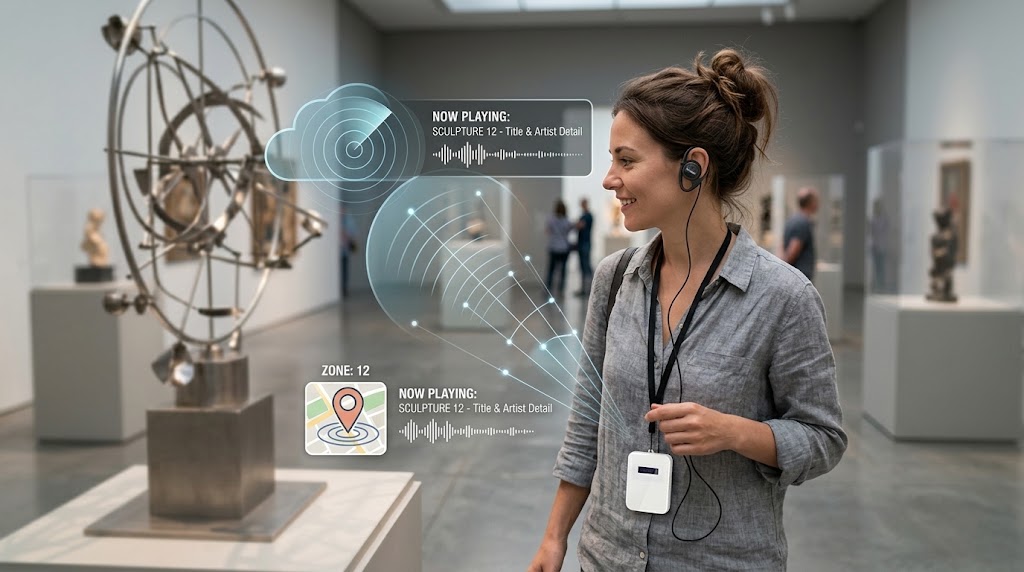
A self-guided audio guide allows visitors to explore independently without following a live guide.
Visitors use handheld audio devices or compatible equipment to listen to pre-recorded commentary. Depending on the system, playback can be started by entering a number, selecting an audio track, scanning an NFC tag, or triggering an RFID identification point.
Common applications include:
- Museums and art galleries
- Historical buildings and heritage sites
- Scenic attractions
- Cultural exhibition centers
- Visitor information centers
The main advantage is flexibility. Visitors can choose what to listen to and spend as much time as they like at each location.
3. Key Differences Between the Two Systems
| Feature | Wireless Tour Guide System | Self-Guided Audio Guide |
|---|---|---|
| Audio source | Live guide | Recorded audio |
| Main users | Groups | Individual visitors |
| Operation | Guide uses a transmitter | Visitor selects or triggers playback |
| Tour arrangement | Guided group activities | Independent exploration |
| Content updates | No recording needed | Audio files may need updating |
| Typical venues | Factories, group tours, business visits | Museums, galleries, scenic spots |
The main difference is how visitors receive information. One supports real-time communication, while the other provides independent access to recorded content.

4. Which System Is Better for Your Venue?
The best choice depends on the type of visitors and daily activities.
Museums: Wireless systems work well for school groups and guided visits. Self-guided devices are more suitable for individual visitors who want to explore at their own pace.
Factories: A wireless tour guide system is usually the better option. Guides can explain production processes while visitors walk through workshops, where machinery noise may make normal conversation difficult.
Scenic Attractions: Self-guided audio guides offer flexibility for tourists exploring different points of interest. Wireless systems are useful for organized sightseeing groups.
Corporate Showrooms: A wireless tour guide system helps company representatives introduce products, facilities, and business operations to visiting clients.
Some large venues may benefit from using both systems to serve different visitor groups.
5. What Should Buyers Consider Before Purchasing?
Before choosing an audio guide system, consider these practical factors:
- Operating Environment: Check whether the equipment will be used indoors, outdoors, or in noisy industrial areas.
- User Capacity: Estimate how many receivers or individual audio guide devices are needed.
- Battery Life: Make sure the equipment can support daily operating hours and has a convenient charging solution.
- Wearing Comfort: Lightweight receivers and easy-to-use controls improve the visitor experience.
- Language Requirements: Consider the languages needed for international visitors.
- Customization: For larger projects, ask whether the manufacturer provides OEM and ODM services.
These details can help buyers avoid choosing equipment based on specifications alone.
6. Working with an Audio Guide Manufacturer
For distributors, project contractors, and organizations purchasing equipment in bulk, the manufacturer’s capabilities also matter.
Look for a supplier with product development experience, manufacturing capabilities, quality testing, and reliable technical support.
Yingmi, established in 2007, specializes in wireless tour guide systems and audio guide solutions. Its products serve applications such as museums, industrial visits, business receptions, and exhibitions.
OEM and ODM services are also available for customers requiring customized products and configurations.
Discussing your venue, visitor numbers, and operating requirements with the manufacturer is a practical way to identify a suitable solution.
Frequently Asked Questions
Q1: Is a wireless tour guide system the same as an audio guide?
No. A wireless tour guide system transmits a live guide’s voice to multiple receivers, while a self-guided audio guide usually plays pre-recorded commentary for individual visitors.
Q2: Which system is better for factory tours?
A wireless tour guide system is generally more suitable because visitors can hear real-time explanations while moving through production areas.
Q3: Can one wireless transmitter connect to multiple receivers?
Yes. Many wireless tour guide systems support one-to-many audio transmission. The maximum number of receivers depends on the specific model.
Conclusion
A wireless tour guide system is ideal for organized group visits and real-time explanations. A self-guided audio guide is better for independent exploration.
For venues serving different types of visitors, combining both solutions can offer greater flexibility.
Before purchasing, consider your operating environment, visitor numbers, and tour arrangements to find the right audio guide solution.