

A tour guide system is a wireless audio set that carries a guide’s voice, or pre-recorded commentary, directly to each visitor’s earpiece, so that everyone in a group can hear clearly without the guide having to raise their voice.
If you have ever stood at the back of a tour group trying to catch what the guide was saying over traffic, a crowd, or machinery, you already know the problem this equipment solves. Tour guide systems are now common at museums, factories, heritage sites, and in the tour programs of travel agencies, and the term covers a few different kinds of equipment that work in different ways.
How a Tour Guide System Works
The basic idea is simple. The guide speaks into a small microphone connected to a transmitter. The transmitter sends the voice out as a radio signal, and each visitor wears a receiver with an earpiece or headphones that turns the signal back into sound. Because the sound goes straight to the ear, it does not matter whether a visitor is standing next to the guide or a few meters away.
Guide speaks normally → Transmitter sends a radio signal → Receiver worn by each visitor →Earpiece clear audio
The Transmitter
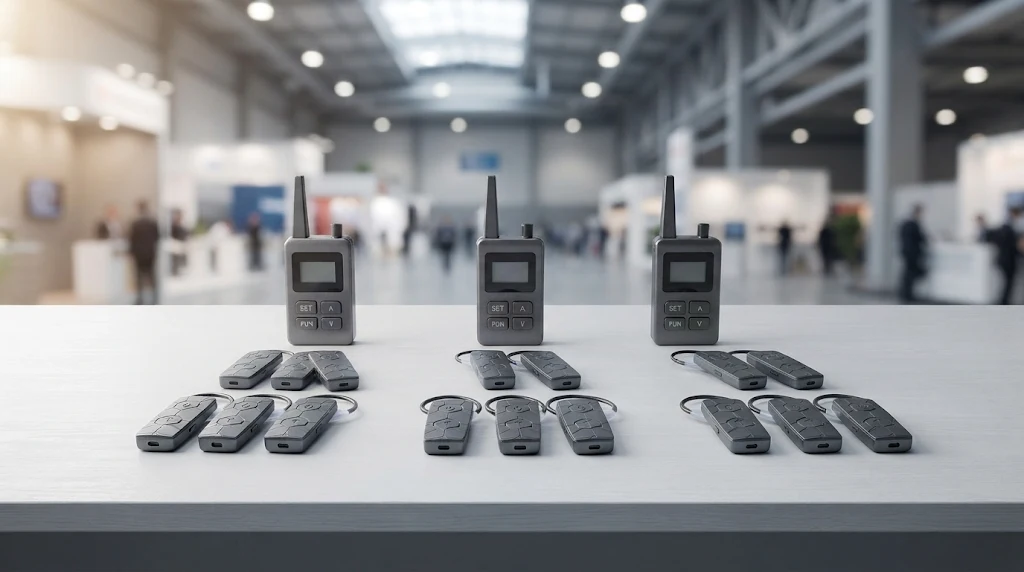
The transmitter is the guide’s half of the system. It is usually small enough to wear on a lanyard or clip to clothing, and it works with a microphone to pick up the guide’s voice. Most modern systems use digital radio on frequencies such as 2.4GHz or UHF, and several groups can work in the same place when the system offers multiple channels.
The Receivers
Each visitor carries a lightweight receiver, normally with an earpiece or headphones. Visitors can usually adjust their own volume. Receivers are handed out before the tour and collected afterward, which is why charging and storage cases are an important part of any practical setup.
Range and Environment
How far the signal reaches depends on the model and on the surroundings. Open ground allows a longer range than a building full of walls, so it is sensible to test equipment where it will actually be used.
The Main Types of Tour Guide System
The phrase “tour guide system” is used for three broad kinds of equipment, and choosing between them is mostly a question of how the visit is run.
One-Way Guide Systems
In a one-way system, only the guide speaks, and the group listens. This is the standard format for guided tours where the guide leads, explains, and answers questions at the end or when the group stops. It is the simplest and most widely used type.
Two-Way Group Systems
A two-way system lets visitors speak as well as listen. When one person asks a question, the whole group hears it, so the guide answers once instead of repeating it for everyone. This helps in factory visits, training sessions, and any activity where people cannot easily gather around the guide, such as horse-riding lessons. YingMi’s 008B is an example of this approach.
Automatic Induction Guides
Automatic induction guides, also called self-guided systems, work without a live guide. Trigger points are placed at exhibits or locations, and when a visitor wearing the receiver reaches one, the device detects it and plays the matching commentary automatically. The YingMi M7 works this way, using RFID trigger points, with up to 9,999 pre-stored audio segments and 8 languages. It suits museums, heritage sites, showrooms, and sightseeing vehicles, where visitors move at their own pace.
Many sites use more than one type. A museum might offer self-guided devices to individual visitors and a one-way system for school groups on the same day.

Where Tour Guide Systems Are Used
Museums and galleries use them to keep rooms quiet while still giving visitors full commentary. Heritage sites and churches use them for the same reason and for multilingual visitors. Factories and industrial facilities use them because machinery makes speaking aloud impractical. Travel agencies use them to keep group tours together and to protect the voices of their guides. Sightseeing buses, boats, and trams use them to deliver commentary that matches the view outside. In a number of these settings, visitors also benefit from commentary in their own language, which a single spoken tour cannot provide.
What a Tour Guide System Changes for Guides and Visitors
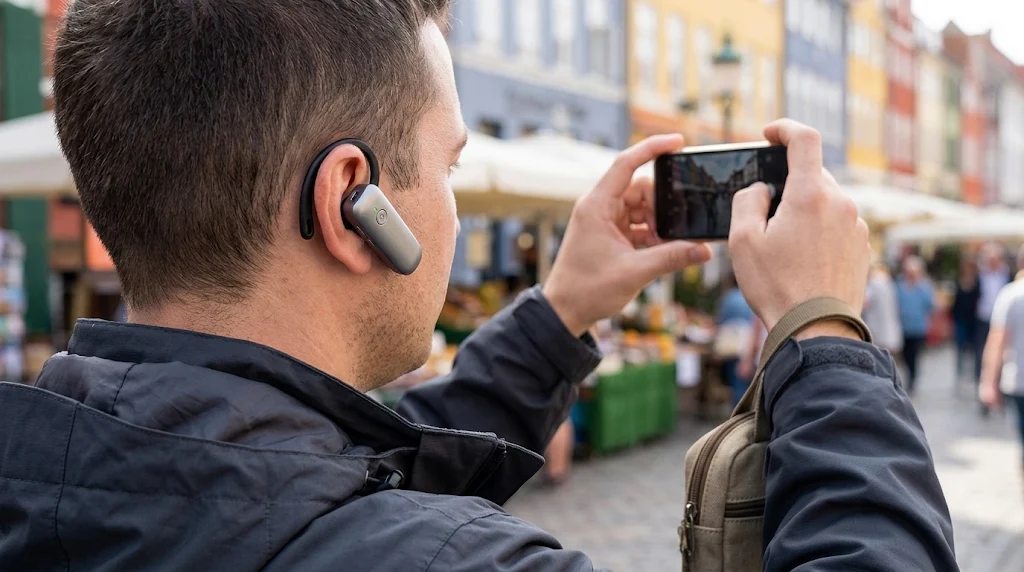
For the guide, the change is mostly physical. Speaking at a normal level all day is far less tiring than projecting over a crowd, and the guide no longer needs to keep everyone within arm’s reach to be heard. For visitors, the change is about control: they can stand where they can see best, look at what interests them, and still follow the story.
For operators, the benefits are more practical. Groups can be larger without losing audio quality, tours are more consistent from one day to the next, and quieter delivery is easier on other visitors, residents, and staff nearby.
How to Choose a Tour Guide System
Start with how the visit works. If a guide leads every group, a one-way system is usually enough. If visitors need to ask questions in the moment, look at two-way. If visitors arrive alone and move through at their own pace, an automatic induction guide fits better.
After that, the practical details matter. Check battery life against the length of your longest tour, the language options for your visitors, how quickly devices can be handed out and collected, and whether the signal holds up in the real environment. If you need the equipment to carry your own branding, ask the supplier about customization before you buy.
Frequently Asked Questions
What is a tour guide system used for?
It is used to let a guide’s voice, or recorded commentary, reach every visitor clearly in places where speaking aloud is difficult or disruptive, such as museums, factories, heritage sites, and busy streets.
What is the difference between a tour guide system and an audio guide?
The terms overlap. “Tour guide system” usually refers to wireless equipment carrying a live guide’s voice to a group, while “audio guide” often means a device that plays recorded commentary for a visitor. Some products, such as automatic induction guides, belong to the second group.
How many people can use one tour guide system at once?
The number of listeners depends on the system. Many are designed for groups and can serve a large number of receivers from one transmitter, and multi-channel models let several groups operate in the same area.
Do visitors need to download an app?
Not with dedicated tour guide equipment. Visitors are handed a receiver and an earpiece, so there is nothing to install or connect on their own phones.
Can a tour guide system work in several languages?
Yes. Some systems support interpretation on separate channels, and automatic induction guides such as the YingMi M7 can store commentary in multiple languages. The M7 supports 8.
A tour guide system does not change what a guide knows or what a site has to say. It changes how many of the people who showed up are able to hear it.