

Walk into the visitor center of almost any major scenic area today, and you will find a rack of small earpiece devices waiting by the entrance. A decade ago, those racks would have held brochures. The shift is not cosmetic. Park operators across Asia, Europe, and increasingly North America have been quietly replacing scheduled live commentary with self-service audio guide systems — and the reasons turn out to be more operational than philosophical.
The Staffing Equation Has Changed
Hiring, training, and retaining qualified guides is harder than it used to be. A single trained guide who speaks two or three languages was once an asset a scenic area could build its visitor experience around. That person now commands higher wages, takes sick days, delivers commentary that varies by mood and crowd size, and — critically — can only be in one place at a time.
Audio guide devices remove that constraint entirely. A park can load commentary recorded by a specialist once and deploy it across hundreds of units simultaneously. A visitor arriving at 8 a.m. hears the same quality explanation as one arriving at 4 p.m. The content does not get tired. It does not rush when the group falls behind.
This is not a criticism of human guides. It is a recognition that the operational math has shifted. Parks with high seasonal traffic — the kind where visitor numbers triple in July and drop by 80% in November — have found it nearly impossible to staff live guide teams that flex as dramatically as demand requires. A fleet of self-service audio guide devices scales in neither direction with any friction.
Visitors Move at Their Own Pace Now
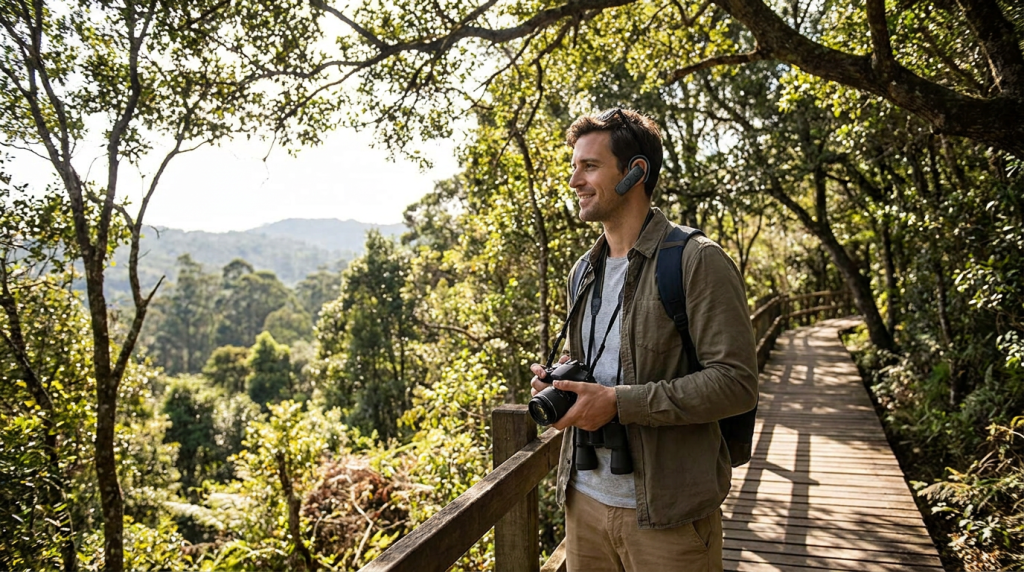
The group tour format that dominated scenic travel for most of the twentieth century assumed that visitors wanted to move together, hear the same things, and finish at roughly the same time. That assumption has frayed considerably. Research from the tourism industry consistently shows that modern visitors — particularly those traveling independently or with small family groups — prefer to linger where they are interested and skip what does not hold their attention.
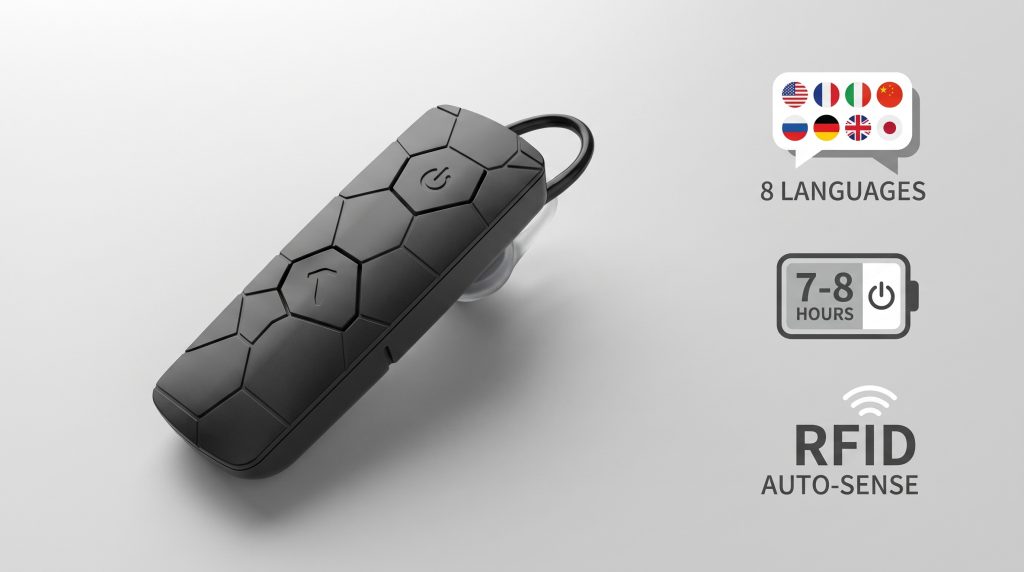
Live guide schedules cannot accommodate that preference. An audio guide system can. Devices like the YINGMI i7, which uses RFID automatic induction technology, trigger explanations when a visitor physically approaches a specific point rather than when a guide decides it is time to move on. A visitor can spend twenty minutes at one exhibit and thirty seconds at the next. The device keeps pace with them, not the other way around.
Multilingual Coverage Without Multilingual Staff
National parks in countries with heavy international tourism face a problem that no reasonable hiring budget can solve: visitors arrive speaking dozens of languages, and there is no practical way to station a native-speaking guide at every key exhibit for every language group. The result, historically, has been a two-tier experience — strong commentary for speakers of the dominant local language, much thinner content for everyone else.
Audio guide devices with multi-language support close that gap without adding headcount. The YINGMI i7 supports eight language options, with the device auto-saving each user’s last language selection so repeat visitors do not have to reconfigure anything. For parks with content in multiple languages, a single hardware fleet handles the full linguistic range. Updating or adding a language means refreshing the audio files, not hiring new staff.
This has particular relevance for parks that have seen growth in visitor numbers from East Asia, Southeast Asia, and the Middle East over the past several years — demographics that live guide programs have historically underserved.
Signal Reliability in Open-Air Environments
One objection that parks consistently raise when evaluating audio guide systems is performance in outdoor settings. Open-air sites present real challenges: ambient wind noise, radio interference from other visitor electronics, and coverage gaps across irregular terrain. These are not minor concerns. An audio guide that cuts out at a key interpretive point, or that bleeds signal from one exhibit into the coverage zone of another, delivers a worse experience than no guide at all.
Current-generation devices address this more effectively than products from even five years ago. Anti-interference design — standard in Yingmi’s audio guide line — separates adjacent transmitter signals so that commentary from one point does not overlap with the next. The i7’s RFID-based triggering system operates on the 860–870 MHz carrier frequency range, which is substantially less congested than the 2.4 GHz band that consumer electronics crowd, and maintains stable performance across the signal adjustment range without dropout.
For parks with routes covering several kilometers, this matters. Visitors walking a long trail should not be troubleshooting connectivity between stops.

Device Management at Scale
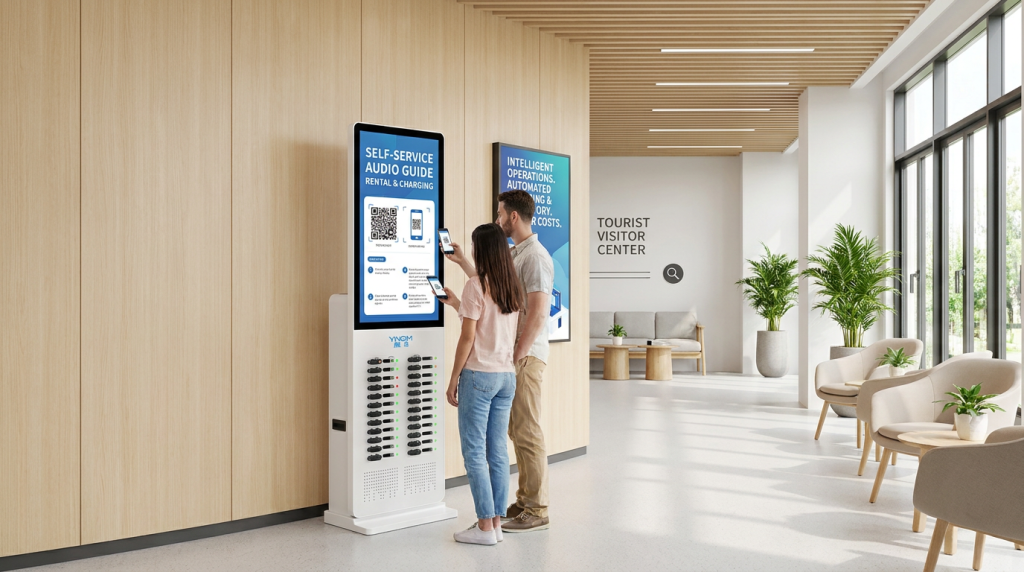
Any operator considering a large fleet of audio guide devices will eventually ask the same question: what happens when devices go missing, run out of battery mid-tour, or need content updates? These are legitimate logistics concerns, and they have become easier to address with the emergence of self-service rental cabinet systems.
Yingmi’s Z-series rental cabinets — including the Z50, Z60, and Z80 models — are designed for unattended deployment at park entrances or visitor centers. Visitors retrieve a device from the cabinet independently, often by scanning a QR code or depositing a small rental fee, and return it to the same cabinet when done. The cabinet handles charging between uses and tracks inventory automatically. Park staff do not need to manage the device pool manually during operating hours.
For parks that have historically avoided audio guide programs because of the staffing overhead involved in running a device rental counter, this model changes the calculation significantly. The infrastructure runs largely without intervention once it is set up.
What Live Guides Still Do Better
None of this suggests that live interpretation is finished. For small groups with specific interests — a guided night walk, a geology-focused route, a school program requiring real-time Q&A — a knowledgeable human guide remains the right format. Audio devices cannot answer unexpected questions, read a group’s engagement level, or adjust emphasis on the fly when something unusual happens in the environment.
The most effective parks are not choosing one model or the other. They are running self-service audio guide systems as the default visitor experience — covering the 90% of visitors who arrive without a booking, who want flexibility, who speak languages the park cannot staff for — while reserving live guide programs for specialized tours where the human element genuinely adds something the device cannot replicate.
The audio guide device does not replace the guide. It handles the volume. And for most national parks dealing with peak-season crowds, that distinction is exactly what the operational picture requires.
Yingmi has been manufacturing audio guide and wireless tour guide systems since 2007, with products deployed across scenic areas, museums, and enterprise venues in more than 70 countries. For parks evaluating self-service audio guide options, the full product range is available at aguider.com.