

A World Cup press conference rarely runs in one language. A coach answers in Spanish, a translator relays it in English, a second interpreter works the room in French or Arabic, and somewhere in the back rows a broadcast crew is trying to capture clean audio for a live feed. Multiply that by dozens of daily briefings across multiple stadiums and a Main Media Centre packed with thousands of accredited journalists, and the real bottleneck of a World Cup becomes obvious: it isn’t the football, it’s the language logistics.
Media operations teams already juggle accreditation, seating, connectivity, and broadcast feeds. Interpretation is too often treated as an afterthought, handled with a single booth interpreter and a PA speaker that half the room can’t hear clearly. A wireless audio guide and simultaneous interpretation system fixes this at the source, giving every journalist a personal, language-specific audio channel regardless of where they sit.
Why Press Conferences Need More Than a PA System
A standard PA system sends one mixed signal into a room. If a coach speaks Portuguese and the interpreter translates over the same microphone, English-speaking, French-speaking, and Arabic-speaking journalists all hear the same single track, layered with whatever overlap or delay the interpreter introduces. Anyone filing a story in real time has to make do with secondhand audio buried under crosstalk.
A multi-channel interpretation system separates this into individual streams. The interpreter speaks into a dedicated transmitter on a specific channel, journalists select their language on a compact wireless receiver, and each person hears a clean, direct feed through an earpiece. The original speaker’s voice and the interpreter’s voice no longer compete for the same airspace, which matters enormously when broadcasters are recording directly off the room audio.
What a Media Center Needs From the Hardware
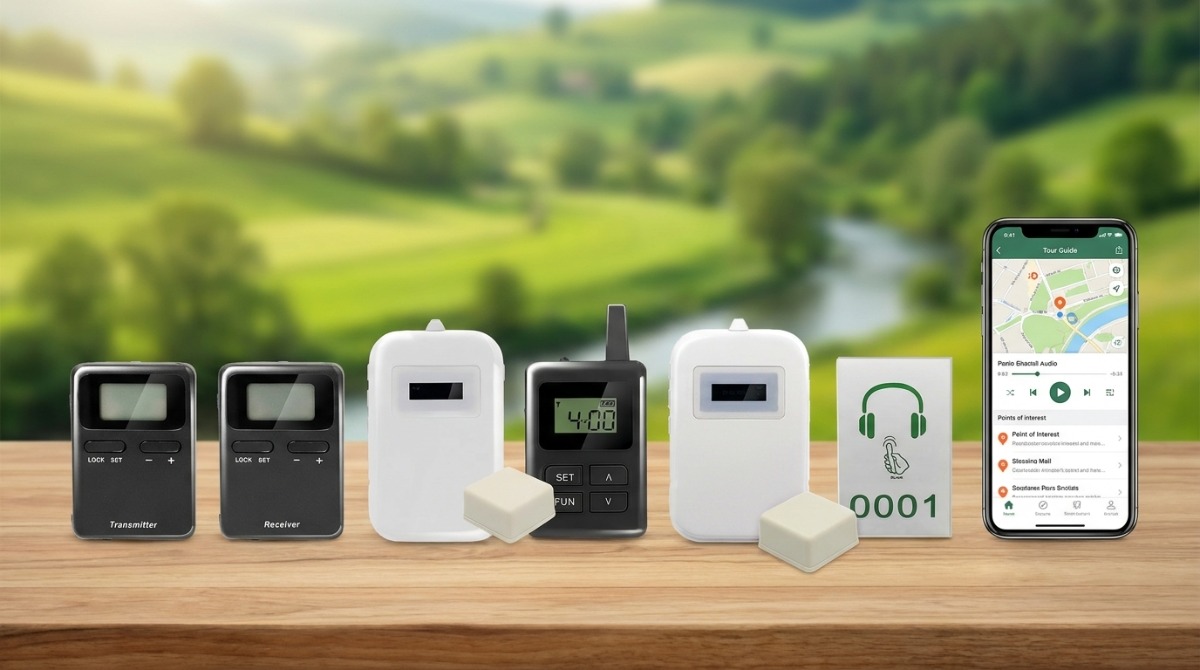
Equipment chosen for a tournament environment has to hold up to volume, not just feature lists. Three practical requirements tend to separate systems that work in a World Cup setting from systems that don’t.
Channel capacity for multilingual coverage. A World Cup media center typically needs to support several languages simultaneously across the host country’s official languages plus the major languages spoken among traveling press and broadcasters. The system needs enough independent channels that adding a language mid-tournament doesn’t mean re-engineering the whole setup.
Interference resistance in a crowded RF environment. A media center is full of competing wireless signals: broadcast microphones, camera links, accreditation scanners, thousands of personal devices. Tour guide-grade transmission with anti-interference design, rather than consumer-grade Bluetooth, is what keeps the interpretation channel stable when everything else in the room is also transmitting.
Fast turnover between sessions. Press conferences run back to back, sometimes with only minutes between sessions. Receivers need to be handed out, collected, and recharged in volume without bottlenecking the next briefing. A charging case that holds and recharges dozens of units at once, paired with receivers simple enough to operate without instruction, keeps the room moving.
Beyond the Press Conference Room
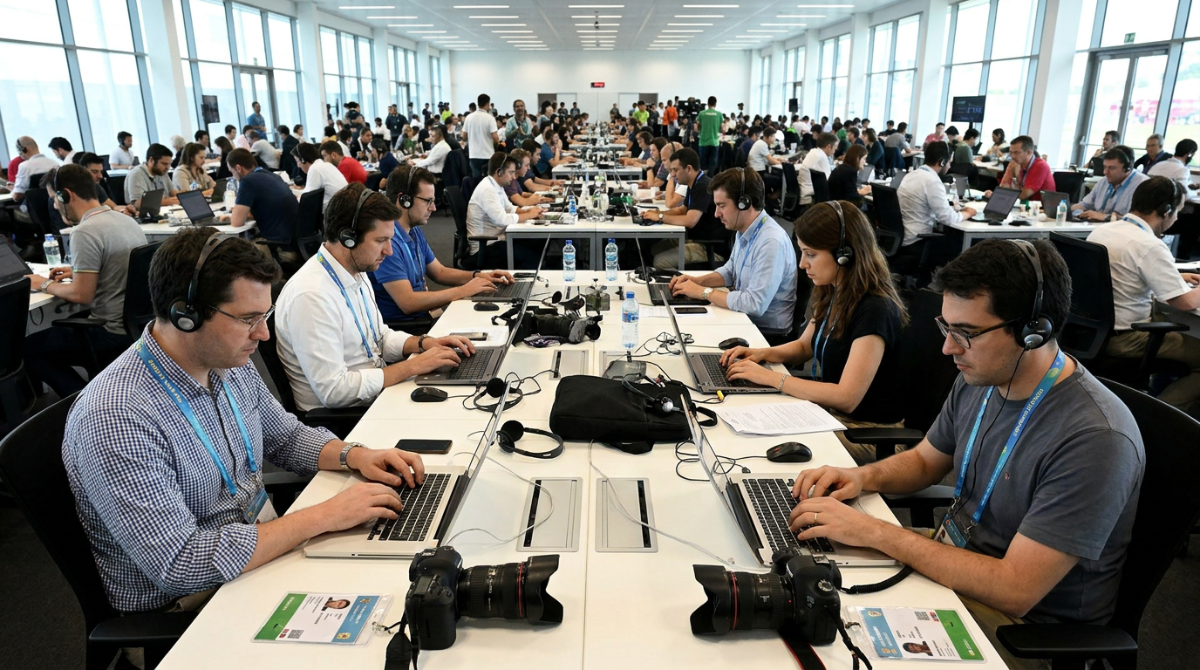
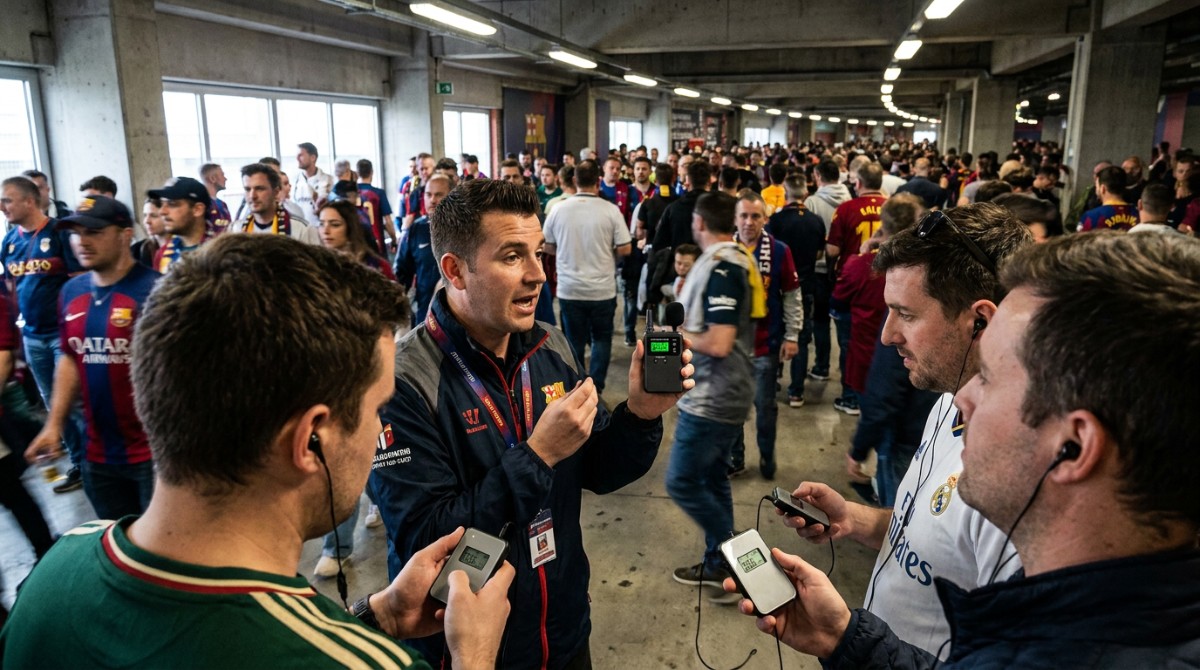
The same wireless interpretation infrastructure extends to other parts of a tournament’s media operation. Stadium tours for accredited press, technical briefings for broadcast partners, and behind-the-scenes facility walkthroughs all involve groups moving through noisy, spread-out environments where a guide or official needs to be heard clearly at a distance. A tour guide transmitter and receiver set, the same core technology behind interpretation systems, handles this without raising anyone’s voice over stadium noise or construction in nearby areas. For self-paced facility walkthroughs where no live guide is available, a self-guided audio system lets visiting press explore on their own schedule instead of waiting on a fixed tour slot.
VIP and delegation visits during the tournament add another layer. Federation officials, sponsors, and visiting dignitaries touring a venue often need real-time interpretation as they move, not just when they’re seated in a fixed room. Portable systems that pair a wireless microphone with individual receivers let an interpreter walk alongside the group and keep every guest on the same audio feed throughout the visit.
Planning Equipment for Tournament Scale
Procurement teams sourcing for a World Cup typically need to plan for several media centers running in parallel, each with its own interpretation requirements and each needing a buffer of spare units for the inevitable wear of daily use across a month-long tournament. Working with a manufacturer rather than a rental aggregator gives more room to customize channel counts, branding, and accessory kits to match exact session needs, and it usually comes at a lower per-unit cost when ordering at this scale.
Yingmi has spent over 19 years manufacturing wireless tour guide and interpretation systems, with equipment deployed across more than 70 countries and 2,000+ venues, including large-scale cultural and institutional sites such as the China National Museum. That manufacturing background, covering everything from anti-interference signal design to high-capacity charging infrastructure, translates directly to the demands of a tournament media operation: many languages, many rooms, and very little tolerance for technical failure on live broadcast day. (See how this same manufacturing depth shows up in self-guided audio tour deployments at museums and cultural venues.)
For media operations teams currently planning World Cup logistics, the interpretation system is worth sourcing early. Channel allocation, language coverage, and unit quantities all need lead time to get right, and a system tested well before opening ceremony is one less variable to manage once the tournament is underway. Get in touch to discuss channel counts and quantities for your media center.