

In overseas schools and training establishments, instructors and advisors often face a common challenge: in lecture halls, students in back rows inch forward. Despite raising their voices, someone inevitably raises a hand saying, “I couldn’t hear clearly.” Taking students to museums for field trips presents similar problems: crowded, noisy weekends where shouting at the top of your lungs still results in students either crowding close to hear or standing far away and missing everything. After field trips, students remember “seeing some old objects” but can’t articulate what they learned.
These audio transmission problems may seem minor but actually reduce class efficiency and diminish field trip value. As a company engaged in voice interpretation for 18 years, Yingmi has consistently focused on helping overseas educators solve these challenges. The wireless audio guide we developed isn’t just a simple volume boost. It’s a solution tailored to real educational needs. Whether classroom communication or field trip exploration, it ensures clear audio transmission and smoother interaction, helping everyone transform “inefficient classes” into “effective classes” and “casual field trips” into “rewarding field trips.”
The wireless audio guide solves classroom challenges
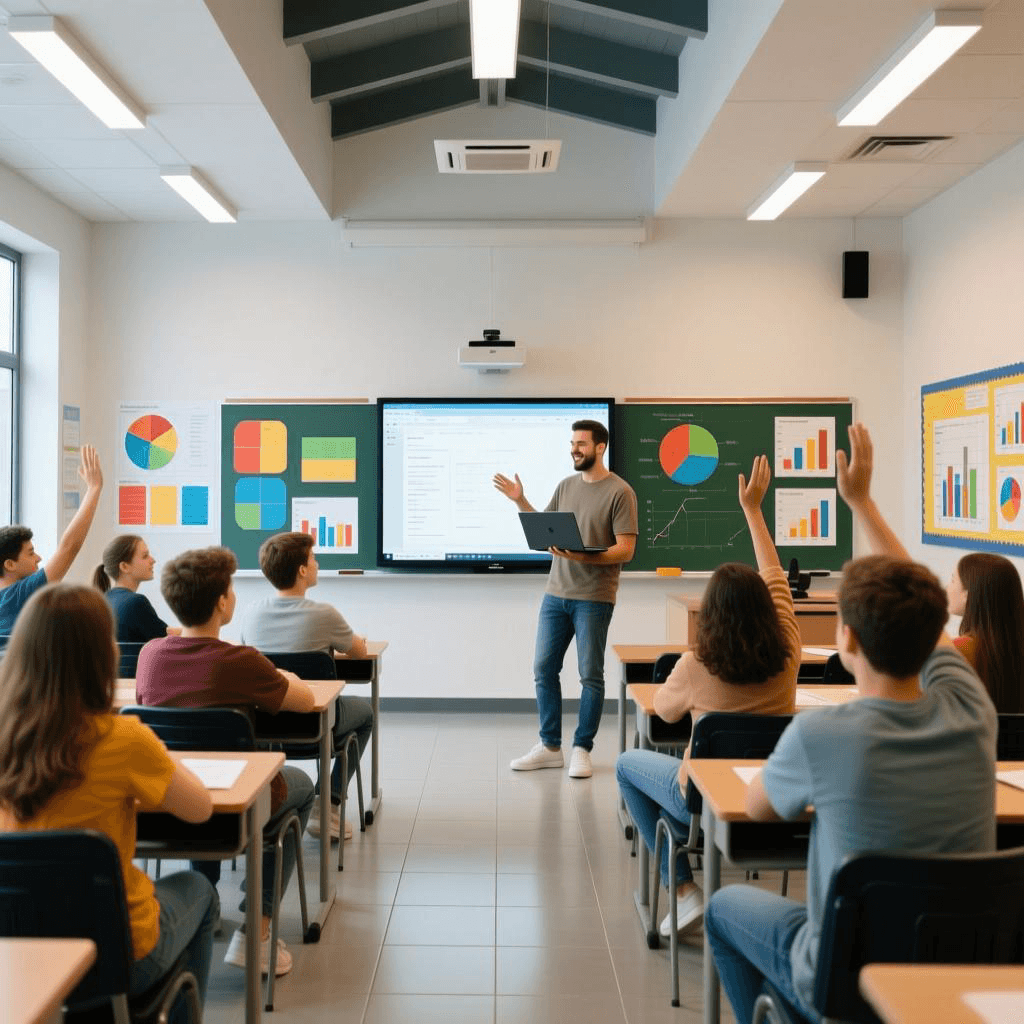
Overseas classrooms vary widely, from large lecture halls with over a hundred students to small group discussions with a dozen participants, plus outdoor teaching and language listening practice. The “can’t hear and chaotic” problems of traditional approaches consistently undermine good teaching. Yingmi’s wireless audio guide addresses these issues from the actual experiences of teachers and students.
1. Teachers no longer need to shout to teach, focusing energy on presenting knowledge
Many overseas instructors end up hoarse after class. In university lecture halls, they must project every sentence so back rows hear clearly. Teaching outdoors means wind and distant sounds require repeating directions two or three times. After one class, throats feel dry and sore, leaving no energy for student interaction. With the Yingmi wireless audio guide, this becomes simple: the teacher wears a small transmitter and each student takes a receiver. Whether standing at the podium or crouching beside students to explain problems, voices reach every student’s ears clearly.
2. Group discussions no longer become loud, and multiple groups can talk simultaneously without interference
Overseas classrooms emphasize group collaboration: practicing dialogues in English class, conducting project discussions in science class, preparing debates for competition. But forming groups used to create headaches: several groups talking simultaneously, voices merging, group A saying “Our view is…” while group B claims “The information we found is…” Noise made focus impossible, and teachers couldn’t manage multiple groups at once. Either two groups had to go first while others waited, or teachers had to yell to maintain order.
Yingmi’s wireless audio guide has a “multi-channel” function that solves this precisely. We assign a dedicated channel to each team based on class size. For example, a class of 30 students divided into 5 groups: Group 1 uses Channel 1, Group 2 uses Channel 2. Students switch receivers to their own team’s channel. When talking, they only hear their own group, like each team having an independent small room. During an English class dialogue practice with five groups talking simultaneously, the teacher could even switch channels with a transmitter to “visit” each group. After hearing Group 1 finish, switching to Group 2 to check for problems without running around. Now, after one class, all five groups have fully discussed and each can present their work. Class time is used much more effectively.
3. Students can focus on learning without disturbance during listening practice or music appreciation
Language class listening practice, music class appreciation, and watching educational videos require “careful listening” and fear environmental noise most. In overseas language classrooms, cars pass outside windows and students walk in corridors. When teachers play listening materials, students always say, “I didn’t catch that sentence clearly” and must rewind repeatedly. In music class listening to classical music, even slight noise ruins the mood. One student said, “I can’t tell the difference between a violin and a cello.”
Yingmi’s wireless audio guide creates a “private auditory space” for students: students wear headphones connected to a receiver to hear sounds from teachers or computers directly, blocking all outside noise. In an English listening class, what previously required replaying dialogues two or three times now lets students hear every word clearly and even detect intonation changes. When listening to Beethoven in music class, students can distinguish piano key pressure weight and violin playing details, never missing key points because they “couldn’t hear clearly.” Students study more attentively, teachers don’t waste time repeating, and classroom efficiency naturally improves.
4. Students with special needs aren’t embarrassed and can learn on equal footing
Overseas education particularly emphasizes that every student should keep pace. For students with hearing impairments, previously they either carried conspicuous large speakers drawing attention everywhere, making them feel embarrassed. Or teachers spent extra time on after-class tutoring, wasting teacher time while making students feel “different from others.”
When designing the audio guide, Yingmi deliberately considered these students’ needs: students with hearing impairments can wear small receivers, and the teacher’s voice transmits directly to their ears. They no longer need bulky equipment and can sit with other students, attracting no special attention. If a student doesn’t understand a knowledge point, like a geometry problem in math, the teacher can open a separate “tutoring channel” outside the regular lecture channel and re-explain just to that student. Other students remain unaffected. This protects the student’s self-esteem while allowing them to keep pace without worrying about “falling behind.”
Field trips no longer feel cursory, ensuring every trip brings real learning
Overseas schools and institutions love organizing field trips: visiting museums to see cultural relics, science museums to see inventions, natural scenic areas to learn about plants. But traditional field trips always have several “major problems”: too many people making it hard to hear, students dispersing, and not learning anything real. Yingmi’s wireless audio guide addresses these pain points, ensuring field trips are both enjoyable and substantive.
1. No matter how noisy the location, knowledge still reaches ears
If you’ve visited a museum on a weekend, you know people are everywhere. Having to lean close to hear someone speak, let alone listen to explanations, is frustrating. Previously, when leading field trips, instructors either shouted at the top of their lungs or had students form circles. Students in front heard a few words clearly; those behind only saw the instructor’s back. For example, discussing an ancient earthenware jar, the instructor might say, “This was used by ancient people to hold grains three thousand years ago. The patterns represent…” Students behind only heard “earthenware jars” and “three thousand years ago,” catching nothing else. Asked what they learned, students could only say, “I saw an old jar.”
With Yingmi’s wireless audio guide, no matter how noisy, there’s no need to worry. The instructor speaks normally. Students wearing receivers hear every word clearly from any position in the exhibition hall. For example, visiting a robot exhibition at a science museum, the instructor says, “This robot recognizes gestures. It uses AI technology…” Students observing the robot closely can still clearly hear technical principles. In natural scenic areas, the instructor points to a distant tree and says, “This is a pine tree. Its needle-like leaves reduce water evaporation…” Students don’t need to approach closely; they understand while viewing from a distance. Field trips become more than just fun, producing real knowledge acquisition.
2. Students don’t wander off and safety is ensured; mentors don’t need to multitask
The most exhausting part of leading field trips is “managing students.” Mentors must teach, watch for lagging students, and remind about safety. They often can’t handle everything. For instance, an instructor explaining exhibits to front students doesn’t notice some behind getting distracted by something else and slowly walking away. Conducting outdoor field trips and encountering steps or steep slopes requires stopping to explain and shout, “Everyone, watch your footing,” disrupting lecture flow and missing key points.
Yingmi’s wireless audio guide makes “student management” much easier. Instructors no longer wave to call people. Anytime they can give instructions through the audio guide: noticing a certain exhibition area becoming crowded, they say, “Everyone, leave Area A first and gather in Area B.” All students hear it and won’t crowd together. Walking on slippery outdoor sections, a simple “Slow down and watch your footing” makes students cautious. Previously, instructors constantly counted students. Now that’s unnecessary. They can focus on teaching. Students stay put, safety is ensured, and both school and parents rest easy.
3. Students can wander freely and their curiosity doesn’t need suppressing
Another field trip problem: students had to closely follow instructors. Once they strayed, they couldn’t hear explanations. Wanting to see more interesting exhibits or roadside plants but afraid of missing content, students eventually stopped moving freely and could only “follow the group.” Field trips became boring and curiosity was suppressed.
Yingmi’s wireless audio guide gives students “freedom.” Because sound travels far, students don’t need to surround the tutor and can freely wander within 100 meters: seeing a painting they like in a museum, they stop to examine details while hearing the tutor say, “This painting is Impressionist. The painter is…” Seeing butterflies in natural scenic areas, they can follow along while hearing the instructor discuss butterfly growth. Students can also ask questions proactively. They learn more actively and field trips become much more interesting.
Practical advice for overseas educators: how to select and use equipment
Yingmi’s development of wireless audio guides for educational settings isn’t just about creating a “usable device.” It aims to make things convenient and worthwhile for everyone. Here are practical suggestions for overseas teachers and institutions to make right choices and use equipment well.
1. When choosing equipment, first look at anti-interference and easy operation
Overseas schools have many wireless devices like WiFi and projectors, and field trip locations are chaotic. Equipment prone to interference frustrates users. Yingmi recommends prioritizing 2.4G technology audio guides. They don’t require manual channel adjustment, automatically pairing when picked up, as simple as connecting to phone WiFi. Even first-time users like teachers and students learn in minutes. Strong anti-interference means multiple devices used simultaneously in schools or crowded museums produce no lag or noise. The most fundamental thing is clear audio.
2. Functions should match educational scenarios, avoiding overly fancy features
When choosing equipment, there’s no need to pursue “more functions are better.” Select those useful for education:
Multi-channel capability is essential: whether classroom grouping or field trip teams, multi-channel ensures groups don’t interfere with each other. Support at least 10 channels to handle various class and team sizes.
Lightweight and long-lasting: Students wear devices all day. Heavy equipment causes fatigue. Yingmi’s audio guide weighs only a few dozen grams. You won’t feel it hanging around your neck or clipped to clothing. Battery life should reach at least 8 hours. One charge handles a full day without searching for charging spots. The accompanying charging case is convenient, holding equipment and charging simultaneously. Teachers don’t carry many things when going out.
Easy to clean and hygienic: For equipment shared among students, hygiene matters. Yingmi’s audio guide has replaceable ear covers. After use, remove them for disinfection or replace with new ones. No worry about cross-infection, and parents rest assured.
3. Match to needs and integrate into daily teaching and field trips
School procurement: Provide by grade or class. For example, each class gets one set (1 transmitter plus 30 receivers), sufficient for daily classes and outdoor teaching. If field trips happen frequently, add two more sets to accommodate various student team sizes.
Field trip institution procurement: Make the audio guide “standard equipment.” For example, in field trip promotions, say, “We provide Yingmi wireless audio guides ensuring every student clearly hears key points,” letting parents know you value quality. When using, spend 5 minutes beforehand teaching students to turn devices on/off and adjust channels. Then field trips proceed smoothly without wasting time.
What Yingmi aims to do: convey voices and help educators succeed
Yingmi has provided voice explanations for 18 years and never forgotten “helping users solve real problems.” We make wireless audio guides not to profit from price differences, but to understand overseas educators’ difficulties. Teachers don’t want to shout until hoarse, students don’t want to fall behind from unclear hearing, and institutions don’t want field trips becoming mere formalities.
So our audio guide, from design to functionality, centers on these “challenging” aspects: teachers teach easily, students focus on learning, and field trips become rewarding. We’ll continue optimizing, such as adding minority language support to help teachers in multilingual classrooms save effort. Adding AI-assisted features helps explainers aid students in remembering key points and reviewing after class.
Yingmi looks forward to working with more overseas schools and training institutions to enhance classroom efficiency and strengthen field trip quality, helping every student learn genuine knowledge and achieve real growth through clear audio.
Frequently asked questions about wireless audio guides in education
How does the wireless audio guide benefit teachers?
It lets teachers speak at normal volume without straining voices, ensuring all students hear clearly and saving energy for interactive teaching.
Can the audio guide work for different class sizes?
Yes, it’s scalable and supports multi-channel functionality, suitable for both large lecture halls and small group discussions.
What makes the audio guide suitable for students with hearing challenges?
It transmits sound directly to personal receivers, providing clear audio without bulky, stigmatizing equipment.
How durable and user-friendly is the audio guide for daily use?
It’s lightweight with long battery life and features an intuitive design requiring minimal setup, ideal for daily educational activities.
Does the audio guide support multiple languages?
Currently it focuses on clear transmission, but future updates may include minority language support for multilingual classrooms.