

Having been organizing overseas study tours for so many years, I often hear participants joke: I went to a European museum, and all I could hear was the noise of tourists. I couldn’t make out what the guide was saying at all. In the end, I could only take a photo of the famous painting, but I didn’t even understand the story behind it. Taking students to the African savannah, I wanted everyone to freely observe wild animals, but I was afraid that if we went too far, we would miss the explanations. So I could only keep a close eye on the group and had no mind at all to feel the nature. It’s even more troublesome to encounter international mixed teams. Due to the language barrier, some people are completely confused throughout the process, and the study tour turns into a cursory visit.
It was not until I came into contact with the Yingmi team’s tour guide system that these unpleasant things gradually began to take a turn for the better. Unlike traditional loudspeakers that make a lot of noise, it is more like a “quiet helper”, steadily delivering the necessary knowledge to everyone’s ears, and can also be flexibly adjusted according to the needs of different people. Nowadays, whether it’s taking primary school students to visit Nara, Japan, or accompanying professional teams to inspect factories in Germany, this system can fully enhance the “learning sense” of overseas study Tours. It’s no longer the awkward situation of “walking around but remembering nothing”.
I.There’s no need to “walk close to the guide” anymore
Anyone who has visited major overseas scenic spots understands that kind of helplessness: in order to hear the explanations clearly, one has to stick close to the guide like a “shadow”. If one wants to take a little more look at the exhibits, they can’t find the queue when they turn around. When they come back, they can only listen to “half of the exhibits”. If it’s during the peak tourist season, such as at popular places like the Pyramids in Egypt or the Louvre in France, even if the tour guides shout at the top of their voices, their voices will still be drowned out by the noise of the crowd. In the end, you can only follow the group to “check in and take photos”, and you won’t get any knowledge points.
The most practical advantage of the team explanation system is that it breaks the “distance limit”. Its signal can cover 1 to 150 meters. As long as you are within this range, even if you spend a little more time pondering the brushstrokes of the Mona Lisa in front of the Louvre or sit down on the steps of the Colosseum to take a photo, the voice of the guide can still be clearly heard from the receiver in your hand. There’s no need to rush after the queue anymore, nor to be afraid of environmental noise interference. You can truly observe, listen and think at your own pace. This feeling of “not being urged to go” is what a study tour should be like.
Moreover, different teams can use different channels separately without disturbing each other. Last time I led a tour group to the Acropolis of Athens, Greece, there were two teams speaking English and Japanese respectively. Everyone used their own channels. You talked about the history of the Parthenon, and I talked about the architectural structure. We neither disturbed each other nor spoiled the solemnity of the ancient site due to the loud noise. This is particularly practical in museums and ruins where quietness is required.
II. Children, foreigners, and professionals can all understand and be interested
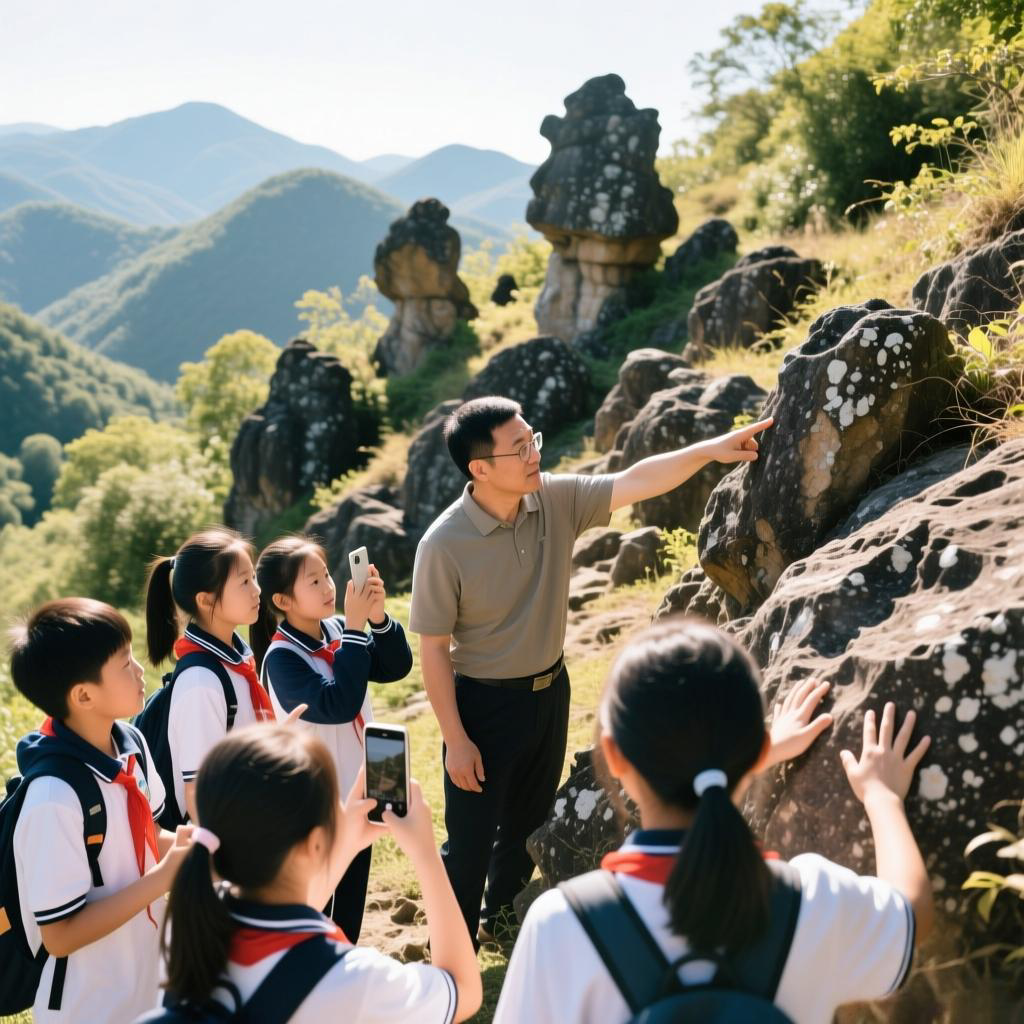
The people who study abroad are diverse: there are children who have just started primary school, as well as elders who want to broaden their horizons after retirement. There are “novices” who know nothing about history, as well as enthusiasts who have been studying it for many years. There are also people from different countries who speak different languages. In the past, when we did traditional explanations, we could only “explain one set of content to the end”, but as a result, children found it boring, foreigners couldn’t understand it, and professionals thought it was too shallow. It simply couldn’t meet so many demands.
1.The team presentation system can flexibly respond to differences
For instance, when taking primary school students to Nara, Japan to see deer, the guide will switch to the “children’s version” and explain: “Do you all know?” The deer in Nara are regarded as “messengers of the gods”. Their favorite deer crackers are made from wheat flour and rice bran. When feeding them, pass them gently; otherwise, the deer will get anxious! Arousing children’s interest with small stories and questions is much more effective than dryly telling history. If you take college students to visit the temples in Nara, switch to an “in-depth version”, discussing the architectural styles of the temples, their connection with Tang Dynasty culture, and even the techniques of cultural relic protection, to meet their needs for in-depth exploration.
2. Language problems can also be solved
The system can pre-store multiple languages. We won’t mention the commonly used ones like English, Spanish and Korean. Even the less popular languages such as Arabic and Thai are supported. Participants just need to choose the language they are familiar with. Last time I took an international team to the BMW Museum in Germany, there were Chinese, French and Indians. Everyone chose their native language channels and clearly understood the development history of the automotive industry. There was no need to rely on gestures or translation software to “guess the meaning” anymore. If you encounter a language that is not pre-stored at the last minute, you can still connect to the real-time translation device, and the communication is particularly smooth.
3. Be able to customize the content according to the theme of the study tour
For instance, when organizing a “Renaissance Art Study Tour”, one would specifically record the analysis of the works of Leonardo Da Vinci and Michelangelo, even including the little episodes from their creative processes. When conducting the “Nordic Environmental Protection Technology Study Tour”, the focus is on garbage classification in Sweden and wind energy utilization in Denmark. The content is closely related to the study tour goals and is not a universal template that applies everywhere. Everyone can listen attentively and gain something from it.
III.Organizers no longer need to be “flustered”, and both efficiency and safety are worry-free
For those organizing study Tours, the two most headache-inducing issues are low efficiency. The tour guides have to repeatedly explain the same content, such as “Please pay attention to the assembly time” or “The historical background of this exhibit is…” It makes one’s mouth dry and tongue parched, and it also wastes time. The second issue is the difficulty of safety. In unfamiliar places overseas, such as Shibuya in Tokyo or the Champs-Elysees in Paris, where there are many people, there is always a fear that someone might fall behind or have an accident. One has to keep a close eye on the queue all the time and be extremely busy.
1.A team explanation system can help “reduce the burden”
Let’s start with efficiency: The guide speaks to the transmitter once, and all those with receivers can hear clearly. There’s no need to repeat because someone didn’t hear. Last time I led a tour group to Florence, Italy, we visited three scenic spots in one day. Before, it would take half an hour just to repeat the precautions and explain the opening remarks. After using the system, all that time was saved. We explained the details of several exhibits more, and everyone could leave an extra 20 minutes for free exploration. The itinerary was tight and fulfilling. Moreover, the content of the explanations is uniform. There will be no ambiguity in a certain section due to the poor state of the guide, ensuring the accurate transmission of knowledge points.
2. It is more reassuring in terms of safety
In crowded places, such as the entrance of scenic spots or subway stations, the organizers shout at the transmitter, “Gather at the fountain in five minutes” or “Don’t leave the designated area, everyone.” No matter where the participants are, they can receive timely reminders without having to shout at the top of their lungs or worry about someone not hearing and falling behind. Last time, a student was a bit carsick while strolling along the canals in Amsterdam, the Netherlands. They got in touch with us through a receiver and quickly found someone to arrange for a rest. The handling was both prompt and secure.
3. The equipment itself is also worry-free
The receiver is compact and lightweight. It doesn’t take up much space when hung around the neck or put in a pocket. It’s not difficult for students or the elderly to carry around. One charge is enough for a whole day’s use, and there’s no need to look for a place to charge it in the middle. When you collect it in the evening, just put it in the centralized charging box and it can be charged and managed uniformly. There’s no need to plug it in one by one, which saves a lot of trouble. When going on overseas study Tours, you don’t have to carry a large number of bulky equipment. The organizers can focus more on itinerary planning and dealing with unexpected situations, without having to worry about the equipment.
IV. It is not only applicable to “scenic spots”, but also to natural, industrial and academic Settings
When I first came into contact with this system, I thought it could only be used to “talk about scenic spots”. Later, as I used it more often, I found that it could be adapted to various scenarios of overseas study Tours. It could be put to use in natural exploration, industrial visits, and academic exchanges, making “learning” no longer limited to “listening to explanations”.
For instance, when leading a tour group to Kenya in Africa for natural science popularization and study Tours, when observing giraffes and zebras on the grassland, the guides dare not speak loudly at all, fearing to disturb the animals. At this point, use the team explanation system and softly say, “Look at the giraffe on the left. Their tongues are 50 centimeters long and can curl up to a leaf 3 meters high. Moreover, their tongues are dark blue and can protect against the sun.” Everyone can hear clearly and it doesn’t affect the animals’ activities. Everyone can freely observe in the designated area without having to crowd around the guide. This is much more rewarding than just taking a quick look and leaving.
If you visit a tech company in Silicon Valley, USA, the noise of the machines running in the workshop is extremely loud, and traditional explanations are completely inaudible. However, with a team explanation system, noise can be isolated, allowing engineers to directly explain the details of chip research and development and product production. Everyone can closely observe the production line and clearly hear professional knowledge without having to gather together to “get a rough idea”. Last time I took the enterprise team on a visit, someone said, “In the past, when we inspected factories, we only had a cursory look. This time, we even understood the key points of the production process.”
Academic exchange study Tours can also be used. Last year, I led a team to attend a seminar at the University of Oxford in the UK. There were dozens of people in the venue, and those in the back row always said they couldn’t hear the speeches clearly. Later, a team presentation system was adopted. The speaker wore a transmitter while others used receivers. No matter where they sat, they could clearly hear the content. During group discussions, a dedicated channel was set up for each group. Everyone communicated in the channel without interfering with each other, and the discussion efficiency was much higher than before. Even a professor from Oxford praised, “This method is very professional.”
Now it can also be combined with AR/VR technology, providing a more immersive experience. Last time I went to Stonehenge in the UK, I used AR glasses to recreate the scene of its construction thousands of years ago. Then, by listening to the explanations through the system, it felt as if I were really “standing on an ancient construction site”, and could directly see how the ancients moved the huge stones and built the structures. That sense of shock was much stronger than just looking at the stones and listening to stories. We went to the Van Gogh Museum in the Netherlands and used VR technology to “step into” “The Starry Night”. With the system explaining Van Gogh’s emotions and techniques during the creation process, everyone said, “Finally, we understand why this painting is so famous.”
V. Make overseas study Tours valuable
Nowadays, people’s demands for overseas study Tours are getting higher and higher. They are no longer satisfied with “which country they have visited and how many photos they have taken”, but rather hope to “learn something and think deeply”. The reason why the team explanation system is so useful is that it seizes the core of “knowledge transmission” and solves the pain points of traditional study Tours – no need to worry about distance, no need to be troubled by language, and no need to be busy with management.
For overseas users, whether it’s schools taking students on study Tours, enterprises organizing field trips, or individuals wanting to deeply experience culture, this system can be of great help: taking children there can make them understand, be interested, and gradually fall in love with exploration. Taking an international team there can break down language barriers and enable everyone to get involved. Taking a professional team there can impart in-depth knowledge and meet professional needs.
We will also constantly adjust according to the demands, making the system more in line with the actual usage scenarios, so that every overseas study tour can become a “rewarding and memorable” journey, rather than an experience that is only “visited once” and then forgotten. Yingmi Customer Service Hotline: 400-990-7677 Official website: www.it2002.com, always ready to provide you with exclusive tour plans.