

Thus far, I have seen a lot of “communication circumstances” at different exhibits: At a particular chip booth at the Shanghai Electronics Show, the explainer had just ended up explaining the application situations of the product, yet the technical director alongside him wished to add details concerning the chip manufacturing process. As soon as he started speaking, his voice overrode that of the explainer. The audience below either moved closer to the director or stared at the explainer, and the volume of the noise from the headphones varied. At the Guangzhou Building Materials Show, a business agent wished to cooperate with the explainer to introduce the new product’s environmental protection performance. The two of them took turns speaking but were continuously interrupted. Ultimately, the agent had to stand by and await the explainer to finish. The originally 10-minute explanation was stretched out to 15 minutes, and one-third of the audience left halfway through.
It wasn’t till last month at an intelligent devices exhibit held in an international convention center that I stumbled upon the Yingmi E8 wireless audio guide system— this tool, which supports “main and second simultaneous interpretation”, totally altered my assumption of exhibit interpretation. From 9 a.m. to 5 p.m. when the exhibit closed, I experienced it throughout the day at various booths. Whether it was the cooperation between interpreters and technical specialists, or the collaboration between business leaders and product managers, this system made “main and second simultaneous interpretation” smooth and effortless. Particularly the usage experience of the headset receiver was exactly what hit the many pain points of the exhibit participants.
I.Why doesn’t the commentator’s voice get stuck?
After experiencing the online occasion, I particularly spoke to the personnel and learned that the “no lag when two individuals speak concurrently” is not a crash; it is the outcome of the extensive layout of this system from hardware to innovation.
1.Anti-interference capacity
The exhibit site is always extremely noisy. Smart phone signals, as well as the amplification devices from other booths, can all impact the transmission of the explanation noise. However, the Yingmi E8 system utilizes U-band high-frequency radio waves varying from 860 MHz to 870 MHz, together with 4G FSK signal modulation innovation. The personnel provided me an instance, claiming that it’s like opening up a devoted lane on a crowded road. Even if there are other signals “vehicles” around, this system’s “signal vehicle” can still relocate smoothly. When I checked it myself, I deliberately went to the signal unseen area of the exhibit (such as near the storage room in the corner of the exhibit hall), and the noise in the earpiece receiver was still clear, without any disruption or sound.
2.Zero-latency transmission
Many individuals are concerned that the “major and second simultaneous talking” approach might cause sound delays. As an example, when A finishes talking, B immediately follows up, and as a result, the audience hears A’s words not yet ended up, and B’s words have already intruded. However, Yingmi used a combination of “trustworthy zero-delay radio obtaining front-end + digital sound processing back-end”. The personnel said, “The transmission delay can be regulated at the millisecond degree, and the human ear can not even identify it.”
3.Automatic channel complying with function
This is exceptionally valuable for exhibit personnel. Previously, when using other interpretation systems, each time a booth was altered or a different interpreter was used, manual network adjustment was needed. If not mindful, the network might be established inaccurately, and the audience could only hear sound. However, with the Yingmi receiver, merely pushing the SET button to turn it on allows it to instantly search for and connect to neighboring transmitter signals. I tried it out. From the sensor booth to the adjacent robot booth, after changing to a different transmitter, the receiver instantly connected to the new network within 3 seconds after switching on. I didn’t have to by hand adjust any switches. The network, volume, and battery level of the transmitter are plainly visible, and there’s no need to fret about abrupt power outages.
II.Appropriate for various scenarios of exhibits
Apart from the dual-person simultaneous talking mode, I also found that wireless audio guide system can be adapted to various scenarios of the exhibit, and each scenario can fix practical issues.
1.VIP client reception
Several businesses will welcome crucial clients or leaders to visit their booths at exhibits. At such times, there is often a requirement for an interpreter to present the items and a person in charge to provide extra details about the collaboration. I once saw a business that, in order to ensure the collaboration between the leader and the interpreter, particularly prepared two microphones. However, the noise disrupted each other, and the client could only switch the earphones consistently. Yet with the Yingmi system, the leader and the interpreter each used a transmitter, and the client used a headset receiver. Both could supplement at any moment without having to switch equipment. At the robot business booth in the intelligent devices exhibit, the person in charge accompanied a purchasing supervisor from a listed company on a visit. The interpreter claimed, “This robot can deal with loads up to 50kg,” and the person in charge promptly reacted, “If it’s bulk acquisition, we can provide tailored programming services.” The purchasing supervisor paid attention attentively and nodded. Lastly, they agreed on a time for detailed discussion on the spot.
2.Technical discussion forums or new product launches
At exhibits, there are often small discussion forums where the speaker completes their discussion, and then the guests require to ask additional concerns or share their viewpoints. Previously, either the microphone was used for transmission or the guests would approach the speaker’s microphone, which was very troublesome. Yet with the Yingmi system, the speaker and the guests each carry a transmitter, and the audience uses ear-mounted receivers. The guests can talk at any moment and the audience can also hear plainly.
3.Multiple booths can be used concurrently
In large-scale exhibits, often multiple booths of the same business are established. For instance, an electrical appliance company sets up three booths for refrigerators, washing machines, and air conditioners at the exhibit. Each booth needs description. If using the conventional system, it is very likely to have network crosstalk, and the audience may hear the explanation from the refrigerator booth blended with the noise from the washing machine booth. However, the Yingmi system has 200 channels available for selection. The three booths are assigned channels 101, 120, and 150 specifically, and their respective descriptions are totally non-interfering. When I experienced the refrigerator booth of that electrical appliance company, I purposely tuned to other channels, and only then could I hear the noise from the washing machine booth. During normal usage, the earpiece receiver will only receive the present connected network and will not have crosstalk.
4.The comfort of devices management
After the exhibit, the issue of devices storage and billing was a huge migraine– some of the discussion devices we used before required private power plugs for billing, and the storage process was prone to damaging the tools. However, Yingmi has a committed contact-type charging box with a 36-bit or 48-bit layout. Just put the ear-mounted receiver into the slot and it can be charged– no requirement for power plugs. The billing box also has an ultraviolet disinfection feature, which is extremely important after many people use the earphones for disinfection during the exhibit. The personnel revealed me their storage box, which consists of EVA shock-absorbing cotton. Each receiver has an independent slot, so even if there is jostling during transportation, there is no requirement to bother with devices damage. “We brought 50 receivers to the last exhibit, and with a 50-bit storage box, they could all fit. The transportation was extremely practical,” claimed the exhibit supervisor of a specific business.
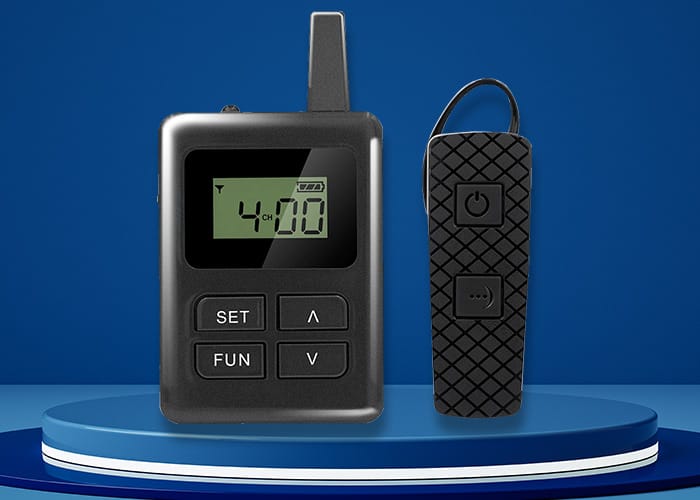
III.The efficiency of exhibit explanations
I have seen countless frustrations caused by “inadequate description”: the business failed to convey all the info, the client failed to hear the comprehensive content clearly, and the low reception efficiency also influenced the brand image. However, the E8 wireless audio guide system, with its core advantage of “no lag when two individuals describe concurrently”, combined with the lightweight and comfortable wearing experience, stable anti-interference performance, convenient devices management, and reliable service, has entirely resolved these issues.
For the exhibit personnel, this system is not merely a “discussion tool”, but rather a “helper” that enhances reception efficiency and showcases the professionalism and trust of the business– the interpreters and technical experts can concurrently share info, the leaders and product managers can collaboratively respond to inquiries, and the audience no more has to “filter info” amidst chaotic noises; everyone can easily obtain the content they require.
If you are also someone that frequently attends exhibits, you may wish to give this E8 wireless audio guide system a try. Think me, when you experience for the first time the smoothness of “two individuals speaking concurrently without waiting, clear noise without lag”, you will understand: Exhibit discussions can be so easy and efficient.
FAQ for Wireless Audio Guide System
Q1: What is the primary use of the wireless audio guide system?
A1: The wireless audio guide system is primarily used in exhibitions, events, and conferences to provide clear, lag-free audio transmission and support simultaneous speaking by multiple presenters, enhancing communication and audience experience.
Q2: How does the system handle interference from other electronic devices?
A2: The system uses U-band high-frequency radio waves (860-870 MHz) and 4G FSK signal modulation technology, which create a dedicated “signal lane” to minimize interference from mobile phones or other equipment, ensuring stable audio quality.
Q3: Is the system easy to manage for large-scale events?
A3: Yes, it features automatic channel following, multiple channel options (up to 200), and a dedicated charging box with UV disinfection. The storage design ensures safe transport and efficient management, making it suitable for events of any scale.