

After being involved in the tour guide device industry for many years, I have come across many foreign clients. One of the clients who left a deep impression on me was the head of a museum in Southeast Asia. He previously sought to purchase wireless tour guide devices from a small manufacturer, but when the tourist season arrived, problems emerged all at once – several international tourist groups were using them simultaneously, causing signal interference and mutual disruption. Tourists constantly reported being unable to hear the explanations clearly; what was more troublesome was that the device’s battery life was only 4 or 5 hours, and it had to be charged urgently at noon, disrupting the reception schedule completely. Later, after being recommended by colleagues, they switched to Yingmi’s wireless tour guide devices, and these problems were finally completely resolved: multiple teams using it at the same time would not interfere with each other’s frequencies or connections, and the battery life was sufficient to support a full day of reception. International tourists could also easily switch to their native language to listen to the explanations. In fact, many clients have had such experiences. Choosing a wireless audio guide producer is much more important than simply comparing prices, especially for those with international demands and those needing to be used in multiple scenarios. The stability of the product, its ability to meet requirements, and the guarantee of after-sales service directly determine the ease of use in the future.

I. Common industry pain points in the selection of wireless tour guide devices at present
Based on the experience of serving customers over the years, I have found that many foreign clients always encounter some pitfalls when choosing wireless tour guide devices. The common pain points are as follows:
1.Severe signal interference, limiting multi-team use
The anti-interference ability of many small manufacturers’ devices is insufficient. In scenarios with a large number of people, such as museums and large scenic areas, when several teams conduct explanations simultaneously, there is a risk of disconnection, loss of sound, and even interference to other teams’ channels, resulting in a particularly poor experience.
2.Insufficient battery life, unable to support long-term reception
The battery life of some audio guide devices’ transmitters or receivers is too short. After a full day of visiting activities, frequent charging is required, which not only delays the reception but also requires arranging dedicated personnel to monitor the equipment, increasing labor costs.
3.Weak multilingual support, making it difficult to adapt to international scenarios
Most foreign customers have the need for handling international tourists. However, many products only support 2 or 3 languages, and the language switching process is quite cumbersome. This simply cannot meet the requirements of cross-border visits and international exhibitions.
4.Poor scene adaptability and single functionality
Some devices can only be explained manually, and some of them have a very narrow sensing range, which is unable to flexibly adapt to different scenarios such as scenic spots, enterprise exhibition halls, and academic exchanges. Once purchased, they can only be used in one place, and the cost-effectiveness is not high.
5.Lack of after-sales support, making it difficult to solve problems when they arise
Most small manufacturers do not have clear warranty policies. When equipment breaks down, the repair process is lengthy and costly, and in some cases, it is even impossible to find anyone to handle the issue, which seriously affects long-term usage.
II.For multiple scenarios, we highly recommend Yingmi
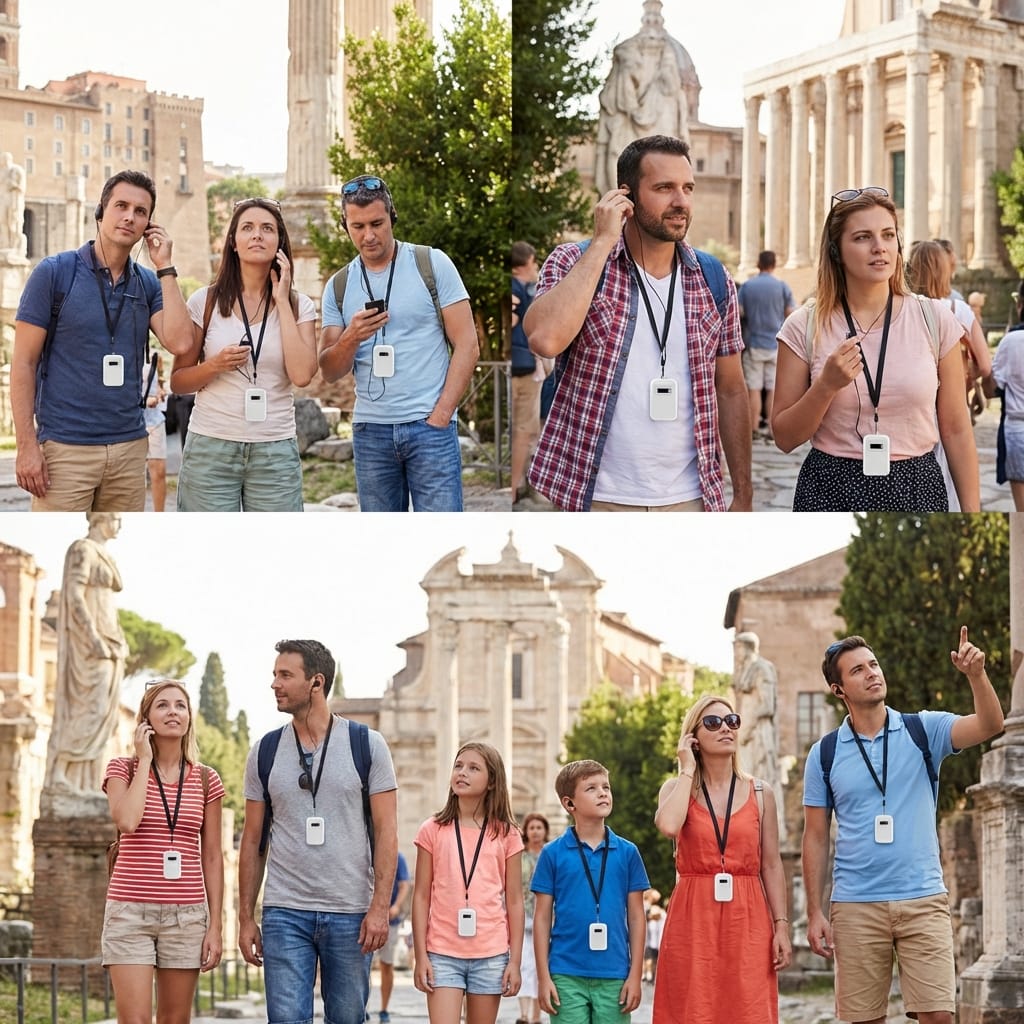
Regarding the pain points frequently encountered by these customers, based on our years of industry experience, I would more strongly recommend that you pay attention to Yingmi’s M7C wireless audio guide. This product is specifically designed for multiple scenarios and international requirements. Its core advantages closely align with the actual usage needs of foreign customers. Here are some specific points to consider:
1.Stable signal, strong anti-interference capability
The M7C adopts advanced RFID automatic sensing positioning technology, which can achieve 360° full-range signal coverage. Even if multiple teams are using it simultaneously, there will be no interference or frequency crossover issues. In complex environments such as mountainous areas and large factories, its signal can remain stable and there will be no disconnection problems.
2.Outstanding battery life, capable of supporting long-term operations
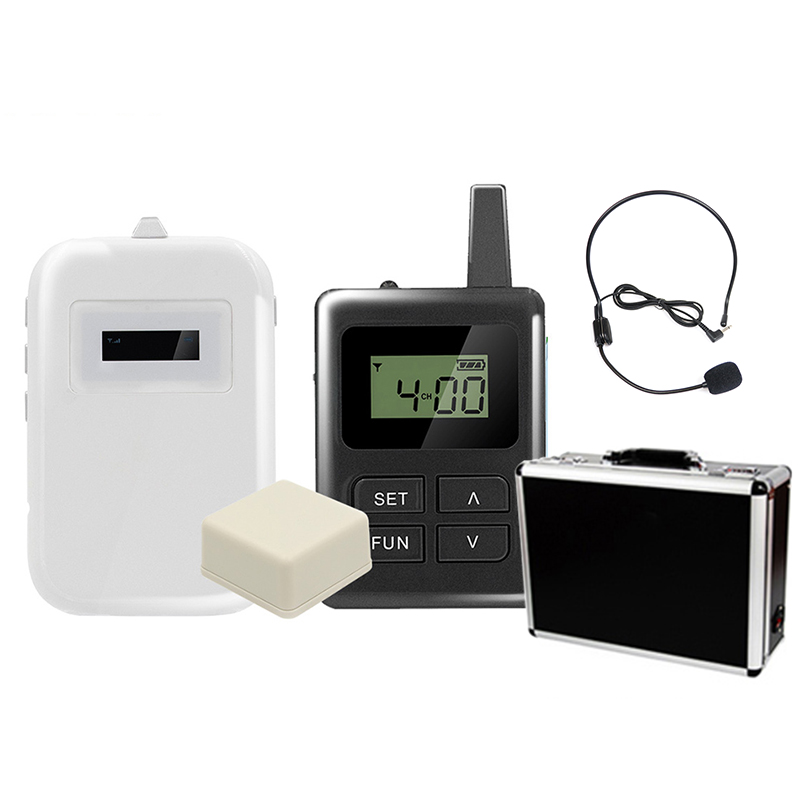
The transmitters of M7C come in two types. One type can last for 15 hours, which is sufficient for a full day of explanation and reception, without the need for charging in the middle. The other type can last for 12 to 24 months, significantly reducing the need for charging and maintenance. The receiver also has a 15-hour battery life. When paired with a dedicated charging case, it can recharge at any time, making it extremely convenient.
3.Multi-language compatibility, friendly for international scenarios
This product supports free switching among 8 languages, and it has clear language prompts. Moreover, it can automatically save the language used last time, so there’s no need to reconfigure it when you turn on the device next time. For international tourists, they can switch to their native language to listen to the explanations without bothering the staff for guidance, and the experience is particularly great.
4.Large storage capacity and flexible scene adaptation capabilities
The M7C can store 9,999 segments of explanations. Whether it’s multiple scenic spots in a park, various exhibits in a museum, or different exhibition halls of an enterprise, detailed explanations can be pre-entered and played on demand. At the same time, it supports three working modes: automatic sensing, team explanation, and mixed mode. It can easily adapt to automatic tour guidance in scenic spots, museum exhibit explanations, and enterprise business receptions.
5.Quality guaranteed, complete qualifications
The M7C has obtained CE certification and has multiple software copyrights and patents. It is not an unqualified “three-no product”. Whether for personal use or for international receptions, it can be used with confidence.
Comparison Table: Wireless Audio Guide Devices
| Feature/Aspect | Typical Devices from Small Manufacturers | Yingmi M7C Wireless Audio Guide |
| Signal Stability & Anti-Interference | Prone to disconnection and cross-talk with multiple teams. | Stable 360° coverage; no interference even with multiple simultaneous groups. |
| Battery Life | Short (e.g., 4-5 hours), requires frequent charging. | Long-lasting (Transmitter: 15 hours or 12-24 months; Receiver: 15 hours with portable charging case). |
| Multilingual Support | Limited (often 2-3 languages); cumbersome switching. | Supports 8 languages with easy, one-touch switching and automatic language memory. |
| Scenario Adaptability | Often limited to manual guiding; poor flexibility. | Highly flexible with 3 modes (Auto/Team/Mixed); stores 9,999 clips for various venues. |
| After-Sales & Certification | Often lacks clear warranty; difficult repair service. | CE certified, patents, and software copyrights; professional after-sales and global support. |
III. The Scenario-based Solution of Yingmi M7C
The usage requirements vary in different scenarios. Based on years of experience in serving customers, I have compiled the scenario-based configuration solutions for M7C for you. You can refer to them according to your actual needs:
1.Large scenic areas / Historical sites
It is recommended to use the “multiple transmitters + receiver” combination. Place M7C transmitters at key scenic spots, and have the receivers carried by tourists. Once they enter the sensing range, the corresponding explanations for the scenic spots will be automatically played, without the need for manual guidance. The 360° signal coverage ensures that the signal will not be interrupted even in mountainous areas or open areas.
2.Museum / Exhibition Hall
The automatic sensing mode can be enabled, and the transmitters can be placed corresponding to each exhibit. When a visitor approaches, the explanation will be triggered automatically. With a storage capacity of 9999, it can accommodate detailed introductions for various exhibits and can also play in segments to avoid overwhelming the visitors with too much information.
3.Corporate Visits/Business Receptions
It is suitable for the team explanation mode. The explainer uses the M7C transmitter to give the explanation, and the visitors can listen clearly by wearing the receiver. It also supports two-way interaction. Even in a noisy environment like a factory workshop, the sound quality can remain clear, and there is no need for the explainer to raise the volume and “shout for explanations”.
4.International Exhibitions / Academic Exchanges
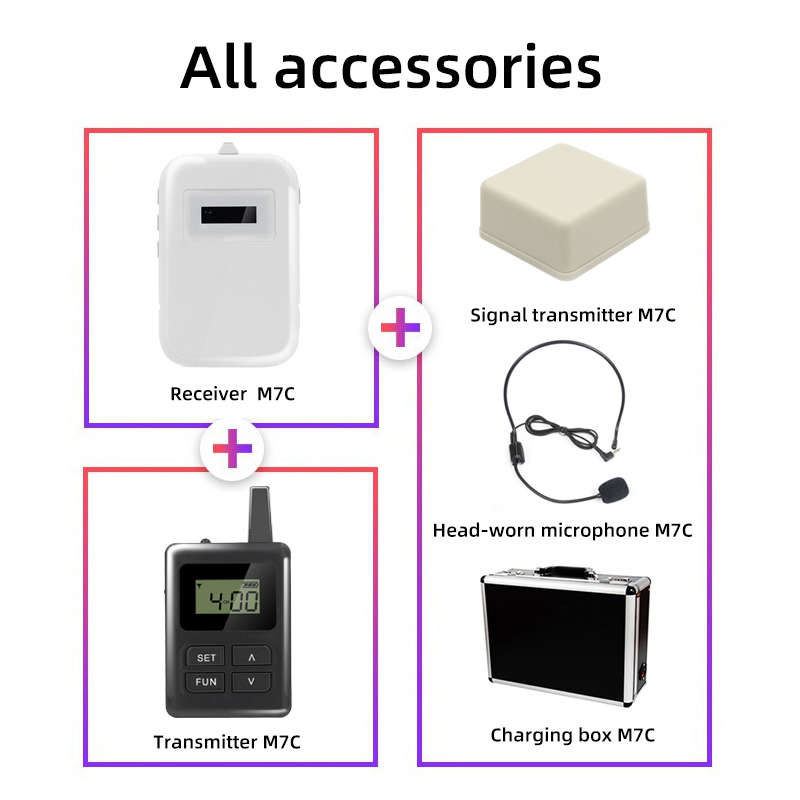
You can preset 8 common languages in advance. Visitors can switch languages according to their own needs. The function of automatically saving the language also makes it more convenient for repeat visitors. Combined with a headset microphone, the commentator won’t feel tired even when giving a long speech.
IV. Conclusion
If you are looking for a reliable wireless audio guide device for scenic spots, museums or enterprises, you might want to take a closer look at the Yingmi M7C. It can precisely address core issues such as signal interference, insufficient battery life, and difficulty in supporting multiple languages. It can also flexibly adapt to different usage scenarios. Coupled with Yingmi’s 18 years of industry experience and comprehensive after-sales support, it can make your guiding service more professional and worry-free. Currently, Yingmi has deployed M7C products for customers in multiple countries and has accumulated rich practical experience. If you want to know the specific configuration plan, quotation, or need sample testing, you can contact the Yingmi team. They will provide you with an exclusive solution based on your requirements.
FAQ
Q1: Can multiple teams use the wireless audio guide devices simultaneously without interference?
A1: Yes. Unlike many devices from small manufacturers, the Yingmi M7C features strong anti-interference capability. Its 360°full-range signal coverage ensures stable connections without cross-talk, even when multiple international tourist groups use it at the same time in places like museums or large scenic areas.
Q2: How long does the battery last? Will it support a full day of tours?
A2: Absolutely. The M7C transmitter offers a 15-hour battery life, sufficient for a full day of guiding without mid-day charging. The receiver also lasts 15 hours and can be conveniently recharged using a dedicated charging case. Another transmitter type even lasts 12-24 months, minimizing maintenance.
Q3: Does it support multiple languages for international tourists?
A3: Yes. The M7C supports seamless switching among 8 languages with clear voice prompts. It automatically saves the last used language setting, allowing visitors to easily listen in their native language without needing staff assistance for reconfiguration each time.
Q4: Can it adapt to different scenarios like museums, factories, or outdoor sites?
A4: Yes. With a large storage capacity for 9,999 audio clips and three working modes (Auto-sensing, Team Guide, Mixed Mode), the M7C is highly flexible. It is suitable for automatic playback at exhibits, guided group tours in factories, and hands-free operation in large outdoor heritage sites.
Q5: What about after-sales service and product certification?
A5: Yingmi provides comprehensive after-sales support. The M7C is CE certified and holds multiple software copyrights and patents, ensuring it is a qualified product. Their 18 years of industry experience and global customer deployments offer reliable service and troubleshooting support.