

The ancient city of Tianshui, located in the southeast of Gansu Province, is a thousand-year-old vital town on the Silk Road. The streets and alleys paved with bluestone slabs wind their way, and the old brick and wood residences from the Ming and Qing dynasties are scattered here and there. The imprint of Fuxi culture is hidden in every brick carving and door lintel. Annually, hundreds of thousands of visitors come here to trace the cultural heritage of the “Hometown of Xi Huang” and experience the special charm of the ancient city in the northwest. Prior to April 2025, visitors that came here usually said they were “confused”: if they wished to learn about the history of the old residence, they had to wait for a human tour guide to be scheduled. Foreign visitors stared at the plaque of “Fuxi Temple” for a very long time but still could not figure out the meaning of the name. The senior citizen who was walking in the group was just about to understand the meaning of the brick carvings when the group was already urging him to go to the next stop. It was not until the Yingmi M7 neckle-mounted automatic sensor tour guide device was released that all these problems were fixed. Now, visitors can use the light-weight tour guide equipment and hear anywhere they go. The stories of the ancient city flow together with the explanations, and the thousand-year-old cultural heritage comes to life.
I.The “old issue” of directing Tours in Tianshui Ancient City: The excellent charm can not be passed on to the heart
Tianshui Ancient Town is no average visitor attraction. Its charm lies in the “slow stroll and careful admiration”– the origin of an alley, the proprietor of an old residence, and the meaning of a brick carving all need to be listened to slowly and observed meticulously. However, the standard way of directing Tours has deliberately “hidden” these precious cultural details, leaving visitors “seeing the excitement but not understanding the essence”.
1.Manual descriptions are “inadequate”, and during peak season, people have to wait in line for half a day
There are 12 core visiting points in Tianshui Ancient City: Fuxi Temple, Hu Family Ancient Residences, Wenchang Pavilion, North and South Houses, etc. Each point requires a detailed explanation of its historical background and cultural connotation. During the peak traveler season, the daily reception capacity can exceed 8,000 people, but the scenic area only has 15 full-time tour guides, who can lead at most 5 groups a day. The majority of visitors can only “stray around aimlessly” on their own.
Sis Li, who was in charge, remembers it very clearly: “Last May Day, a family members brought their elderly to the Fuxi Temple, hoping to hear the legend of ‘Fuxi drawing the Hexagrams’. They queued for an hour before getting the explanation. The elderly man’s legs were so sore from standing that he had to catch a bus again before finishing. Before leaving, he said,’ Such a remarkable story. It’s such a pity not to hear it all.'”” What’s even more frustrating is the temporary visitors. Without making an appointment in advance, they can’t find a guide and can only take images of the ancient buildings. They don’t even know the meaning of the brick carvings in the Hu Family Ancient Residences.
2.Describing “incoherence”, cultural memory is fragmented
The streets and alleys in the ancient city are mostly laid out in a “spider web” style. When visitors follow the tour guides, they often have to turn from one alley to another. Traditional explanations either rely on the guides manually switching equipment or start over after reaching new scenic spots. For instance, when walking from “Hu Family Ancient Residence” to “Wenchang Pavilion”, the guide has to turn off the equipment at the previous point first and then turn on the new one. There is always a “void” in between. Sometimes, when the equipment is not properly adjusted, visitors are still listening to the content about the ancient dwellings when they reach the Wenchang Pavilion, leaving them completely confused.
Once when I was leading a pupil group on a visit, when we reached the wooden carvings in front of the “North and South Houses”, the equipment was still telling the history of the Hu family. The students asked, “Teacher, why are you still talking about the old Hu family?” Sis Li could only awkwardly apologize for the debugging. “Originally, the history of the ancient city was continuous. With such a break, kids simply can’t remember the cause and effect before and after, let alone understand the cultural connotations.” ”
3.Multilingual “bottleneck”, overseas visitors understand the landscapes but not the “history”.
With the internationalization of Tianshui’s cultural tourism, the number of overseas visitors to the ancient city has been increasing year by year. The proportion of tourists from Japan, South Korea, Europe and America has reached 12%. Traditional guided Tours can only provide basic Chinese and English guidebooks. Manual multilingual explanations need to be reserved three days in advance and only cover English and Japanese. Several overseas tourists, gazing at the plaque of the “Fuxi Temple”, were left sighing and wanting to learn about the influence of Fuxi culture on traditional Chinese culture. However, due to the language barrier, they could only take photos and leave.
There was once a French couple who lingered for a long time in front of the brick carvings in the Hu family Ancient Residence. They struggled to find out the meaning of “Fu Lu Shou” with translation software. Eventually, the staff gave a rough explanation in simple English. Although the couple nodded in gratitude, their eyes couldn’t hide their regret. “We desire overseas visitors to understand the thousand-year-old cultural heritage of Tianshui, but due to the language barrier, no matter how good the story is, it cannot be passed on.”” Old Chen, the operation supervisor of the ancient city, said helplessly.
II.Yingmi M7: Breaking the Deadlock with “Smart Sensing” to Make Ancient City Explanations More engaging.
After discovering the pain points of Tianshui Ancient City, Yingmi did not merely promote general equipment. Instead, she sent a technical team to stay on-site for five days: following visitors throughout the entire journey and recording the frequently asked questions. Test the signal at each core scenic spot (especially in areas with weak signals such as deep alleys and inside old residences); After assessing the multilingual demands, a solution centered on the M7 neckle-mounted automatic sensing tour guide system was finally customized– from “automated triggering” to “multilingual adaptation”, every feature precisely meets the demands of the ancient city’s cultural tourism.
1.RFID automated sensing: Just speak as you go, no requirement to press by hand.
The most shocking function of the M7 for visitors is its “seamless trigger” function– it adopts advanced RFID modulation technology. The technical team has installed signal transmitters in 12 core scenic places and 20 characteristic alleys in Tianshui Ancient City. When visitors wear the tour guide tool and approach within a variety of 0.5 to 40 meters, the tool will automatically recognize the position and start the explanation without any manual operation.
When you reach the “Xian Tian Hall” of the Fuxi Temple, the tour guide automatically sounds: “The Xian Tian Hall you see now is the core building of the Fuxi temple. The statue of Fuxi enshrined inside is 3 meters high and holds the image of bagua. It is said that Fuxi observed the celestial phenomena and examined the geography here, created the eight trigrams, and initiated the origin of Chinese civilization …”; Entering the “Five Blessings Hall” of the Hu Family Ancient House, the explanation switches to: “The brick carvings in this room are truly distinct. The pattern of ‘Five Blessings Come To the Door’ on the lintel corresponds respectively to longevity, riches, health, virtue and goodness, which is a typical cultural symbol of the northwest residences during the Ming and Qing Dynasties …”.
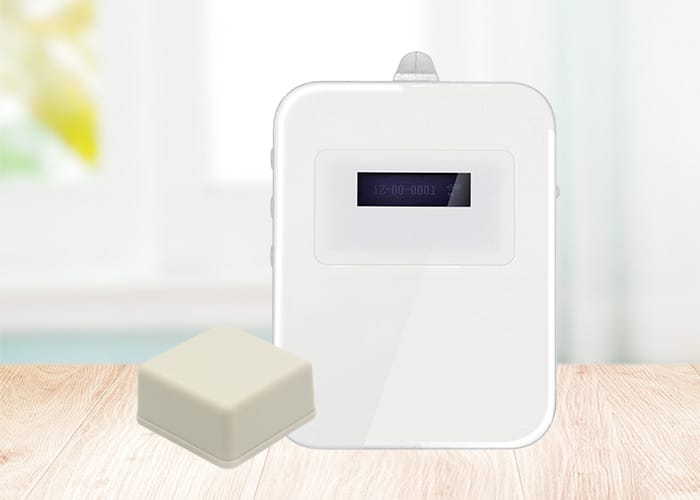
To adapt to the complex environment of the ancient city, the technical team has also optimized the signal transmitter: it supports 16 signal strength level adjustments, and the sensing is precise even in the deep alleys and dark corners of old residences. The transmitter weighs only 27 grams and is about the size of a palm. It can be placed next to a scenic spot indicator without looking out of place. It is also powered by a lithium battery and can last for 12 months on a single charge, eliminating the need for frequent replacement and saving a lot of trouble. Sis Li said, “Nowadays, visitors can simply explore by themselves. The tour guide machines follow the steps and explain. Both the elderly and children can use them. No one asks ‘How to switch the content’ anymore.”.
2.Several languages + 9,999 pre-stored sections: Overseas visitors can also understand the cultural heritage of the ancient city.
In response to internationalization demands, Yingmi has tailored 8 languages (English, Japanese, Korean, French, Spanish, German, Russian, and Arabic) for the M7 system, and also supports pre-storing 9,999 sections of explanation content. The explanations for each language are refined by professional interpreters in combination with the cognitive habits of overseas audiences. For example, when explaining the “Fuxi Eight Trigrams” to European and American tourists, they would add, “This ancient symbol system, similar to the Western theory of astrology, is an early exploration of the laws of the universe by humans,” to help them understand quickly. When introducing the “Hu Family Ancient Residences” to Japanese and South Korean tourists, the Japanese version will compare “the similarities and differences between the machiya architecture in Kyoto, Japan and the residences in northwest China”, evoking cultural resonance.
The tour guide machine also supports “one-click language switching”, accompanied by a language prompt tone. Visitors can switch from Chinese to the desired language by pressing the “language key” on the body. Pierre, a tourist from France, after listening to the explanation of the Fuxi Temple in French, specially found the staff and said, “In the past, when I came to ancient Chinese cities, I could only see the architecture. This time, I can understand the story of ‘Fuxi drawing the Hexagrams’ and also learn about its influence on the I Ching. This experience is so precious.”.
Now, the complaint rate of overseas tourists to Tianshui Ancient City has dropped from 35% to 6%. Many foreign tourists have shared their experiences of “visiting Tianshui Ancient City with M7 listening to explanations” on social media platforms, which has attracted more international exchange teams to the scenic area.
3.Long battery life + anti-interference: Clear listening even when there are many individuals, and the tool can be used all day long without shutting down.
The streets and alleys of Tianshui Ancient City are narrow. During peak season, there are a multitude of visitors, and traditional equipment is prone to “crosstalk”. The M7 adopts a 2.4 GHz high-frequency signal and is combined with digital coding area recognition technology, which can effectively resist interference from mobile phones and other electronic tools. Even if dozens of people are visiting in the same alley at the same time, each person’s guide tool can clearly play the corresponding content without mixing audios.
The battery life of the tool is also very impressive: it is equipped with an 800mAh lithium battery, which can work continuously for up to 16 hours, providing a longer standby time, which is more than enough for visitors to “wander from morning till night”. Once, Mr. Wang, a traveler, visited from 9 a.m. to 5 p.m. His tour guide still had 30% battery left and didn’t need to be charged in the middle. Mr. Wang said, “I was originally worried that the equipment would run out of power, but I didn’t expect it to work after a whole day of browsing. I also listened to the brick carving explanation three times in the middle. It was very convenient.”.
The tour guide machine weighs only 50 grams and adopts a neck-hanging style. Wearing it around the neck is like carrying a light little accessory, and you won’t feel tired even after a whole day of browsing. The body of the machine is made of wear-resistant material. Even if it occasionally touches the wall or door frame, it is not easy to be damaged. The scenic area has used it for half a year and has not experienced a single malfunction.
Iii. Execution Achievements: New Modifications in Cultural Tourism in Tianshui Ancient City.
The Yingmi M7 self-service tour guide equipment has been in place in Tianshui Ancient Town for half a year. It has brought about not only a change in the “method of explanation”, but also a leap in the “effect of cultural dissemination”. These changes are hidden in the feedback of visitors and also written in the operation data of the scenic area.
1.Visitors’ experiences proceed from “shallow to deep”, leaving a more profound cultural memory.
The scenic area conducted a survey: Among the visitors who used the M7 to listen to the explanations, the proportion of those who could retell knowledge points such as “the cultural connotation of Fuxi” and “the meaning of brick carvings in Hu Family Ancient Residences” was 55% higher than that of traditional explanations. The average stay time of visitors has been extended from 2 hours to 3.8 hours, and the proportion of visitors who have “comprehensive visits” (covering more than 8 scenic spots) has increased from 38% to 78%.
An old traveler gave feedback: “When I visited in a tour group previously, I didn’t catch many details clearly. This time, using the tour guide, I listened slowly to the story of ‘Fuxi drawing the Hexagrams’, and only then did I realize that Tianshui is one of the sources of Chinese civilization. This understanding is deeper than looking at the text cards.”” The feedback from the pupil group was also very good. The kids, wearing tour guides, would actively ask, “What do the patterns on the brick carvings mean?” After the excursion, they could also share the stories of the ancient city with their educators.
2.The operation and management have been “simplified from complex”, reducing costs by 45%.
On the operational side, M7 has dramatically enhanced the efficiency of the tour guide management in Tianshui Ancient City: there is no need to arrange staff to coordinate teams for “off-peak visits”, the demand for manual explanations has been reduced by 45%, and the scenic area can also focus more on cultural exploration. The equipment is easy to maintain. The signal transmitter needs to have its battery replaced once a year. The tour guide machine uses a “one charger for ten chargers”, and all ten tools can be fully charged in one hour without the need for dedicated supervision.
“Before, during peak seasons, we had to hire temporary tour guides, which cost several thousand yuan a day. Now, that’s not necessary.”” Old Chen did the calculation. Over the past six months, he has saved nearly 30,000 yuan on the cost of guided Tours. The saved money can also be used for the “Compilation of Ancient City Stories”. Currently, 40 new explanations on “The Origin of the Alleys” and “the History of the Old Homes” have been added.
Conclusion: Let the stories of the ancient city be heard and remembered by more people.
Nowadays, when visiting the ancient city of Tianshui, one can often see such a scene: visitors are hanging M7 audio guides and quietly listening to the legend of “drawing the Hexagrams” in front of the Fuxi Temple. Overseas visitors listened to the English explanations while taking photos of the brick carvings in the Hu Family Ancient Residence. The children surrounded the wooden Windows of the old residence and followed the explanations to identify the “Five Blessings” patterns. On the bluestone pavement, the voices of explanations and the exclamations of visitors interwove, creating the most distinctive “sound landscape” of this thousand-year-old ancient city.
Yingmi has always believed that good self-guided trip equipment should not be a “cold machine”, but a “megaphone of culture”– helping ancient cities tell their thousand-year-old stories clearly and helping visitors remember their cultural memories deeply. In the future, Yingmi will continue to optimize the functions of M7, such as adding AR interaction (allowing visitors to scan the code to see the “life scenes of the ancient city during the Ming and Qing Dynasties”), and expanding more minor languages, so that more people around the world can understand the cultural heritage of Tianshui Ancient City, and let the charm of this thousand-year-old Silk Road town spread throughout the world through the explanations.
Whether it’s the Fuxi Temple in Tianshui Ancient City or historical scenic spots and museums overseas, Yingmi hopes to use smart tools like the M7 to ensure that every precious cultural memory can be clearly conveyed and remembered for a long time, and to rejuvenate ancient civilizations with the help of technology.
FAQ
1.Q: How does the Yingmi M7 system improve cultural dissemination?
A: By providing automatic, multi-language explanations, it helps visitors deeply understand and retain cultural stories, enhancing the overall experience.
2.Q: What is the range for the automatic sensing feature?
A: The device triggers explanations when visitors are within 0.5 to 40 meters of a signal transmitter.
3.Q: Are there any plans to add more languages in the future?
A: Yes, Yingmi plans to expand support for minor languages to cater to a global audience.
4.Q: How does the device handle battery life for extended use?
A: It has an 800mAh battery that lasts up to 16 hours, and charging is efficient with a multi-device charger.
5.Q: Can the system be integrated with other technologies like AR?
A: Yes, future updates may include AR features to provide immersive historical scenes.