

Overseas friends who have visited museums probably all have this regret: standing in front of a precious cultural relic and wanting to hear the story behind it, either due to the language barrier, they can only “guess the meaning” by following the text description. Either the exhibition hall is too noisy, the voices of the tour guides are drowned out, and one can only follow the group to have a cursory look around. After much difficulty, I had some doubts and wanted to ask the guide, but I was afraid of disrupting everyone’s pace. In the end, I just let it go.
We, Yingmi, have been engaged in the production of intelligent tour guide devices for 18 years, serving over 4,000 museums and scenic spots worldwide. We have witnessed too many overseas tourists failing to truly appreciate the charm of cultural relics due to explanations. In fact, a suitable wireless audio guide can solve these troubles and turn a museum visit from a “check-in” into a true “cultural dialogue”. Today, starting from the actual needs of overseas tourists, let’s talk about how the Yingmi wireless tour guide can help everyone embark on a smart journey to the museum.
I.For overseas tourists visiting museums, there are really a lot of troubles
Many people think, “Isn’t visiting a museum just about looking at the exhibits?” But for overseas tourists, it’s not that easy to truly “understand” them. These common troubles are almost encountered by every overseas tourist.
1.Language barriers make it difficult to understand cultural stories
Most museums’ guided Tours are mainly in the local language. Even if there are English sessions, you need to make a reservation in advance and often can’t get one. It is even more difficult for visitors who speak minority languages. They can only rely on the textual explanations beside the exhibits, but many historical backgrounds and cultural connotations cannot be fully explained in just a few words. For instance, an Arab tourist went to the Henan Provincial Museum to see blue and white porcelain. The text only stated “Ming Dynasty, blue and white with continuous branch patterns”, but he wanted to know “why there are Arab patterns on it”. These profound cultural exchange stories were not mentioned at all in the text. In the end, he could only take a photo and leave.
2.The environment is too noisy and the content of the explanation cannot be heard clearly
The museum seems quiet, but in fact, it is filled with sounds everywhere – footsteps, whispers of visitors, and occasional announcements. When there are more people in the popular exhibition halls, the sounds become even more chaotic. In order to make everyone hear clearly, the tour guide has to shout at the top of his voice, which is both tiring and likely to disturb others. Overseas tourists often feel too embarrassed to squeeze into the front row. Standing at the back, they can only catch a rough idea. For instance, when the tour guide says, “This cultural relic is very important,” they fail to make out how significant it is or what historical value it has. In the end, they can’t even remember the name of the cultural relic.
3.You have to follow the group. It’s hard to watch for a while longer
In traditional explanations, one has to closely follow the guide. Once one lags behind, all the subsequent content will be missed. Among overseas tourists, many enjoy strolling at their own pace – standing a little longer for the exhibits they like, carefully observing the details and taking photos. Those who are not interested, just go quickly. But following a group doesn’t offer such freedom at all. For instance, at the Louvre, someone wanted to take a closer look at the brushstrokes of the Mona Lisa. As soon as they stopped, the group moved far away, and they could only catch up in a hurry without even hearing the “perspective techniques in the painting” mentioned by the guide.
4.When in doubt, one dares not ask, and in-depth communication becomes empty talk
When overseas tourists visit, they always have all kinds of questions: “How was this cultural relic discovered?” How did people use it at that time? In traditional tour guides, the guides follow a fixed route. If tourists have any questions, they can only remember them first and ask them when the tour is over. Often, they can’t find anyone, and in the end, their doubts can only be “buried in their hearts”. Without communication, the “cultural dialogue” of museums becomes empty talk and there is no question of deep understanding at all.
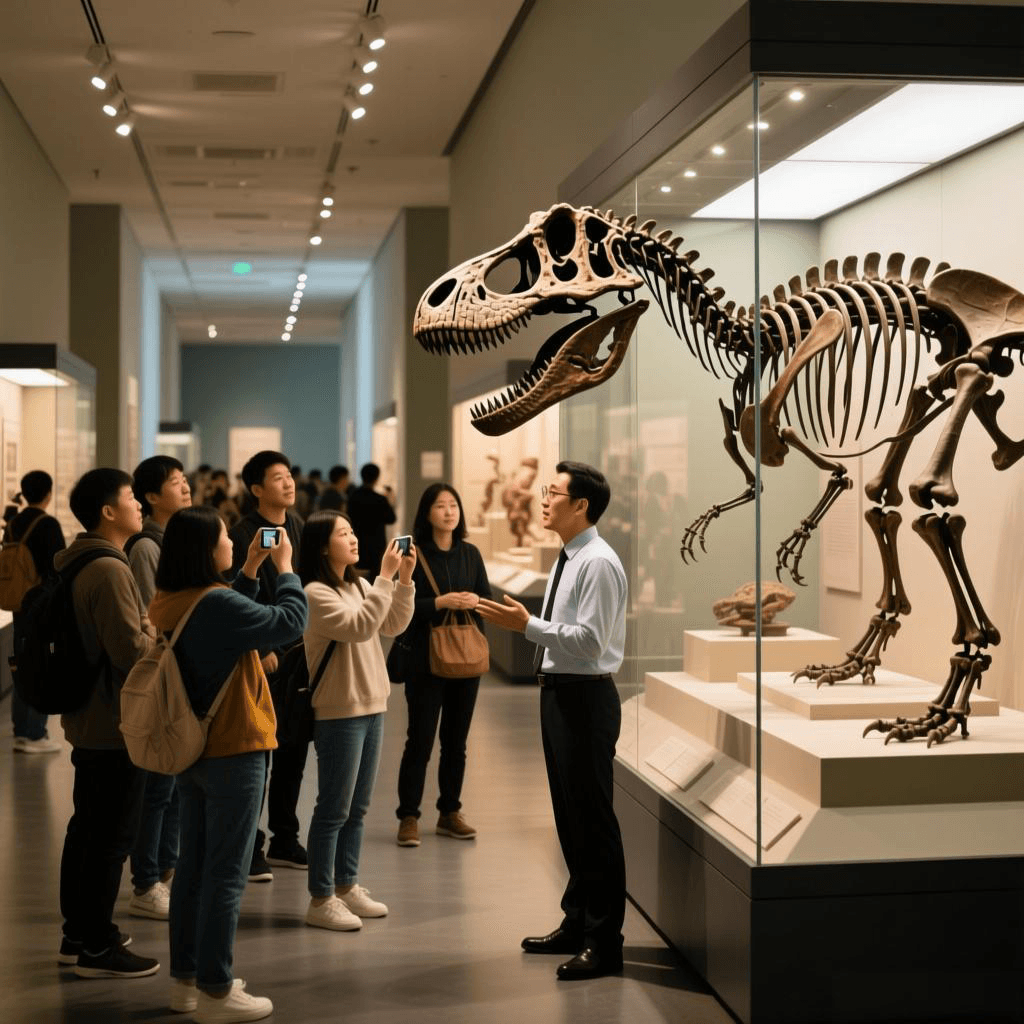
II. Wireless Tour guide: Solve all these troubles
The wireless audio guide of Yingmi is specifically designed to address these issues. Whether they are group tourists or individual visitors, they can all easily and clearly feel the charm of cultural relics through it and truly “understand” the museum.
1.You can freely switch between multiple languages, and even minor languages can be understood
Language is the biggest obstacle for overseas tourists. Our tour guide has directly solved this problem – it is pre-set with eight commonly used languages including Chinese, English, Japanese, Korean, French, German, Spanish and Arabic, covering over 90% of overseas tourists. If there are special requirements, we can also customize minority languages such as Russian and Portuguese.
For instance, museums in the Middle East can customize explanations in Arabic. European museums, with Italian and Dutch languages available. The explanations are all recorded by a professional team. They are not simple translations but will be combined with cultural backgrounds to thoroughly tell the deep stories. As mentioned earlier about blue and white porcelain, the Arabic explanations will elaborate that “during the Ming Dynasty, trade between China and Arab countries was frequent, and these patterns are proof of cultural exchanges at that time”, allowing overseas tourists to truly understand the value of cultural relics.
2.Noise reduction + strong signal, even the noisiest sounds can be heard clearly
To address the noise issue in museums, our audio guide devices employ two core technologies: the first is the GFSK Gaussian frequency shift keying modulation technology, which has three times stronger anti-interference capability than ordinary Bluetooth. The second is the intelligent noise reduction function, which can automatically filter out environmental noise and only keep the voice of the tour guide.
No matter how noisy the exhibition hall is, such as crowded places in popular exhibition halls or crying children, visitors can clearly hear the explanations. The transmission distance is also quite long, within a range of 200 to 300 meters. Even if it’s a bit far from the guide, there’s no problem. Last time in the Egyptian exhibition hall of the British Museum, a tourist was standing in front of the display case looking at the statue of Ramses II. He was nearly 200 meters away from the guide, but he could still clearly hear the detail that “the nose of the statue was deliberately damaged during the war”, and there was no need to squeeze to the front row at all.
Moreover, when multiple teams use it simultaneously, there is no cross-linking of sounds. Each team has its own channel. For instance, the Chinese team uses Channel 1 and the English team uses Channel 2. Everyone listens to their own content without interfering with each other. The reception efficiency of the museum has been immediately improved.
3.Control your own pace and browse however you like
Our tour guides come in two types, catering to both group tourists and individual visitors.
The group tourists use the “group tour guide system”. The receivers worn by the tourists weigh only 18 to 25 grams and are almost imperceptible when hung on the ears. Within a range of 150 meters, tourists can move freely. For instance, if they want to take a closer look at a certain exhibit or take some photos, they don’t have to worry about missing the explanations. Last time, a European team visited the Suzhou Museum. Someone lingered in front of the model of the Humble Administrator’s Garden for over ten minutes and could clearly hear the guide say, “The model recreates the layout of the Qing Dynasty.” It was particularly free.
Individual visitors use the “self-service tour guide system“, which is more convenient – rent a tour guide machine, and you don’t need to press any buttons. When you approach a certain exhibit, the device will automatically sense it and play the corresponding explanation. For instance, when a tourist approaches a Tang Tri-color glazed pottery, the tour guide machine automatically explains, “This is a burial object from the Tang Dynasty, using three glazes.” When you move on to the next exhibit, the content will automatically switch. If you want to stay longer, just listen a few more times. If you want to leave, just go. Do it completely at your own pace and you won’t have to be “pushed around” anymore.
4. You can ask questions at any time and communicate without waiting
Many overseas tourists like to ask questions. Our high-end tour guide devices (such as 008B) have a two-way intercom function – there is a “Question button” on the receiver of the tourist. If you want to ask a question, just press it and the tour guide can hear it immediately and respond promptly. If many people ask the same question, the guide can switch to the “broadcast mode” to answer it uniformly without having to repeat the explanation.
For instance, an American study tour group visited the Henan Provincial Museum. The students asked, “How were oracle bone inscriptions discovered?” As soon as the guide answered through the audio guide, all the students heard it and it even sparked a discussion. This kind of interaction makes the visit no longer “being listened to”, but “actively learning”. Overseas tourists have commented, “This is how visiting museums is interesting.”
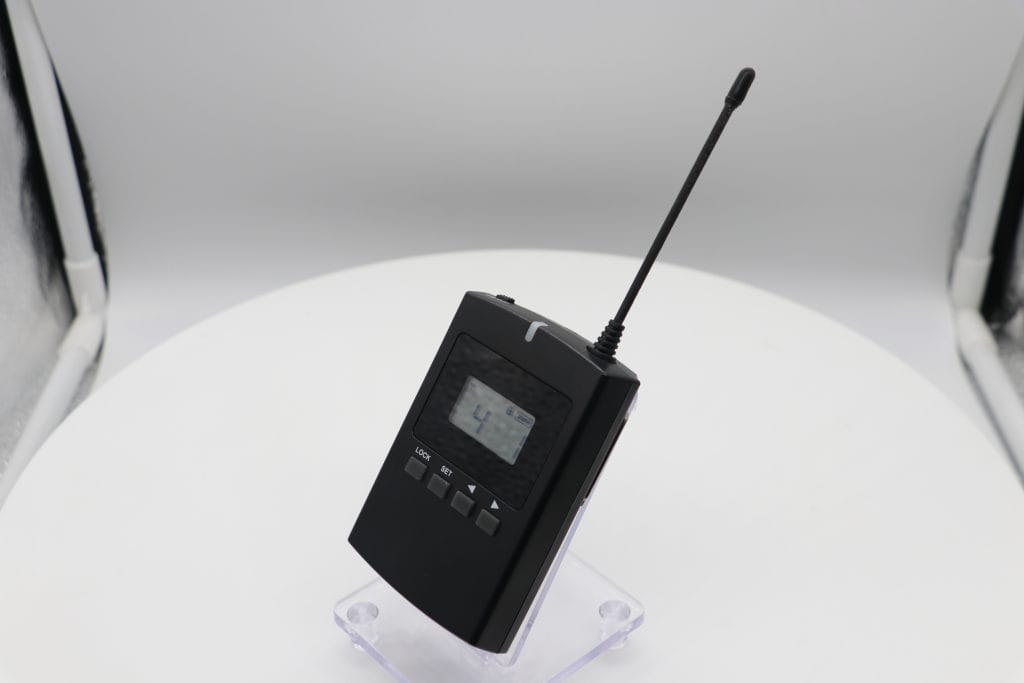
III. These details are tailor-made for overseas museums and are very considerate
In addition to its core functions, our audio guide also features many detailed designs tailored for overseas scenarios, making it comfortable for visitors to use and convenient for museum management.
1. It is lightweight and comfortable, and you won’t get tired even after wearing it for a whole day
Overseas tourists often spend 3 to 5 hours visiting museums. If the equipment is too heavy, it definitely won’t work. Our receiver weighs as little as 18 grams, which is even lighter than a pen. The ear-hanging type is made of food-grade silicone, which is skin-friendly and breathable. Even after wearing it for a long time, your ears won’t feel sore. The neck-hanging lanyard is also made of soft silicone, and there is no sense of pressure when hung around the neck. The appearance of the equipment is simple and clean, which will not affect taking photos and will not spoil the atmosphere of the museum.
2.It has a long battery life and is convenient to charge
A single charge can last for 8 to 12 hours, which is enough for a whole day of shopping. The museum has dedicated centralized charging boxes that can charge 36 to 50 devices simultaneously. They also have ultraviolet disinfection functions. After the museum closes every day, you can put the devices in to charge and disinfect them. The next day, you can take them out and use them, which is very convenient. The tour guide machines and charging boxes rented by individual customers also support payment through a mini-program, eliminating the need for manual registration and ensuring high management efficiency.
3.Simple operation, easy to master without learning
Overseas tourists may not understand Chinese. We have designed the operation to be particularly simple: all the buttons on the receiver have ICONS. For example, the language key is “Earth” and the volume keys are “+/-“, which is easy to understand at a glance. After the team receiver is turned on, it automatically searches for signals, eliminating the need for manual channel adjustment. The self-service tour guide machine requires no operation at all and senses automatically. Even the elderly or children can use it easily.
4.Durable and durable, with a low failure rate
The museum is crowded with people and has many hands, making it easy for equipment to be knocked off or dropped. Our explainer is made of industrial-grade materials. Its shell is wear-resistant and shock-resistant. Even if it accidentally drops on the ground, it is not easy to break. After being tested in over 4,000 venues worldwide, the failure rate is less than 1%. Museums do not need to worry about frequent repairs, and their reception work is more stable.
IV. We not only sell equipment but also provide full-process services for overseas museums
Many overseas museums are worried that “they won’t be able to use the equipment they have purchased”. In fact, we offer a full-process service from customization to after-sales, so that museums don’t have to worry about technical issues.
1.Customized according to the characteristics of the museum, it better meets the needs
The exhibits and visitors of each museum are different. We will customize according to your needs: for example, for history museums, add more historical background to the explanations. Art museums, focusing on the interpretation of artistic styles; Since the tourists are mainly Arabs, more Arabic language should be customized. The museum’s LOGO can also be printed on the device. For instance, the custom-made audio guide for the British Museum, with their signature pattern printed on it, has become a “mobile business card”.
2. Professional teams record the content to ensure the quality of the explanations
The quality of the explanation content directly affects the experience. We have a professional recording team. History and foreign language experts first study the exhibit materials and dig out the stories behind them. Then, find a professional announcer to do the dubbing. The language should be authentic and the intonation natural. If the museum has special requirements, we can also record on-site and adjust the content according to the actual situation of the exhibits to ensure that each explanation is accurate.
3. Global after-sales service, no need to panic if problems occur
Overseas museums are most worried that if their equipment breaks down, no one will repair it. We support global warranty, one-year free warranty, and direct replacement within three months if there are quality problems. If the equipment is broken, it can be repaired through the local cooperative service point or sent to us. It will be fixed and returned within 10 working days. We also offer 24-hour online technical support. If you have any questions about the museum, you can contact us at any time.
4.The cooperation model is flexible, and budget is not an issue
Not all museums have large budgets. We offer three models: “sales, leasing, and joint operation”. Large museums can purchase equipment for long-term use. Small and medium-sized museums or temporary exhibitions can rent equipment to cope with peak hours. For those with limited budgets, they can also form a joint venture. There’s no need to spend money first, and the profits can be shared. No matter what size the museum is, it can all make use of the intelligent interpretation service.
V. Global Cases: All these museums are using it and the feedback is very good
Over the years, our tour guides have served many well-known overseas museums, enhancing the experience of overseas visitors for them
For instance, the British Museum has customized the explanations in 12 languages, and the satisfaction rate of visitors has increased by 85%. Many people say, “For the first time, I truly understood these cultural relics.” The Tokyo National Museum has adopted a two-way intercom function, which has increased the average stay time of overseas tourists by 30%. The Museum of Ethnic Cultures of China has customized multilingual explanations to enable overseas tourists to better understand the cultures of China’s ethnic minorities.
Conclusion: Let the stories of museums be heard by the whole world
Every cultural relic in the museum holds the code of human civilization. But it would be a pity if these passwords couldn’t be passed on to overseas tourists due to explanations. The Yingmi wireless tour guide is like a “cultural bridge”, breaking the limitations of language, distance and rhythm, allowing overseas tourists to clearly, freely and deeply experience the charm of cultural relics, and also enabling the cultural value of museums to truly reach the world.
We always believe that a good tour guide service can make every visit to the museum an unforgettable cultural journey. If you are an operator of an overseas museum and want overseas visitors to better “understand” your exhibits, please feel free to contact us at Yingmi Technology. We will customize an exclusive solution based on your needs, ensuring that the story behind each cultural relic can be clearly heard by the world.