

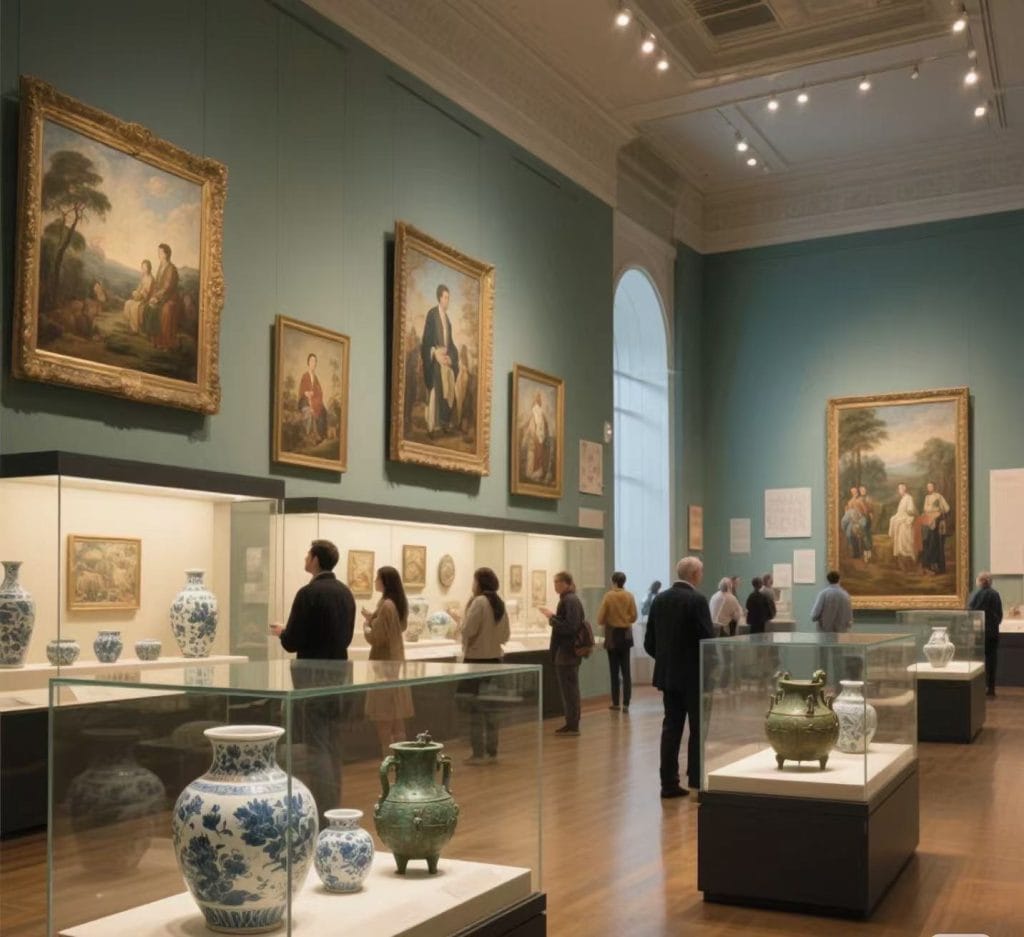
Nowadays, more and more people around the world like to visit museums to “check in”, not only to see the appearance of the cultural relics, but also to learn about the history and culture behind them. However, for overseas tourists, language barriers, unclear explanations, and having no place to ask about the details they want to know often leave them with regrets during their museum visits.
Yingmi Interpretation, have been in this field for 15 years and have always believed that a good museum display interpretation system is not merely a tool for “talking”, but more like a bridge – one side connecting the thousand-year-old stories of cultural relics, and the other side connecting the curiosity of overseas tourists. Whether it is the ancient Qiang ethnic relics in the domestic Kungang Museum or the precious collections in foreign museums, they can all be understood, liked and remembered by tourists from different countries through this system. Today, let’s talk about how important a museum display and interpretation system is, how to choose the right one, and how Yingmi helps museums do this well.
I. Museum Exhibition and Interpretation System: Not Merely an “interpreter”, but also a “translator” of culture
Many people think that a museum with a label and a tour guide is enough, but when they actually use it, they realize that the limitations of the traditional way are too many. A good display and explanation system can solve these troubles and even bring cultural relics to life.
1.Breaking down the language barrier, overseas tourists can also “understand” cultural relics
For overseas tourists visiting museums, the thing they fear most is “not understanding and not being able to understand”. For instance, when visiting the Kungang Museum, there are the remains of “giants”, ancient Qiang pottery, and silk that can prove the exchange between Eastern and Western civilizations. The stories behind these cultural relics are particularly fascinating. However, without corresponding language explanations, overseas tourists can only be “anxious” in front of the cultural relics in the glass display cases.
The exhibition and interpretation system we have developed for the museum supports over twenty languages, ranging from English, French, German to Japanese, Korean and Arabic, basically covering the languages of the major source countries of visitors. Tourists can take an audio guide or scan a mini-program, select a language they are familiar with, and walk up to a certain exhibit to hear the corresponding explanation – such as the age of the remains of the “giant”, the burial customs of the ancient Qiang people, and how silk was spread from the East to the Western Regions. There’s no need to push and shove along with the tour guide or search word by word through translation software. One can quietly understand the stories of the cultural relics.
For museums, this is not merely about improving services. A previous overseas tourist, after visiting the Kungang Museum, specifically told us, “I originally thought I could only see bones and jars, but I never expected to understand so many details. It turns out that this place used to be the center of exchanges between the East and the West. It’s so interesting.” Look, a single system can turn a museum into a window for cultural exchange. How worthwhile it is!
2.Adapt to different exhibition halls, and no matter how large the museum is, it can be “explained accurately”.
The layout of each museum is different. Some have a large exhibition hall, while others have several small ones, and the exhibits are scattered. If the explanation system “can’t keep up”, either you miss something or repeat it, the experience will be extremely poor.
The Kungang Museum is divided into three exhibition halls: “Desert Wonders, Giant Tribes”, “Thousand-Year Kungang, Ancient Qiang Ethnic Traces”, and “The Vast Sea of the Western Regions, Treasures from Kungang”. Each exhibition hall has a different theme. We provided them with a zoned explanation system. When visitors reach the first exhibition hall, the system automatically explains the discovery process of the “giant’s” remains. When you reach the second exhibition hall, you will switch to the culture of the ancient Qiang people. In the third exhibition hall, the focus is on the cultural relics related to the exchanges between Eastern and Western civilizations. Visitors don’t need to press the buttons manually or follow the tour guide. They can explore on their own and hear the core content of each exhibition hall.
If you encounter group tourists, it is also very convenient to use our group tour guide system. The tour guide doesn’t need to shout at the top of his voice. With a normal speaking volume, tourists can hear it clearly just by wearing headphones. Previously, a European tour group visited the Kungang Museum. The tour guide said, “In the past, when leading a group, the tourists at the back would always shout ‘I can’t hear you’. Now, with this system, everyone can listen quietly and freely look at the details of the exhibits. The experience of group Tours has improved a lot.”
3.Help museums “understand” the preferences of visitors and provide more considerate services
Many museums have no idea what overseas tourists like to see or hear, and can only adjust their exhibits based on their feelings. However, the display and explanation system can record data – such as which exhibit is listened to the most times, which language overseas tourists prefer the most, and which exhibition hall they stay in the longest.
Through the data from our system, the Kungang Museum has found that overseas tourists have the highest interest in “silk exhibits”, and they listen to explanations 30% more often than other exhibits. Later, they specially added interactive screens beside the silk exhibits, showing more historical videos about the silk trade, and also launched related cultural and creative products, which were particularly popular. You see, data can help museums accurately identify the needs of visitors, eliminating the need to “rush around aimlessly”.
II.When choosing an exhibition and explanation system for museums: Don’t just look at the parameters; it must “fit your needs”
When many overseas museums choose systems, they are often attracted by the “high-tech” and “multi-functional” features. After purchasing them, they find that they are not applicable and have wasted money. In fact, when choosing a system, there are three key points to consider: whether it can be adapted to your exhibition hall, whether it is convenient for overseas visitors to use, and whether it can be used for a long time.
1. First, look at the layout of the exhibition hall: For large exhibition halls and multiple exhibition halls, different systems are selected
If a museum is divided into several small exhibition halls like Kungang, with each hall having a different theme, a zonal interpretation system would be suitable – one that can automatically switch contents, eliminating the need for manual operation by visitors. If the museum is a large open space, such as many art museums with scattered booths, a UHF band team interpretation system is suitable. It has a long transmission distance and strong anti-interference ability. Even if there are many people, there will be no frequency crossover or disconnection.
There was once a small overseas museum with a long and narrow corridor exhibition hall. At the beginning, a mismatched system was purchased. When tourists reached the end of the corridor, the signal became weak and they couldn’t hear the explanations clearly. Later, we switched to our zoned explanation system. We set up several positioning points in the corridor and explained wherever we went. Since then, there have never been any signal problems. So before choosing a system, it is essential to first clarify the situation of your exhibition hall: how large the area is, how many zones it is divided into, and how the exhibits are arranged. All these are directly related to the selection of the system.
2.Language and operation: The simpler and more comprehensive it is, the more tourists will like it
Overseas tourists come from different countries, and the language coverage must be comprehensive. Moreover, it cannot be in a “machine voice” – if the explanation voice is stiff and the pronunciation is inaccurate, tourists will find it difficult to listen and the experience will be poor. In our system, all languages are recorded by professional announcers. For example, English is recorded by native speakers with authentic pronunciation. For Japanese and Korean, local professionals were also sought to ensure the accuracy of word usage.
The operation should also be simple. Many overseas tourists are not familiar with complex equipment. It would be best if it could be “picked up and used immediately” – for instance, the audio guide only has a few buttons: turn on, select the language, and adjust the volume. It can be operated without reading the manual. Or you can scan a mini-program. There’s no need to download an APP. You can use it directly in wechat, which is also friendly to elderly tourists. Previously, an overseas tourist gave us feedback: “I originally thought it would be very complicated, but I didn’t expect that once I chose the language, I could use it. I could talk wherever I went. It’s much more free than following a tour guide.” “
3. Durability and battery life: Museums are used every day, so they need to be “durable”
The museum’s interpretation system is used by dozens or even hundreds of people every day. If it is not durable and breaks down frequently, it will be both costly and time-consuming to maintain. When we make the equipment, we pay special attention to these details: The main unit shell is made of anti-drop ABS material. Even if a tourist accidentally drops it on the ground, it is not easy to break. The headphone cable is thickened and is not easy to break even after repeated plugging and unplugging. The charging interface uses the internationally recognized Type-C. Even if the cable is lost, a replacement can be easily purchased locally.
Battery life is also very important. Museums are usually open for 8 to 12 hours. If the power of the audio guide runs out in half a day, the staff will have to keep changing the equipment, which is very troublesome. Our audio guide has a battery life of over 10 hours, which is more than enough for a full day of normal operation. It is also equipped with a centralized charging cabinet – capable of charging 30 devices at a time. The battery level of each device can be seen on the cabinet, and it is clear whether it is fully charged or not. It can also prevent overcharging and protect the battery life. The Kungang Museum receives so many visitors every day, and its equipment has never been delayed in use due to power failure or damage.
Iii. Yingmi’s Museum Exhibition and Interpretation System: 15 years of experience, meticulous attention to detail
We have been in this field for 15 years, serving renowned institutions such as the National Museum of Chinese Nationalities, the Palace Museum, and the British Museum overseas. We do not rely on gimmicks but on solving problems in a down-to-earth way.
1. Accurate positioning: Wherever you go, talk about it without straying
Many tour guide systems encounter problems such as “starting to explain before reaching the exhibits” or “continuing to explain even after passing by”, resulting in a particularly poor visitor experience. Our system employs several positioning technologies. For instance, in indoor exhibition halls where GPS signals are weak, infrared positioning is used. In the outdoor exhibition area, the Beidou Navigation Satellite System is used for positioning, with an accuracy within one meter.
For instance, beside the “Giant” remains display case at the Kungang Museum, we have installed positioning points. When visitors walk about one meter in front of the display case, the system will immediately trigger the explanation, neither too early nor too late. A museum director once told us, “The system we used before always went off course, and tourists complained that ‘what they heard didn’t match what they saw.’ Since we switched to yours, this problem has never occurred again.”
2. Good sound quality: No matter how noisy it is, every detail can still be heard clearly
When there are many people in the museum, it can be very noisy. If the sound quality is poor, tourists won’t be able to hear the explanations at all. Our system has been equipped with a professional noise reduction module, which can filter out environmental noise – such as footsteps and voices in the exhibition hall, all of which can be weakened, leaving only clear explanations. Moreover, the audio is in high definition. Whether it is about the archaeological process of the “giant” remains or the weaving techniques of silk, all the details can be heard clearly.
A previous overseas tourist had poor hearing. After using our audio guide, he said, “I originally thought I wouldn’t be able to hear clearly, but to my surprise, even when someone was speaking beside me, the audio guide was very clear. I could even hear small details like ‘The patterns on the pottery are hand-carved’.”
3. Interactive: Not just “listen”, but also “play”
Nowadays, museums all want to attract young visitors, and interactive functions are particularly important. Our Z1 display and explanation system supports multiple interaction methods such as touch, voice, AR/VR. For instance, when visiting the Kungang Museum to view pottery, tourists can simply touch the screen on the display case to watch the video of the pottery’s production process. By scanning with AR, you can “see” how pottery was used in ancient times. If you have any doubts, just say to the interpreter, “How much can this pottery hold?” and the system will answer immediately.
A student tourist said before, “I used to think museums were very boring. This time, I saw the restored scenes of the cultural relics with AR and could even talk to the audio guide. It felt like I was’ chatting ‘with ancient people. It was so interesting.”
Iv. Common Problems Encountered by Museum Systems: We’ll help you solve them
When many museums use display and interpretation systems, they often encounter some minor troubles, such as signal disconnection, language switching inability, and equipment running out of power. In fact, all these problems can be solved.
1.Signal disconnection or frequency crossover: Don’t panic.
First, check these points. Sometimes, when multiple teams use it simultaneously, frequency crossover may occur – for instance, when tourists from Team A hear the explanations from Team B. Or when walking to some corner, the signal suddenly cut off. When encountering such a situation, first check if you are using too many channels. Our system supports over 30 channels. Turn off the unnecessary ones and only keep the ones you are currently using to avoid frequency crossover. If the signal in a certain corner is weak, adding a repeater will enable the signal to cover it.
Previously, a museum had a constant signal loss in the exhibition hall on the basement floor. We went to the door and added a repeater, and the problem was immediately solved. In fact, many signal problems are not due to broken equipment, but rather that they have not been adjusted properly according to the situation in the exhibition hall.
2. Language switch failure: First, check the language pack, then the network
Sometimes tourists choose a language, but there is no sound or the sound quality is particularly poor. At this point, first check if the language pack has been fully downloaded – if you are using a mini-program, it might be due to poor network connection that the download has not been completed. If an interpreter is used, it might be that the language pack is not installed correctly. Our system supports remote update of language packs. Museums don’t need to send people to their sites; they can operate from the background, which is very convenient.
Previously, an overseas museum was going to add Portuguese. We remotely updated the language pack for them, and it was available on the same day. It was really convenient.
Vi. Conclusion
Each cultural relic in the museum conceals a story of a thousand years, and the exhibition and explanation system is the “microphone” that tells these stories to the world. Whether it is the ancient Qiang ethnic relics in the Kungang Museum or the precious collections in overseas museums, they all deserve to be seen, understood and liked by more people.
Yingmi, have been engaged in the display and interpretation system for 15 years. We have never merely sold equipment; rather, we aim to help museums tell their historical stories well, so that overseas visitors can leave with a full sense of gain. If your museum also wants to solve the language problem, enhance the visitor experience, or want to know how to choose the right system for yourself, please contact us at any time – Yingmi Explanation Global service hotline 400-990-7677, official website www.it2002.com, we will take every detail into consideration for you, let the story of the cultural relics cross mountains and seas, Be remembered by more people.