

It is often said that traveling is about seeing the world in its true form, and the tour guide’s explanatory device is the “key” that helps us understand the world. Over the years, the global tourism industry has grown larger and larger, and this “key” has also been constantly upgraded – from the earliest time when tour guides could only speak with their mouths, to later when they could transmit sounds through wireless signals, and now when they can automatically speak according to the location and even translate in real time. Every step of change has not lagged behind the pace of technological development and has always been adjusted in accordance with the needs of tourists and scenic spots.
Yingmi Explanation, have been deeply involved in the explanation and display industry for 15 years, personally experiencing and participating in the transformation and growth of this industry. Today, let’s take a good look at the development of tour guide interpretation devices and talk about the technological innovations within them. We hope to provide some useful references for our overseas partners and colleagues in the industry.
I. Early Exploration: Initial Attempts from manual explanations to the first generation of audio equipment
Before the mid-20th century, whether in museums in Europe or historical sites in Asia, to learn the stories behind the scenic spots, one basically had to rely on human tour guides. Back then, tour guides were particularly “precious” – they had to be well-versed in a lot of historical knowledge and also be able to chat with tourists, answering their questions immediately. For instance, in the Forbidden City, the tour guide will point to the plaque of the Hall of Supreme Harmony and tell you about the scenes of the grand ceremonies held by the emperor in those days. At the Louvre, you will be held a picture album to help you compare the details of the Mona Lisa. This kind of face-to-face explanation has a particularly strong sense of interaction and can also bring up many small stories that are not in textbooks. It is something that many smart devices nowadays cannot replace.
However, as more and more people went out to play, the problems of manual explanations gradually emerged. First of all, the quality of tour guides varies greatly. Some of them haven’t received systematic training. When they talk about the history of scenic spots, it’s like reciting a text, lacking both details and interest. Some even get professional knowledge wrong, such as confusing the ages of cultural relics. Then there is the issue of language. There are more and more international tourists, but there are too few multilingual tour guides. A tour guide who can only speak Chinese can only be anxious when encountering a group of foreign tourists who want to learn about the history of the Great Wall. Conversely, foreign tour guides visiting Chinese scenic spots are also unable to communicate well with Chinese tourists. Another issue is the limit on the number of people. Once there are too many people in the group, the tour guide has to shout at the top of his voice, but the tourists standing at the back still can’t hear clearly. Sometimes, in order to make sure everyone can hear, he has to repeat it several times, which disrupts the tour rhythm.
To solve these troubles, the earliest audio explanation devices emerged. Back then, the equipment was particularly simple. It was just about recording explanations in different languages on tapes or CDS. Tourists could rent a player and put on headphones to listen. For instance, when visiting the Egyptian pyramids, tourists can choose explanations in English, French or Spanish. When they reach a certain pyramid, they can press the corresponding button to listen to the explanation. Although this device looked bulky and it was troublesome to change tapes and CDS, and sometimes it would get stuck, it was already a great help at that time – there was no need to rely on tour guides anymore. No matter how many people there were or what language they spoke, they could listen and watch slowly by themselves. The reception capacity of the scenic area was also greatly improved at once.
However, the shortcomings of the first-generation audio equipment were also quite obvious. The most headache-inducing thing is that the content cannot be modified. The recorded commentary is like a fixed script. Tourists want to know more details, such as the production process of a certain cultural relic. If it is not recorded in the equipment, they cannot listen. If you don’t want to listen to a certain part, you can only press the fast-forward key to jump over it, which is extremely inflexible. Moreover, the equipment itself is heavy. Tourists carry it around the scenic area for a whole day, and their arms get sore. The tapes and CDS are also prone to scratches, and it costs a lot of money to repair them if they break down. However, in any case, these early attempts can be regarded as the beginning, transforming the tour guide service from “relying entirely on people” to “the coordination of people and equipment”, and paving the way for subsequent development.
Ii. Technological Innovation: The Popularization of Wireless Interpretation Systems and Industry Transformation
After entering the 21st century, digital technology and wireless communication technology have developed particularly rapidly, which has brought about the first major innovation to tour guide interpretation devices. Wireless interpretation systems emerged as The Times required and quickly became widespread, completely transforming the traditional model of tour guide services. This transformation not only solved many problems of the first-generation audio equipment, but also promoted the development of tour guide services towards a more efficient, more humanized and more environmentally friendly direction.
1.The technical core and advantages of the wireless interpretation system
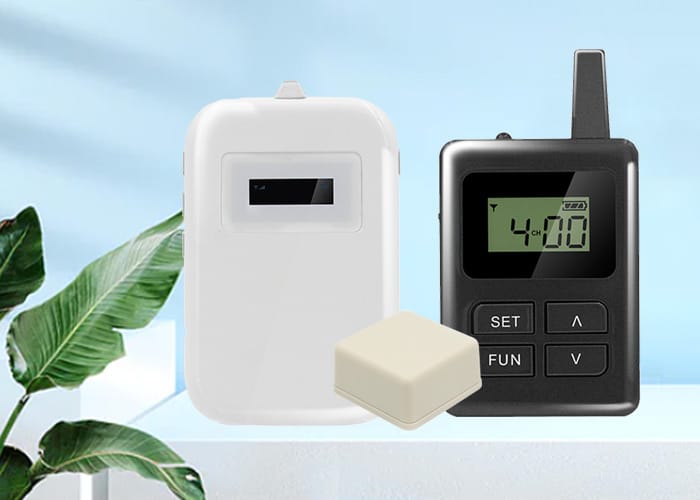
The wireless interpretation system mainly consists of the transmitting host worn by the tour guide and the receiving headphones used by the tourists. The core uses UHF band or infrared wireless signal transmission technology. Compared with the traditional “loudspeaker”, the wireless interpretation system has achieved a key breakthrough of “soft interpretation and clear listening” : tour guides no longer need to shout loudly; a normal speaking volume is sufficient. The sound can be stably transmitted to the tourists’ receiving headphones through the transmitting host. In this way, tour guides no longer need to worry about sore throats, and the noise problem caused by traditional amplification equipment has been completely solved. It is particularly suitable for places that need to maintain quietness, such as museums, art galleries, and historical sites.
In terms of signal stability, the wireless interpretation system has a strong anti-interference ability. Even in scenic spots or exhibition halls with a large number of people and complex environments, it can ensure that every visitor can clearly hear the interpretation content. Some high-end wireless interpretation devices also support multi-channel switching, which can meet the needs of multiple teams visiting simultaneously. The signals of different teams will not interfere with each other, which greatly enhances the reception capacity of scenic spots and exhibition halls.
For tourists, the wireless tour guide system makes the tour more flexible. Tourists no longer need to closely surround the tour guide. Within a certain range, they can freely disperse to view the details of the scenic spots without affecting their listening to the explanations. This “relaxed tour” has greatly improved the tourists’ experience. Moreover, wireless interpretation devices have become more portable. The transmitting host and receiving headphones are small in size and light in weight, making them convenient for tourists to carry. The operation is also simple and easy to understand, and can be used by tourists of all ages.
2. Yingmi Interpretation’s in-depth exploration and practice in the field of wireless interpretation
As a national high-tech enterprise, Yingmi Explanation has long recognized the opportunities that wireless communication technology brings to the industry. As early as 2007, when the company was just established, we have been dedicated to the research and development and production of wireless interpretation systems. After so many years of technological accumulation, our wireless interpretation products have formed a complete system, including several series such as team interpretation systems and zonal interpretation systems, which can meet the usage requirements of different scenarios.
Our team tour guide system is specially designed for multi-person group Tours, supporting long-distance transmission. Multiple teams can use it simultaneously. Whether it’s for corporate visits, museum Tours, or theme park guidance, it can all be applied. This system adopts advanced UHF wireless transmission technology, featuring a wide signal coverage, clear and stable sound quality, and core advantages such as anti-crosstalk and anti-interference.
In terms of product quality, our company, Yingmi, has passed the ISO9001, 4001 three-body certification, as well as international certifications such as CE and ROHS. Our products meet the technical standards of overseas markets and have been exported to many countries and regions around the world. Overseas customers have given us very good evaluations of our products. To ensure the stability and reliability of our products, in 2010, we also invested in building an SMT assembly factory – Hefei Sucheng Electronics, achieving independent production of PCBA. From core components to finished product assembly, we strictly control the quality of every link, which also provides a solid guarantee for the excellent performance of the wireless interpretation system.
Iii. Intelligent Upgrade: Technology Integration drives Tour guide interpretation devices into a new Era
In recent years, Bluetooth, Wi-Fi, GPS positioning, mobile Internet and artificial intelligence technologies have been deeply integrated, ushering in the second major transformation of the tour guide interpretation device industry. Intelligence has become the core trend of industry development. The intelligent tour guide not only has achieved a comprehensive upgrade in functionality, but also has promoted the transformation of tour guide services from “passive reception” to “active interaction”, injecting strong impetus into the development of global smart tourism.
1.Core Functions and Technological Breakthroughs of Intelligent Tour Guides
(1). Automatic navigation and precise positioning:
The intelligent tour guide integrates GPS positioning and electronic map technology, which can know in real time where tourists are and realize the automatic tour guide function of “wherever they go, they will be guided”. When tourists approach a certain scenic spot, the equipment will automatically play the corresponding explanatory content without manual operation, greatly enhancing the convenience of the tour. Some high-end products also support Beidou positioning, with an accuracy reaching the meter level, ensuring that the explained content can be accurately triggered.
(2). Multilingual and real-time translation
In response to the demands of the international tourism market, intelligent tour guides generally support multi-language explanations, including dozens of mainstream languages such as English, French, German, Japanese, and Korean, thus resolving the language barriers in cross-cultural tourism. Even more impressive is that some devices incorporate real-time artificial intelligence translation technology, enabling immediate language translation between tourists and tour guides, breaking down communication barriers and making cross-cultural exchanges smoother.
(3). Interaction between APP and mini-program
Tourists can remotely control the tour guide through a mobile phone APP or mini-program, such as choosing the language of explanation, adjusting the volume, and switching the content of the explanation. Meanwhile, the APP can also offer additional services such as panoramic hand-drawn maps, route guidance, and scenic spot recommendations, helping tourists plan their visiting routes and improving their visiting efficiency. Some apps also support offline download of the explanation content. Even in places without Internet access, tourists can still use it normally.
(4). Intelligent Interaction and Personalized Services
With the help of voice recognition technology, the intelligent tour guide can receive voice commands from tourists and realize interactive functions such as voice inquiries and Q&A about scenic spots. If tourists ask questions like “How long is the history of this scenic spot?” or “What are the local specialties nearby?”, the equipment can quickly give accurate answers. In addition, the intelligent tour guide can also recommend personalized tour guide content based on tourists’ visiting routes and interests, achieving “thousands of faces for thousands of people” customized services.
(5) .Integration of AR/VR Technologies
Integrating augmented reality (AR) and virtual reality (VR) technologies into tour guides can offer tourists an immersive visiting experience. Through AR technology, tourists can view virtual restored images of scenic spots on their mobile phones or dedicated devices, such as the original appearance of ancient buildings and dynamic scenes of historical figures, bringing historical culture to life. VR technology can create virtual tour scenes. Even if tourists do not visit the scenic spots on site, they can still tour the spots as if they were really there through VR devices. It is predicted that within the next five years, the market size of explanations related to AR/VR will reach 15 to 20 billion yuan, with particularly huge market potential.
2.The intelligent layout and innovative practice explained by Yingmi
In the wave of intelligent transformation, Yingmi Interpretation has always been at the forefront of the industry. Through technological cooperation and independent research and development, we continuously launch intelligent interpretation products with core competitiveness. In 2019, we collaborated with iFLYTEK, fully leveraging its technological advantages in artificial intelligence, speech recognition, and real-time translation, to launch the Z1 presentation and explanation system. This system integrates intelligent functions such as automatic multilingual switching, voice interaction, and real-time translation, providing users with an all-round intelligent explanation experience.
Our self-service explanation system is a typical application of intelligent technology. This system is based on GPS positioning technology and supports multi-language automatic navigation. It is suitable for scenarios such as scenic spots, museums, and factory visits, effectively solving the problem of shortage of small-language interpreters. Nowadays, renowned museums such as the National Museum of Nationalities of China, Henan Provincial Museum, and Guizhou Provincial Museum, as well as 5A-level scenic spots like Suzhou Taihu Scenic Area, all use our self-service tour guide system. Meanwhile, this system has also been exported to many countries overseas, providing high-quality intelligent tour guide services for international tourists.
To further enhance the user experience, we have also launched a tour guide mini-program and APP. With the user’s mobile phone as the entry point, it integrates functions such as panoramic hand-drawn maps, route guidance, scenic spot explanations, and online payment, achieving a “one-stop” tour service. In addition, we have also keenly noticed the development prospects of the AR/VR field, integrated the concept of the metaverse into our interpretation services, and launched innovative products such as AR tourism, VR exhibition halls, and AR teaching, helping overseas customers seize the development opportunities of the intelligent cultural tourism market.
IV. Conclusion
From manual interpretation to wireless transmission and then to intelligent interaction, the development process of tour guide interpretation devices vividly demonstrates the empowerment of technology to the cultural and tourism industry. Every technological innovation stems from our profound understanding of the needs of tourists. Every product upgrade is dedicated to making cultural dissemination more efficient, convenient and interesting. As a brand manufacturer that has been deeply involved in this industry for 15 years, Yingmi Interpretation has always taken technological innovation as the core driving force and quality service as the foundation of development, constantly moving forward in the development wave of tour guide interpretation devices.
Yingmi Customer Service Hotline: 400-990-7677 Official website: www.it2002.com, always ready to provide you with exclusive tour plans.