

Friends who are engaged in overseas cultural tourism and corporate reception must have all been torn: Should they choose automatic trigger explanations or hire human guides? Some people think that automatic systems are convenient as they don’t need to worry about people. Some people think that human labor is flexible and can answer questions at any time. In fact, both have their own merits. The key lies in what kind of scene you are in, who you are serving, and what you value most.
We have been engaged in the production of interpretation equipment for 18 years and have served over 6,000 overseas clients worldwide – from individual visitors to the British Museum to overseas business groups of Huawei. Both models have been used particularly frequently. Today, starting from the actual needs of overseas users, let’s talk about the differences between these two models and then discuss which one should be used in what scenarios to help you choose the most suitable one.
I. What are the differences between the two? From operation to experience, the difference is quite obvious
Automatic trigger explanations and manual explanations, regardless of how they operate or the experience they offer, are completely different. Before making a choice, it is necessary to first understand:
(1) Operation mode: One “relies on equipment sensing”, the other “relies on dedicated personnel leading the team”
Auto-trigger explanations rely on technology to work on its own. In simple terms, it means installing signal transmitters beside exhibits and scenic spots. Visitors can take a tour guide device, and it will automatically sense and play explanations wherever they go. There is no need to press any buttons or follow the tour guide. For instance, in overseas museums, when you walk up to the mask of an Egyptian pharaoh, the equipment itself starts to say, “What material was this mask made of and how many years is it old?” When you walk away, it stops and automatically starts talking about new exhibits at the next one.
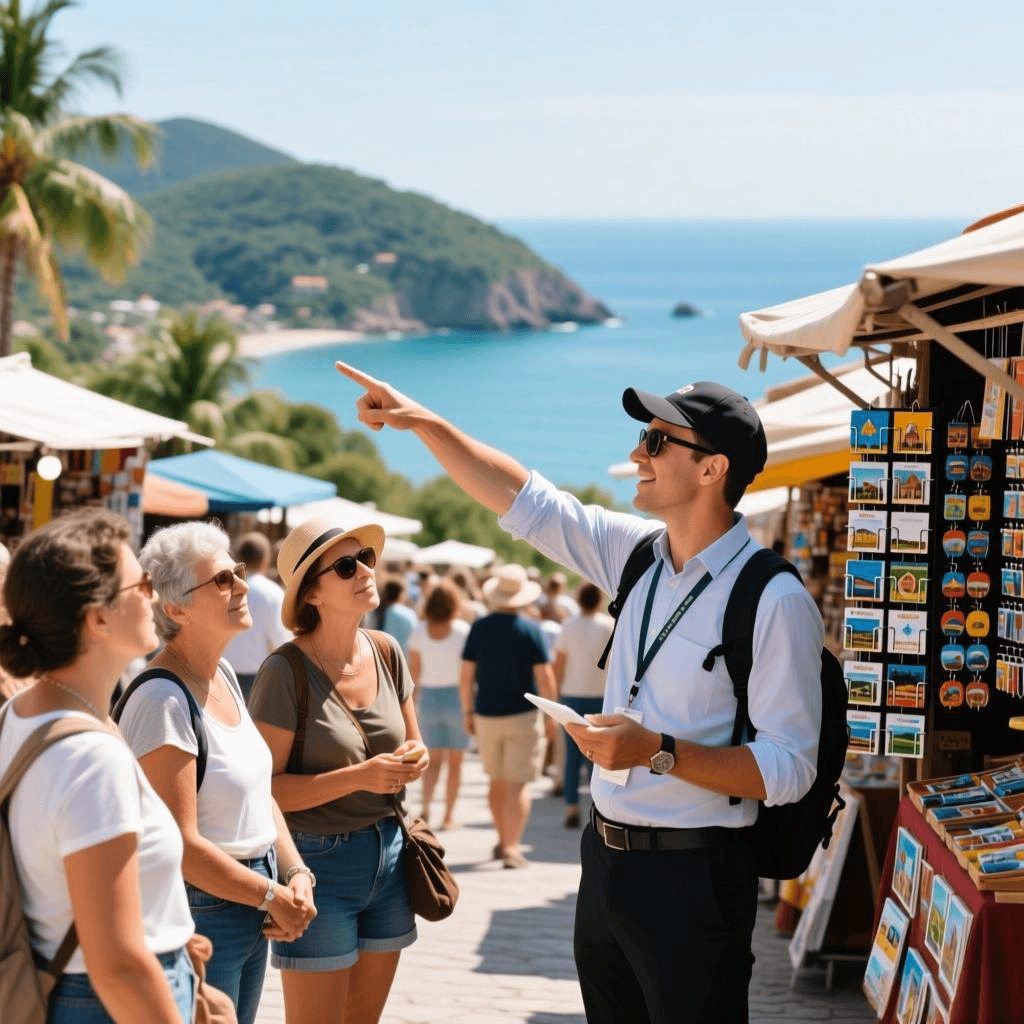
Manual tour guiding means relying on tour guides to lead the group. The guide takes a transmitter and speaks in real time, while the visitor wears a receiver to listen. The tour guide can flexibly adjust the content – for instance, if you are interested in a certain knowledge point and ask, “How was this cultural relic unearthed?”, he can explain more. If there are elderly people or children in the team, you can also slow down the pace and wait a little longer. When overseas study Tours visit factories, the guides can break down the “production process” in more detail based on the students’ questions, which is much more practical than the fixed content.
(2) Content to be discussed: One “fixed standard”, one “Flexible adjustment”
The content of the automatically triggered explanations is pre-recorded and has been polished by a professional team. The information is accurate, error-free and never missed. The forms are also diverse, capable of displaying text, pictures, videos, and audio – for instance, when talking about volcanoes in overseas scenic spots, videos of volcanic eruptions can be added, along with audio explanations from experts, making it much clearer than just listening to the text. However, the drawback is that the content is fixed and cannot be added temporarily. For instance, if you want to know the niche knowledge points of the exhibits, it cannot be fulfilled if they are not included in the recorded content.
The content explained by humans is much more flexible. The tour guide can adjust according to the situation: for ordinary tourists, tell more interesting stories. For professionals, it delves deeper into the technical details. For overseas visitors, it is also advisable to enhance their cultural background. For instance, when showing Middle Eastern visitors ancient Chinese architecture, the guide can emphasize, “What are the differences between the patterns on this building and those in the Middle East? What cultural exchanges does it reflect?” Such personalized adjustments that automatically trigger explanations simply cannot be achieved. However, whether the content is good or not depends entirely on the level of the guide. Different people may present it differently, and occasionally there may be omissions.
(3) Interactive Experience: One “Enjoying browsing by oneself”, the other “able to ask questions at any time”
The auto-trigger explanation focuses on “you have the final say”. If you want to stay longer in front of your favorite exhibits, listen to the explanations several times. If you’re not interested, just take a couple of quick steps and skip it. There’s no need to wait for others. For instance, when overseas independent travelers visit scenic spots, they can take photos slowly from the viewing platform and listen to the explanations at the same time, without having to push and shove with the group. However, the drawback is that there is no interaction. When there are questions, no one answers them, and common problems can only be covered by pre-recorded content.
The advantage of human explanations is that “communication can take place at any time.” If you have any questions while listening, such as “How is the after-sales service for this product overseas?”, just interrupt and ask directly. The guide can answer them on the spot. When you come across interesting points, you can even chat with the guide for a while or even organize a small discussion. When an overseas business delegation visits a company’s exhibition hall, visitors can ask questions about “cooperation policies and technical details”. If the guide explains clearly, the cooperation negotiation will go more smoothly. However, the interaction should be measured and not interfere with the overall itinerary. It is suitable for organized teams.
(4) Money spent: One is “one-time investment, long-term use”, and the other is “monthly salary payment”
The automatic trigger explanation requires a lot of investment in the early stage: purchasing equipment, installing transmitters, and recording content, with a considerable one-time investment. However, the subsequent cost is low, the equipment can be reused, and content updates only need to be made in the background without having to spend money on hiring people. For instance, once overseas museums are installed, as long as the equipment is regularly repaired and the exhibition content is updated, they can be used for several years. The more people they receive, the more cost-effective it is on average.
Human explanation is a labor cost. We need to hire tour guides and provide training. Salaries and travel expenses will all be incurred. If multi-language explanations are needed, several speakers of different languages will have to be hired, which will be even more costly. For instance, at overseas exhibitions, if you need to receive customers who speak Chinese, English or Arabic, you have to hire three tour guides. The cost for a whole day is not low. However, there is no need to spend a large amount of money on equipment in the early stage, which is suitable for short-term and occasional use scenarios.
Ii. What should be chosen for Overseas scenarios? Practical experience tells you
Neither of them is omnipotent. It depends on how you use them specifically. These scenarios have all been verified by us and are definitely correct.
(1) Automatic trigger explanation: Suitable for situations where “you are strolling alone, there are many people, and unified information is needed”
1. Places with a large number of overseas individual tourists
For instance, independent travelers to scenic spots and museums do not want to join tour groups and prefer to arrange their own time. The automatic triggering of explanations enables them to listen at any time and wander around freely without having to queue up for the guides, providing a much better experience. After the British Museum adopted it, the satisfaction rate of individual visitors increased by 70%. Many people said, “Finally, we can visit exhibitions at our own pace.”
2. Large venues with a particularly large number of people
For instance, overseas 5A-level scenic spots and large exhibition centers receive several thousand people in a single day during peak seasons, and it’s simply impossible to handle them all by manual labor. The automatic trigger tour guide can serve many people at the same time without being crowded. After the Tianmu Lake Scenic Area in Jiangsu Province adopted it, the number of visitors during peak season increased by 50%, and the tour guides were not so tired.
3. Scenarios where unified information needs to be conveyed
For instance, when visiting enterprise exhibition halls or factories, every visitor must be informed of the same product information and production processes without any mistakes. Automatic triggering of explanations can ensure this. When Huawei’s overseas showrooms use it, the “product advantages” that global customers hear are the same, and there will be no misunderstandings due to omissions or mistakes made by the guides.
4. Places with a high demand for minority languages
Overseas visitors speak a variety of languages. If we hire multilingual guides, the cost would be too high. The automatic trigger explanation can be preset in 8 commonly used languages, including Chinese, English, Arabic and Spanish. After a scenic spot in the Middle East adopted it, the satisfaction rate of tourists who learned minor languages rose from 60% to 92%.
(2) Manual explanation: Suitable for situations where “teams are needed, high-end services are required, and in-depth interaction is necessary”
1. Overseas team reception
For instance, study Tours, business delegations, and government delegations. There must be someone to lead the team and maintain order, and the content also needs to be adjusted according to the team’s requirements. For instance, when overseas study Tours visit science and technology museums, the guides can design interactive questions and small experiments based on textbook knowledge, making students learn more attentively. When business delegations visit enterprises, the guides can focus on explaining the “cooperation policies”, which helps to advance the negotiations.
2.High-end customized services
For instance, VIP customers and high-end tour groups are all seeking personalized experiences. For instance, when Bentley Cars welcomes overseas clients to its factory, the tour guides accompany them one-on-one and explain in detail “how to customize the body color and interior materials”, which appears particularly high-end and makes the clients feel valued.
3.Scenarios where complex content needs to be discussed
Such as professional exhibitions and academic exchanges, where the content is deep and difficult to understand, and someone needs to break it down on the spot. For instance, at international science and technology forums, if the presenters can explain “complex technical principles” in a more accessible way and answer professional questions, overseas participants will understand them immediately.
4.For places that require in-depth cultural experiences
Such as historical scenic spots and folk custom exhibition halls, the stories and cultures behind them should be told. For instance, when taking overseas visitors to visit ancient Chinese cities, the tour guide can ask, “Why are the doors and Windows of this house designed this way? What does it have to do with local customs?” They can also tell some folk tales, which is much more interesting than regular explanations.
III. Frequently asked questions by overseas users to help you allay your concerns
Many overseas friends worry about this and that when making a choice. Based on the situations we have encountered, here are some answers for you:
(1) “Will the automatic trigger explanation operation be very complicated?” “Will overseas visitors be unavailable?” “
Don’t be afraid at all. The automatic trigger explanation is not complicated at all. Visitors can take the device and it will automatically explain wherever they go without pressing any keys. The ICONS on the device are also simple. For instance, the language switch is “Earth” and the volume is “+/-“. Even the elderly or those using it for the first time can understand it at a glance. There is an overseas rural scenic area. Without staff guidance, tourists use it by themselves, and the usage rate has reached 95%.
(2) “The cost of manual explanations is too high. Is there a compromise solution?”
Sure there is. For instance, the combination of “manual and automatic” – during group visits, the guides explain the core content and answer questions. For complex exhibits, automatically triggered videos are used to complete them. This not only ensures interaction but also reduces the need to hire fewer guides. Another option is to hire part-time tour guides. Hire them during peak seasons when they are busy and don’t use them during off-peak seasons when they are not. This can save a lot of fixed costs.
(3) “The overseas scenarios are complex. Is the signal that automatically triggers the explanation stable?” “
We have tried it in over 4,000 venues around the world, and the signal is particularly stable. It uses UHF ultra-high frequency technology, which can penetrate walls, trees and other obstructions. Whether it is outdoor mountain scenic spots or multi-story museums, it can accurately sense and rarely has problems, with a failure rate of less than 1%. There is a study and research base on the African savannah. Despite the strong wind and dense trees, the equipment can still be stably triggered for explanations.
(4) “Can both be used together?” Would the effect be better?”
Nowadays, many overseas venues are doing this, balancing efficiency and experience. For instance, in museums, individual visitors use automatic triggers to visit on their own, while groups use manual guidance. The key exhibits feature automatically triggered videos, and the guides can also add some interactive elements beside them. In this way, whether it’s individual customers or groups, their demands can be met, and the service quality will improve immediately.
Iv. Conclusion
You don’t have to choose between automatic trigger explanations and manual explanations. The key lies in your needs: if you want to save time, be efficient and serve more people, then choose the automatic one. If you want flexible interaction, high-end services and complex content, choose the human one. If the budget is sufficient and the requirements are diverse, it’s also quite good to use both together.
Over the past 18 years, we have helped many overseas clients build interpretation solutions. Whether it’s the automatic triggering of equipment landing or the configuration of a manual interpretation team, we can handle it all for you. If you are still not sure, tell us what kind of venue it is (such as a scenic area, a museum or an enterprise exhibition hall), who it will receive and what the budget is. We will help you come up with a plan to ensure that the interpretation service does not hold back and even adds points. Yingmi Customer Service Hotline: 400-990-7677 Official website: www.it2002.com, always ready to provide you with exclusive tour plans.