

As an analyst with years of experience in the audio guide industry, the question I’m asked most frequently when working with overseas clients from museums, scenic spots and corporate exhibition halls is: “Which one should I choose, a neck-worn or an ear-worn audio guide system?” Yingmi has seen numerous cases where the right choice of equipment has led to an enhanced visitor experience, as well as instances where poor selection has compromised venue service efficiency. In fact, there is no absolute superior or inferior option between these two types of equipment; the key lies in whether they align with your actual usage scenarios and needs. Today, from a practical application perspective, we will clarify the differences, advantages and adaptability of the two, to help overseas clients make the most suitable choice.
Neck-worn Audio Guide Systems: A Reliable Choice for Long-lasting, Scenario-adaptable Performance
The core design philosophy of neck-worn audio guide systems is “reliability, long endurance and strong adaptability”, making them the mainstream choice for large overseas venues and long-operating scenic spots. Their core advantage first lies in battery life: they can work continuously for more than 16 hours, fully supporting visitors’ all-day tour needs without the need for mid-tour charging, which greatly reduces the venue’s equipment management costs. Secondly, in terms of wearing experience, the neck-worn design ensures even weight distribution around the neck, causing no obvious sense of weight even with long-term wear, and is suitable for visitors of all ages.
Functionally, neck-worn audio guide systems are equipped with high-capacity memory chips that can prestore up to 9,999 audio commentaries and support language switching in 8 languages, meeting the commentary needs of large museums and historical sites with abundant exhibits and a large number of overseas visitors. Adopting a 2.4GHz carrier frequency, they deliver stable signal transmission and outstanding anti-interference capability, ensuring no audio interruptions or skipped playbacks even when multiple people use the devices simultaneously in the venue. In addition, neck-worn devices offer greater customization space; battery capacity, exterior logos, functional modules and other features can be adjusted according to venue needs, better catering to the personalized requirements of different scenarios.

Ear-worn Audio Guide Systems: A Lightweight Choice for Portability and Flexibility
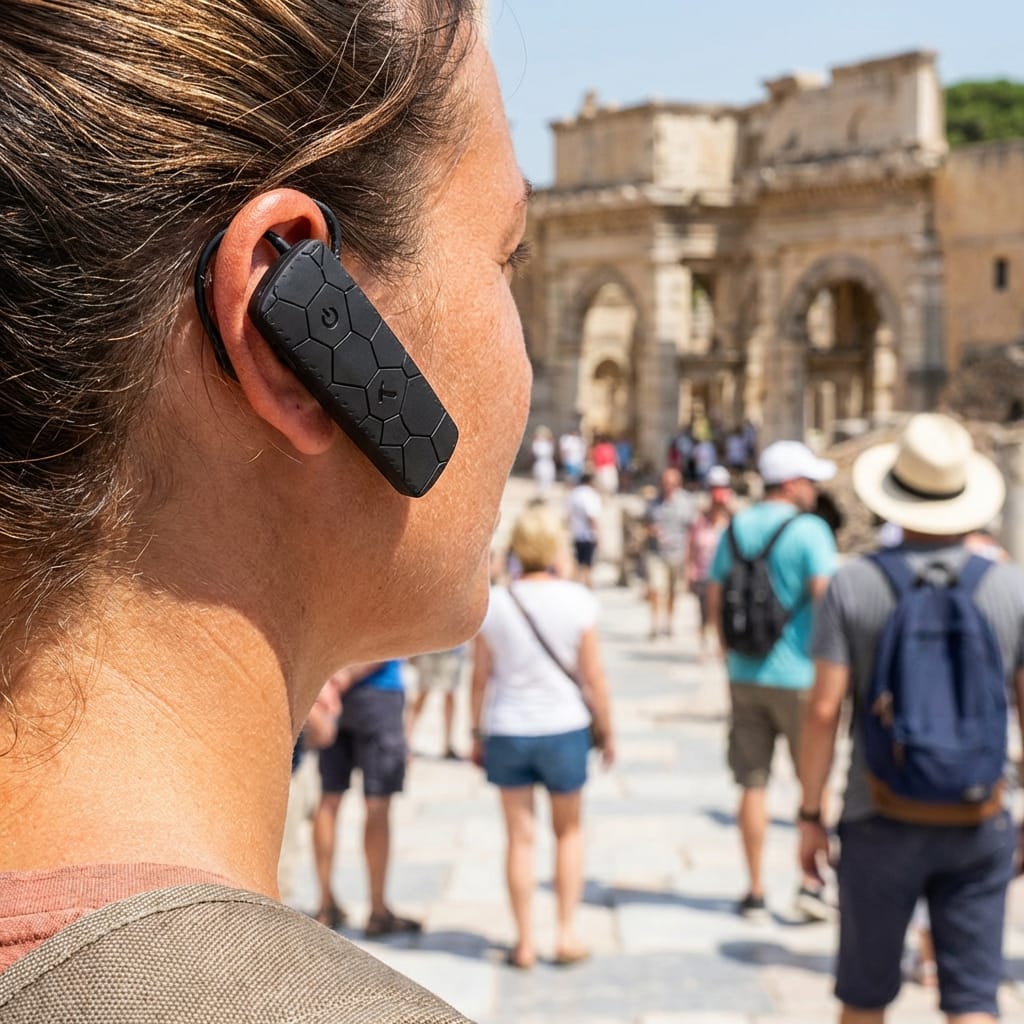
Ear-worn audio guide systems focus on “portability, compactness and high mobility”, making them the optimal choice for short tours and scenarios with high mobility. Their most intuitive feature is the ultra-lightweight design: a single device weighs only a dozen grams, making it almost unnoticeable when worn on the ear. Compared with neck-worn devices, they are also more convenient to put on and take off – visitors can remove them with a simple hand movement when taking photos or communicating, without the need for additional storage, greatly improving the flexibility of use.
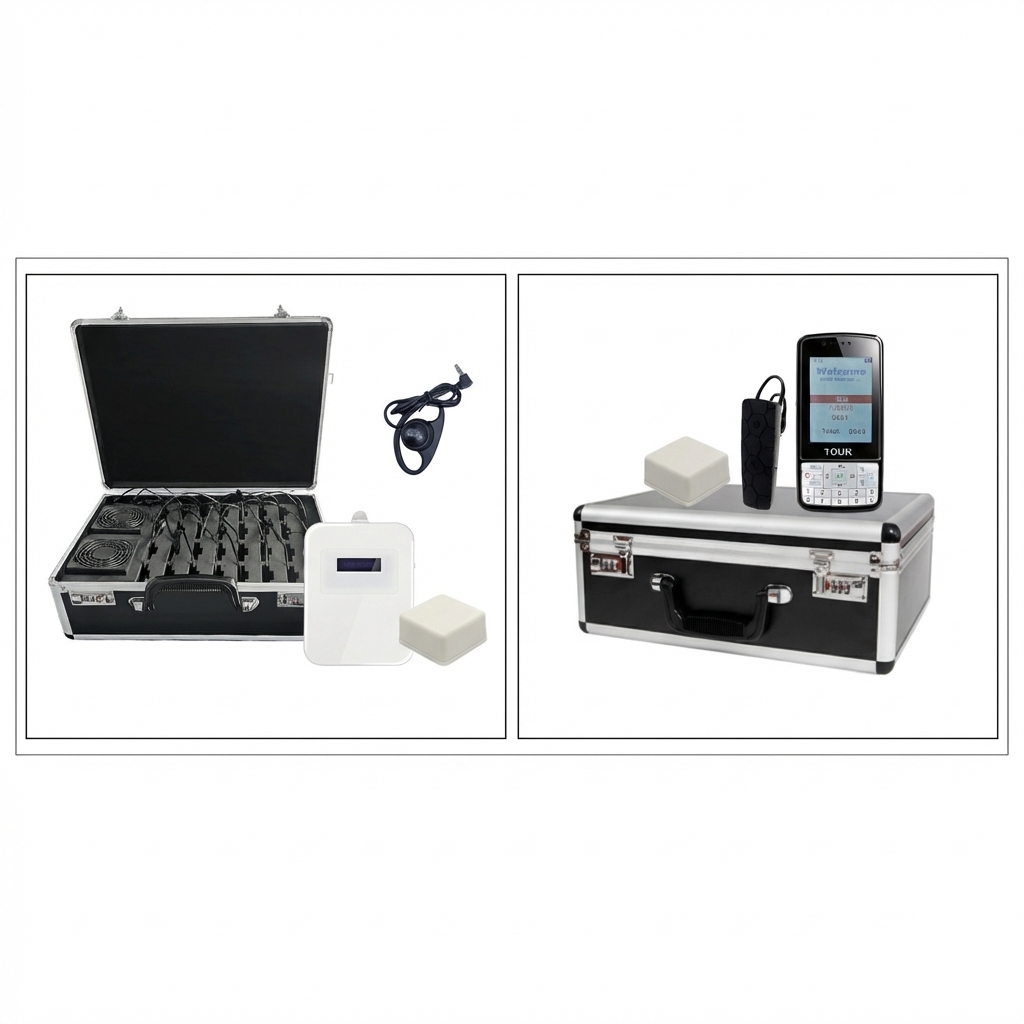
Technically, ear-worn devices adopt a high-frequency carrier of 860MHz-870MHz, enabling faster response speed for RFID induction triggering. Visitors can enjoy instant playback of the corresponding commentary content as soon as they reach the induction point, with zero latency. Although their battery capacity is smaller, with a continuous working time of 7-8 hours, this duration is fully sufficient for one-day short tours and temporary visits. Meanwhile, they also support the storage of 9,999 audio commentaries and language switching in 8 languages, matching neck-worn devices in core commentary functions. In addition, the compact size of ear-worn devices, together with supporting storage cases, enables batch storage and quick distribution, making them ideal for scenarios that require frequent equipment deployment.
Neck-worn vs. Ear-worn: A Direct Comparison of Core Technical Parameters
| Comparison Dimensions | Neck-worn Audio Guide System | Ear-worn Audio Guide System |
| Storable Audio Commentaries | 9,999 segments | 9,999 segments |
| Supported Languages | 8 languages | 8 languages |
| Device Battery Capacity | 800mAh | 280mAh |
| Continuous Working Time | ≥16 hours | 7-8 hours |
| Device Weight | Approx. 50g | Approx. 17g |
| Carrier Frequency | 2.4GHz | 860MHz-870MHz |
| Signal Coverage | 40m | 40m |
| Transmitter Battery Life | ≥15 months | ≥12 months |
Scenario-based Selection: Recommended Adaptations for Different Usage Scenarios
The core differences between the two devices determine their applicable scenarios. Combined with the actual usage needs of various overseas venues, the specific selection recommendations are as follows:
- Large Museums/Historical Sites: Prioritize neck-worn systems. These scenarios are dominated by long static tours with extended visitor stays. The long battery life of neck-worn systems supports all-day use, and their stable signals are adaptable to the simultaneous use of multiple people in multiple areas of the venue. The large storage capacity can also carry rich commentary content for exhibits.
- Sightseeing Vehicles/Short-distance Scenic Spots: Prioritize ear-worn systems. Visitors in these scenarios have high mobility and short tour durations. The portability of ear-worn systems ensures more comfortable wearing during movement, and their sensitive induction triggering adapts to commentary needs on the go. The easy on-and-off feature also aligns better with visitors’ usage habits.
- Corporate Exhibition Halls/Automobile Showrooms: Flexible selection. Choose ear-worn systems for short-term visits and VIP receptions – their portable design exudes professionalism and enables efficient distribution and recovery. For long-term exhibitions and fixed commentary services, neck-worn systems are a better choice, as their long-lasting and stable performance eliminates the need for frequent charging and reduces the workload of equipment management.
- Temporary Exhibitions/Educational Tours: Prioritize ear-worn systems. These scenarios require rapid equipment distribution and storage; the compact size of ear-worn systems allows batch storage, greatly improving staff efficiency. Meanwhile, the lightweight design is also suitable for teenagers participating in educational tours.
- Large Outdoor Scenic Spots/Theme Parks: Prioritize neck-worn systems. Outdoor environments have more interference factors; the 2.4GHz carrier frequency of neck-worn systems delivers stronger anti-interference capability, and their long battery life meets visitors’ all-day outdoor tour needs. The neck-worn design is also more suitable for outdoor mobile scenarios than the ear-worn one.
Avoid Mistakes in Selection: Core Recommendations
Combined with 19 years of industry experience and practical cases of thousands of clients, we have five core selection recommendations for overseas clients. By referring to these in light of your own situation, you can avoid selection pitfalls:
- Consider tour duration: If visitors use the device for more than 8 hours a day, choose neck-worn systems directly; if the daily usage time is within 8 hours, the battery life of ear-worn systems is fully sufficient.
- Consider scenario mobility: Choose neck-worn systems for static commentary scenarios in fixed areas for more stable signals; opt for ear-worn systems for scenarios with high mobility and unfixed travel routes for more flexible wearing and use.
- Consider equipment management needs: Choose ear-worn systems if you need batch rapid distribution and storage of equipment, or if the equipment is used frequently and deployed often; select neck-worn systems for long-term fixed use and the pursuit of low maintenance costs.
- Consider the user group: Choose neck-worn systems for visitors of all ages, especially the elderly and children, as they are more secure to wear and less likely to fall off; opt for ear-worn systems mainly for young people and short-term visitors for a more lightweight user experience.
- Consider customization needs: Choose neck-worn systems if you have demands for personalized hardware adjustments and function customization, as they offer more diverse customization dimensions and can better meet the specific needs of the venue.
Conclusion: The Best Choice is the One That Aligns with Your Needs
In essence, neck-worn and ear-worn audio guide systems are product variants based on the same core technology for different scenarios. Both are equipped with RFID automatic induction technology to realize hands-free automatic commentary playback, and both feature large storage capacity and multi-language support, fully meeting the commentary needs of overseas clients. With 19 years of deep cultivation in the audio guide industry, Yingmi has validated both types of devices in various scenarios around the world. Both come with a 2-year comprehensive warranty for all units, 24/7 global online after-sales support and long-term supply of spare parts, with no differences in product quality and after-sales protection.
For overseas clients, the key to selection is never the “quality” of the equipment itself, but whether it aligns with their actual usage scenarios, tour durations and equipment management needs. As long as you make a precise selection based on real situations, you can maximize the value of the audio guide system – not only reducing the venue’s operational and management costs, but also bringing visitors a smooth and high-quality audio guide experience, thus achieving better dissemination of the venue’s culture and content.
FAQs
- Which audio guide system has longer battery life?
Neck-worn systems offer 16+ hours of continuous use, while ear-worn systems last 7–8 hours – sufficient for full-day short tours. - Are ear-worn systems suitable for large museums with many exhibits?
Yes, both systems can store up to 9,999 audio commentaries and support 8 languages. However, for all-day static visits, neck-worn systems are recommended due to their longer battery life and stable signal in crowded areas. - Which type is better for outdoor scenic spots or theme parks?
Neck-worn systems are preferred. Their 2.4GHz frequency provides stronger anti-interference in outdoor environments, and the neck design is more secure for movement. - When should I choose ear-worn audio guides?
Choose ear-worn for short-duration, high-mobility scenarios such as sightseeing vehicles, short-distance scenic spots, temporary exhibitions, or educational tours where rapid distribution and easy on/off are priorities. - Is there any difference in customization options?
Neck-worn systems offer more customization dimensions (battery capacity, logo, functional modules). Ear-worn systems are less customizable but extremely lightweight and compact.