

After doing overseas cultural and tourism reception, enterprise investigation or study tour activities for a long time, I often encounter users asking: “Which one should I choose, the ear-hanging type or the neck-hanging type of tour guide?” In fact, there is no absolute good or bad between these two devices. The key lies in the scenario where you use them and what your needs are. We, Yingmi, have been engaged in wireless interpretation equipment for 18 years, serving over 4,000 customers worldwide. We have witnessed numerous cases where choosing the right equipment has doubled the experience, as well as situations where choosing the wrong equipment has caused trouble. Today, from the perspective of practical usage, we will clarify the differences between the two devices to help overseas users choose the most suitable one.
I. Understand the core difference: The key lies in whether it is comfortable to wear and easy to use
The most essential difference between the ear-hook style and the neck-hook style is actually the “design logic” – the ear-hook style pursues “lightness, speed and simplicity”, and is suitable for short-term use. The neck-hanging style emphasizes “stability, durability and flexibility”, and is suitable for scenarios with long periods of time and frequent interaction. Let’s break it down from the points that everyone is most concerned about:
1.Is it tiring to wear it for a long time? Check the wearing comfort
When choosing equipment, first consider the “wearing experience”. After all, overseas activities often require wearing for most of the day. If it’s not comfortable, the experience will be directly discounted.
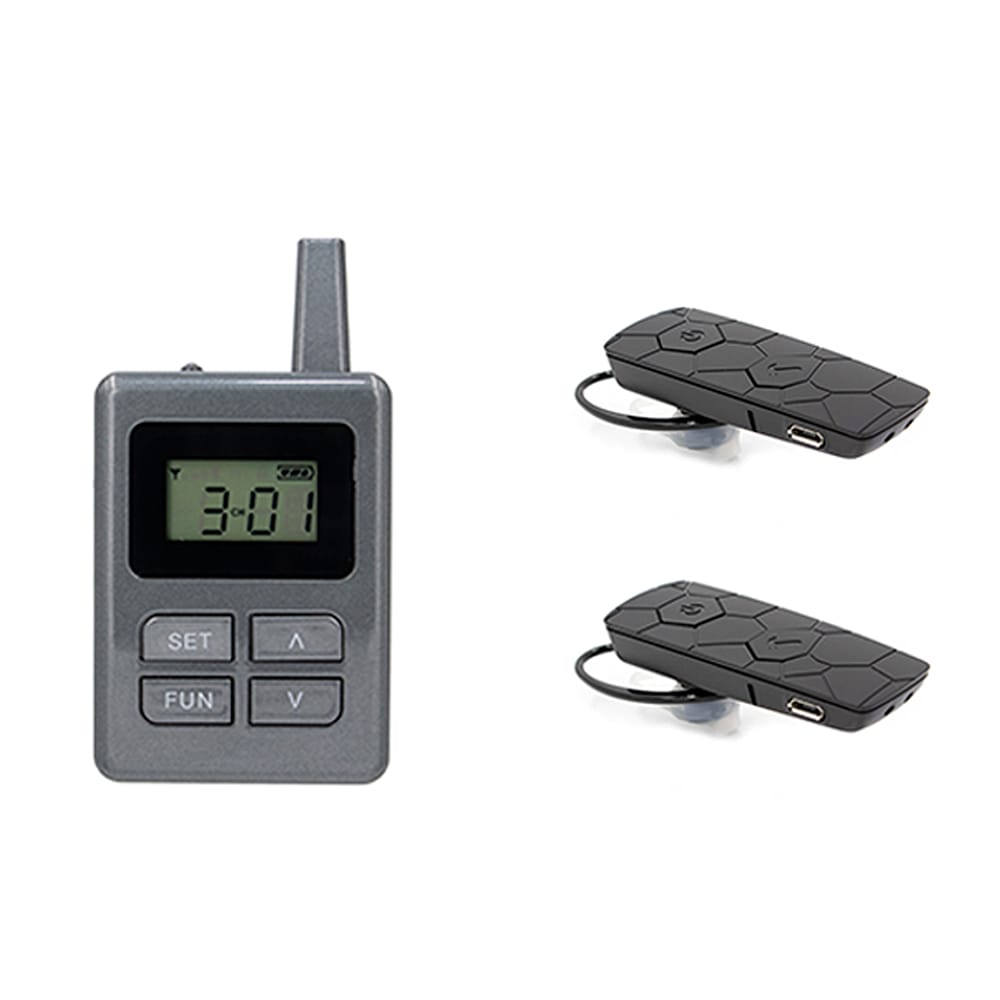
The greatest advantage of the ear-hook type is its “lightness”. Take our Yingmi E8 ear-hook receiver for example. The lightest one weighs only 18 grams, which is even lighter than a pen. When hung on the ear, there is almost no sensation. If you visit a museum or a company’s exhibition hall, after 1 to 2 hours, your ears won’t feel any pressure. Moreover, it is extremely convenient to put on and take off. If you want to take a photo or chat with a companion for a while, you can simply take it off without having to find a special place to put it.
However, it also has a minor drawback: friends who wear glasses may feel that the ear hook and the temple of the glasses are “fighting”, and after a long time, there will be a bit of soreness and swelling around the ears. If you encounter naughty children or active teenagers, it’s easy for them to slip down when running or jumping. Last time, a European study tour group took primary school students to the Forbidden City, and two children’s ear loops fell to the ground. Fortunately, they didn’t break.
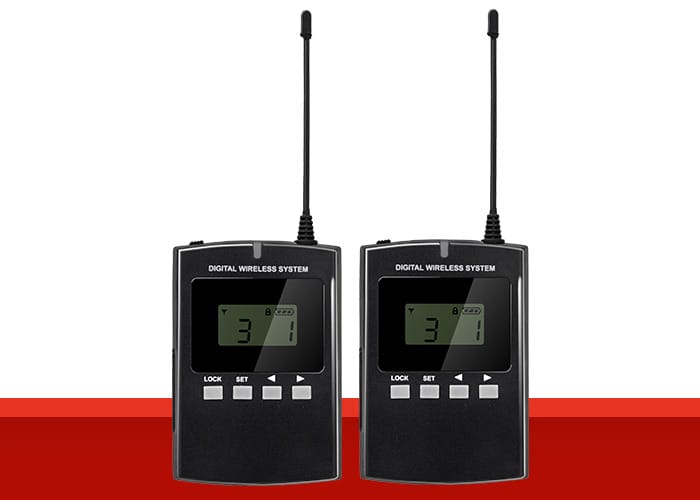
The neck-hanging style is different. It is hung around the neck with a silicone lanyard, and the weight is evenly placed at the back of the neck. It is not picky about the shape of the ears and does not conflict with glasses. Take our 008B neck-mounted tour guide as an example. Many overseas users have reported that they “didn’t feel tired even after wearing it all day”, making it particularly suitable for all-day study Tours, such as visiting scenic spots from 9 a.m. to 5 p.m. However, if worn in summer, the lanyard might feel a bit stuffy sticking to the neck. If you wear a turtleneck sweater or local traditional clothing (such as an Arabian robe or a Japanese kimono), the lanyard might get hooked on your clothes. This point needs to be noted.
2.Will it drop or be inaudible? Look at stability and anti-interference
In overseas scenarios, it is often the case that there are many people and the environment is complex. The stability of the equipment is extremely important.
The ear-hook type is very stable in “static scenes”, such as walking slowly or listening to explanations in a museum exhibition hall. As long as it is worn properly, it basically won’t fall off. Moreover, it has strong anti-interference ability. For instance, the Yingmi E8 adopts SOC embedded digital noise reduction technology and supports 200 channels. Even if 10 international teams use it simultaneously in the same exhibition hall, there will be no frequency confusion. During the last international exhibition at the V&A Museum in London, 8 teams used our ear-hook type, and there was never a situation of “mixed sound” throughout the process. However, when going outdoors for mountain climbing or rafting, as people run and jump, the ear-hook type is prone to slipping off. After all, it is only fixed by the ears and is not as stable as the neck-hook type.
The neck-hanging style is simply “as stable as a mountain” in “dynamic scenes”. Wearing it around the neck, you don’t have to worry about it falling off even when chasing giraffes for photos on the African savannah or climbing steps on Mount Huangshan. Its signal is also particularly strong. The Yingmi 008B uses GFSK modulation technology, which can transmit up to 280 meters in open areas and has a good wall-penetrating effect. Even in complex environments like factory workshops, no matter how loud the machine noise is, the explanations can still be heard clearly. Last time, a delegation from a German car factory used the 008B to walk around the workshop for two hours. No matter how far they were from the tour guide, there was never a situation of “sound interruption”.
3.Can special requirements be met? Check the functional compatibility
In addition to the basic function of “being able to hear clearly”, many overseas scenarios also require special functions. At this point, the differences between the two devices become even more obvious.
The ear-hanging style has the advantage of being “simple and easy to use”, and it can be mastered without learning. For instance, after the Yingmi E8 is turned on, it will automatically search for signals, eliminating the need for manual channel adjustment. It has an LCD screen, allowing you to clearly see the battery level and channels. Even overseas users who don’t understand Chinese can operate it by looking at the ICONS. It can also be connected to mobile phones or tablets to play pre-stored audio explanations. For instance, if a museum wants to provide background information about cultural relics to visitors, it can simply connect the device, which is very convenient. However, its functions are relatively basic and it lacks interactive features, making it suitable for scenarios where one only needs to “listen to explanations”.
The highlight of the neck-hanging style lies in its “interactivity”, making it particularly suitable for scenarios where questions and communication are needed. Take our 008B for example. There is a “Question button” on the visitor’s receiver. When you want to ask a question, just press it and the guide will respond immediately. They can also “broadcast” the questions that everyone is concerned about to everyone. Last time, an Arab study tour group visited the Tokyo National Museum. A student asked, “Why are the noses of Egyptian statues missing?” The guide answered through 008B, and all the people wearing equipment heard it without having to repeat it. The efficiency was particularly high. Moreover, it is very convenient to switch between multiple languages. Just press a button and you can change the language. It is very convenient for international mixed teams to use.
Ii. How to Choose Overseas Scenarios? Just take a look at these few cases and you’ll understand
Just talking about theory is not enough. Let’s combine practical cases and see how to choose in different scenarios.
1. Museums/art galleries: Ear-hanging style is preferred as it is lightweight and does not disturb
The core demand for overseas museums and art galleries is “quietness and no disturbance to viewing the exhibits”. In such places, tourists walk slowly and stay for 1 to 2 hours. They don’t need much interaction. The ear-hanging style, which is “light and simple”, fits perfectly.
For instance, in the Clock and Watch Museum of the Forbidden City in Beijing, overseas tourists come to visit mainly to admire the craftsmanship and history of the clocks and watches. The Yingmi E8 ear-hanging type is convenient for tourists to take off and put on. When taking photos, there is no need to specially remove the equipment, and the heavy equipment will not affect the viewing. Moreover, the ear-hanging style doesn’t take up much space. Tourists can just put it in their pockets. Unlike the neck-hanging style, it won’t get hooked on the exhibits when hung around the neck. Staff at the Victoria and Albert Museum in London said that after using the ear-hanging type, the number of tourists complaining about “troublesome equipment” has decreased by 80%.
2.Outdoor scenic spots/study Tours and adventures: The first choice is the neck-hanging style, which is stable and durable
For overseas outdoor scenic spots (such as the African savannah and the Nordic fjords) and study Tours, the most feared issues are equipment failure and poor signal. In such scenarios, one has to walk a long distance, even climbing mountains or hiking. The “stability” and “strong signal” of the neck-hanging style are the essential needs.
Every year, many overseas study tour groups visit the Longhu Mountain Scenic Area in Jiangxi Province, and they all use our 008B neck pendant. When the students were walking in the mountains, no matter how far they were from the guide, they could hear the explanations clearly. Even if it rains, the equipment is not afraid of getting wet (it has a slight waterproof function). Once, an American study tour group got lost in the mountains. The guide shouted through 008B, “Gather on the left,” and everyone heard it. They quickly met up safely and efficiently.
3.Corporate reception/business meetings: Choose ear-hanging style, which is professional and not out of place
For overseas enterprise receptions and business meetings, the principle of “professionalism and non-disturbance” is emphasized. The ear-hook style has a simple appearance and will not damage the business image, making it very suitable.
When Huawei’s overseas headquarters receives clients, they use the Yemi E8 ear-hook model. When the client wears a suit and tie, the ear-hanging style is not conspicuous and will not be worn around the neck like the neck-hanging style, which would affect the image. Moreover, the ear-hanging type can filter out environmental noise. In a meeting room, even if there are many people talking, you can still clearly hear the explanations. A German customer said, “Listening to explanations with this device is both clear and not disturbing. It feels very professional.”
4.Parent-Child study Tours/International Mixed Teams: Choose the neck-hanging style for stress-free interaction
Parent-child study Tours and international mixed teams most need the ability to “ask questions and switch languages”. The neckband-style interactive function and multi-language support can precisely meet these needs.
Last time, there was a Sino-German mixed parent-child group that went to the Taihu Lake Scenic Area in Suzhou. They used the Yingmi 008B. The Chinese children listened in Chinese and the German children in German. When parents wanted to ask questions, they just needed to press a button. A German child asked, “How are the fish in Taihu Lake protected?” As soon as the guide answered, the children on both sides heard it and it even sparked a discussion. It was much more interesting than just listening to the explanation. Moreover, the neck-hanging type is not easy to fall off, so parents don’t have to keep an eye on their children’s devices all the time, which saves a lot of trouble.
Iii. When overseas users choose equipment, don’t overlook these points
In addition to choosing between “ear-hook style” and “neck-hook style”, overseas users also need to pay attention to these details; otherwise, they may fall into a trap.
1. Anti-interference ability: In places with a large number of people and equipment, choose those with strong anti-interference capabilities
There are often many wireless devices in popular overseas scenic spots and large exhibitions. If the anti-interference ability is poor, the situation of “mixing up sounds” will occur. No matter which one you choose, you should select the one with strong anti-interference ability. For instance, the devices of Yingmi all adopt professional anti-interference technology. Even when multiple teams use them simultaneously, there will be no frequency crossover. This point must be confirmed.
2.Battery life and Charging: For all-day activities, choose a vehicle with a long battery life and convenient charging
Overseas activities often last all day. If the equipment runs out of power, it will be troublesome. The battery life of the ear-hanging type is generally 8 to 10 hours, and that of the neck-hanging type is 8 to 12 hours, both of which can meet the needs of the whole day. However, it is essential to have a centralized charging box. For instance, the charging box of Yingmi can charge 36 to 50 devices simultaneously. It can also be disinfected. You can take it back at night and charge it together, and it can be used the next day. It is particularly convenient. Last time there was a French study tour group with 30 people using equipment. They charged it with a charging case at night and it was fully charged in the morning, which didn’t affect the itinerary at all.
3.Multilingual and customized: Teams specializing in minor languages should customize in advance
Many overseas teams have requirements for minor languages, such as Arabic and Russian. When choosing equipment, it is necessary to ask clearly whether customization is possible. In addition to the preset 8 languages, our Yingmi can also add minor languages as needed, and even customize the explanation content. For instance, if a museum wants to add special stories about cultural relics, they can all be recorded in advance.
4.After-sales Guarantee: For overseas use, choose a product with a global warranty
The equipment broke down overseas. If there is no after-sales service, it can only be thrown away. It’s such a waste. Our Yingmi offers a global warranty. If it breaks down within 3 months, it can be replaced. Within 1 year, it is repaired for free. If it cannot be repaired after two attempts, a new one can be exchanged. Last time, an American customer’s equipment had some problems during use. We quickly solved it through our local partner and didn’t delay their activities.
Iv. Conclusion: There is no best, only the most suitable
In fact, there is no such thing as “which is better” between ear-hanging and neck-hanging styles; there is only “which is more suitable”. In simple terms:
If you are going to a museum or a company for a short period of time, choose the ear-hanging type. It is light, professional and won’t disturb you.
If you are going to outdoor scenic spots or study Tours and need interaction and long-term use, choose the neckband type. It is stable, durable and can be asked questions.
Whether it’s the ear-hanging E8 and i7 or the neck-hanging 008B, our Yingmi products have all been tested by over 4,000 customers worldwide. From the aurora scenic spots in the Arctic Circle to the grasslands of Africa, from museums in Europe to factories in the Americas, our equipment can be found everywhere. If you are not sure which one to choose, you can also tell us your specific scenario and needs, and we will recommend the most suitable solution for you. After all, choosing the right equipment can ensure that every overseas presentation is clear and smooth, and make cultural exchanges more boundless.