

We often receive inquiries from overseas partners, whether they are engaged in scenic spot tours, museum receptions, factory visits, or government-enterprise study tours. All of them face the same dilemma: how to choose between 2.4G and UHF tour guide devices, the two mainstream frequency band solutions. As a brand founded in 2007 with 19 years of deep cultivation in the tour guide device industry, we have seen too many cases of unstable signals, inconvenient wearing, and scene incompatibility caused by wrong frequency band selection. In fact, there is no need to follow the trend blindly. As long as you clarify the characteristics, parameters and applicable scenarios of the two technologies, you can quickly select the most suitable equipment.
I. 2.4G Tour Guide Devices: The Global, Lightweight and Short-Distance Preferred Choice
1.1 Core Definition of 2.4G Tour Guide Devices
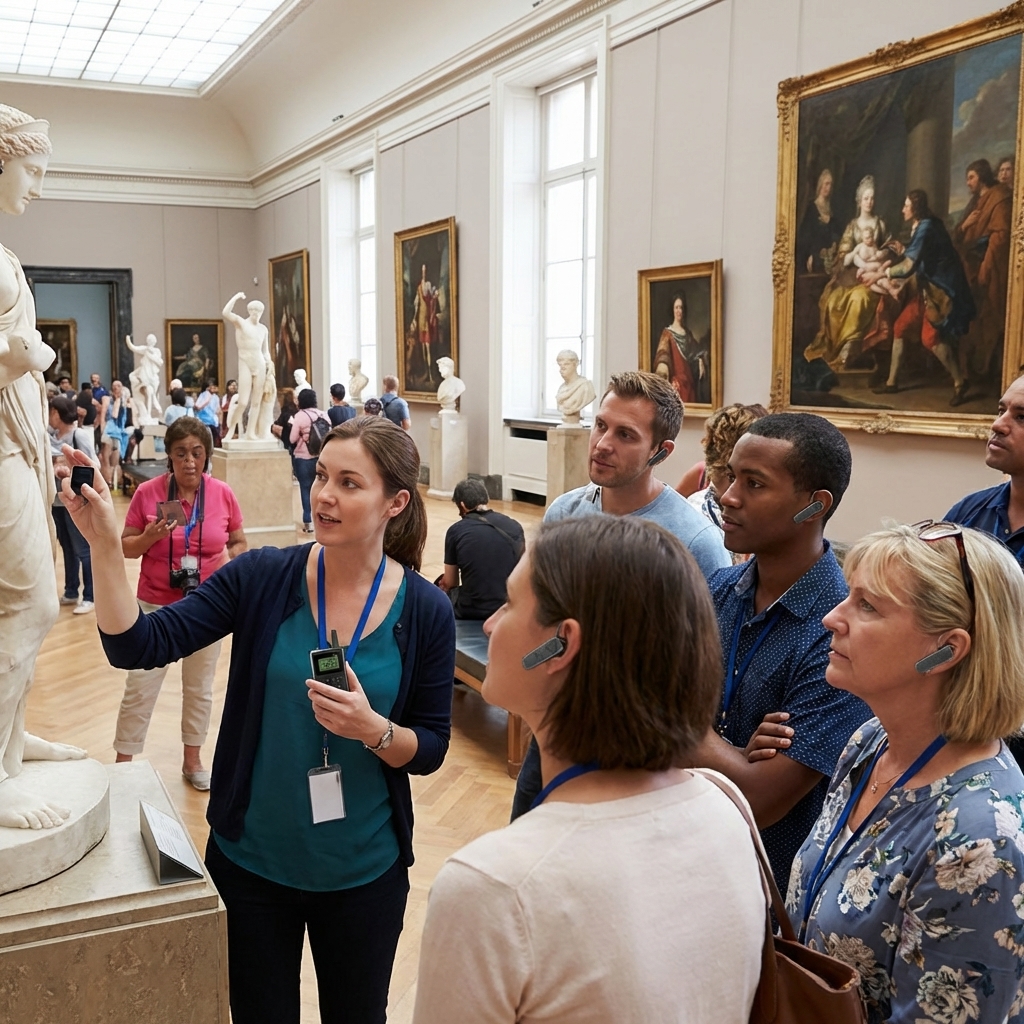
2.4G tour guide devices adopt the globally universal ISM frequency band of 2400MHz-2490MHz, which is the most widely used technical solution for short-distance team tour guide scenarios at present. It requires no special frequency band authorization from various countries and has no threshold for overseas use. As a professional one-to-many one-way audio transmission tour guide device, it works with guides holding transmitters and listeners wearing receivers to complete explanation and listening.
1.2 Core Advantages of 2.4G Tour Guide Devices
Globally universal without restrictions
The frequency band is free and unauthorized for use in most countries. There is no need to worry about compliance issues for cross-border procurement and multi-country scenario reuse, making it a safe choice for overseas customers.
Ultra-light and portable
Both transmitters and receivers adopt a lightweight design. The receiver weighs only about ten grams, causing no burden for long-term wearing, and is suitable for visits and study tours that require full-time portable wearing.
Strong anti-interference capability
Adopting digital modulation technology, it is not easy to have frequency cross-talk when used by multiple teams at the same time, and remains stable in indoor environments with dense crowds and numerous electronic devices.
Functionally adapted for small teams
It supports seamless switching between two guides, and has both manual explanation and pre-stored audio playback modes to meet flexible explanation needs.
Balanced battery life
The working hours after a single charge can reach 7-10 hours, covering a full day of tour guide trips, and the charging duration is only 2.5 hours for efficient power replenishment.
II. UHF Tour Guide Devices: The Ideal Choice for Large Scenarios with Long-Distance and Strong Penetration
2.1 Core Definition of UHF Tour Guide Devices
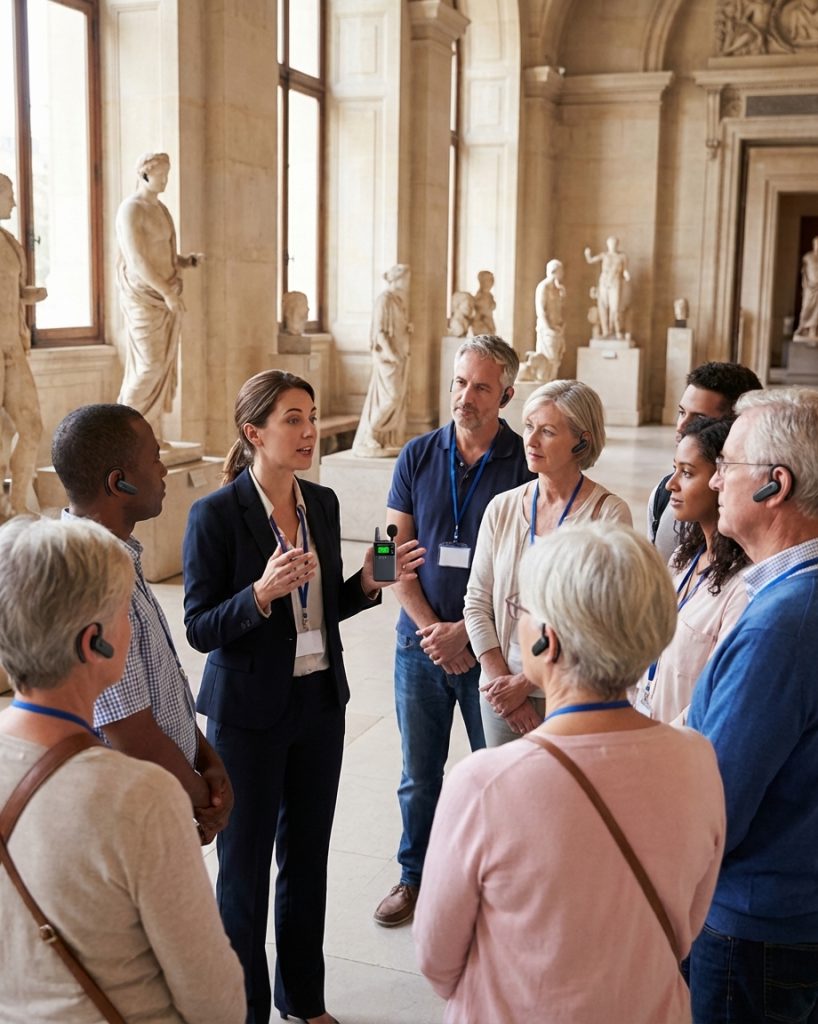
UHF refers to ultra-high frequency. Tour guide devices commonly use the 663-694MHz frequency band, which has a longer wavelength and more outstanding signal diffraction and penetration capabilities. It is a wireless tour guide technology designed for long-distance, large-space and complex sheltered environments, suitable for large teams and outdoor/large-span indoor scenarios.
2.2 Core Features of UHF Tour Guide Devices
Longer transmission distance
The effective communication distance in open areas can reach 1-300 meters, with a larger coverage range than 2.4G, so guides do not need to lead teams within a limited small range.
Strong signal penetration
It can easily pass through obstacles such as crowds, walls and equipment, and the signal is more stable in complex environments such as factory workshops, large venues and outdoor scenic spots.
Supports multi-guide collaboration
It enables seamless explanation switching by 3-5 guides, suitable for professional scenarios such as large-scale receptions and multilingual group explanations.
Stronger scalability
It supports Bluetooth connection to external tools such as mobile phones and translation devices, with higher functional adaptability to meet diversified explanation needs.
Less frequency band interference
There are few civil devices in the UHF frequency band, ensuring signal stability in scenarios where multiple teams use devices intensively.
III. Core Parameter Comparison of 2.4G and UHF Tour Guide Devices
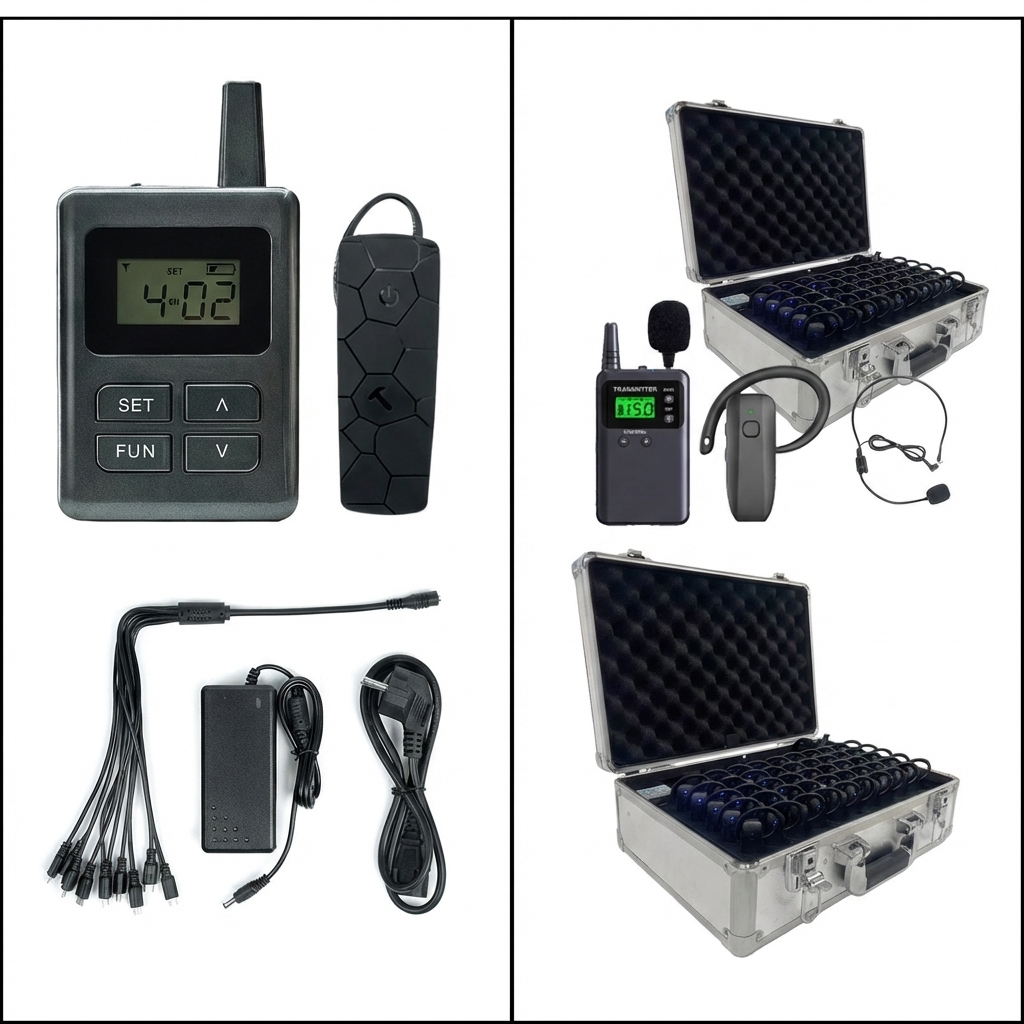
To help you see the differences more intuitively, we take the parameters of the E8 wireless tour guide systems and L8 wireless tour guide systems as examples and organize them into a table, which are all mainstream industry configuration references:
| Comparison Items | 2.4G Tour Guide Devices | UHF Tour Guide Devices |
| Carrier Frequency | 2400MHz-2490MHz (customizable) | UHF 663-694MHz (customizable) |
| Effective Communication Distance | 1-200 meters | 1-300 meters |
| Number of Channels | 150 channels | 18/48/150 channels (adjustable) |
| Working Hours | 7-10 hours | 6-8 hours |
| Device Weight | Transmitter: approx. 68.8g; Receiver: approx. 18g | Transmitter: approx. 98g; Receiver: approx. 16g |
| Charging Duration | 2.5 hours | 2.5 hours |
| Core Functions | Dual-guide switching, manual + pre-stored audio | Multi-guide switching, Bluetooth external connection, strong penetration |
IV. 2.4G or UHF? Choose Based on Different Usage Scenarios
4.1 Scenarios to Prioritize 2.4G Tour Guide Devices
- Small indoor spaces: Museum exhibition halls, small exhibition centers, government-enterprise conference rooms, education classrooms, etc., with small spatial spans and high requirements for portability.
- Short-distance explanations: Small scenic spots, cultural venues, business receptions, etc., with an explanation range basically within 200 meters.
- Lightweight demand: Study tours, long-duration visits, senior/children tour groups, giving priority to lightweight and comfortable receivers.
- Global universal demand: Overseas customers who need to use devices in multiple countries, purchase cross-border, and do not want to apply for frequency band authorization.
- Quiet and private scenarios: Small religious ceremonies, cultural relic exhibition halls, high-end small-scale receptions, pursuing interference-free, clear and private listening experience.
4.2 Scenarios to Prioritize UHF Tour Guide Devices
- Large outdoor scenarios: Large scenic spots, parks, outdoor cultural tourism projects, requiring long-distance and large-scale coverage.
- Complex sheltered environments: Factory production lines, large workshops, multi-story venues, where signals need to penetrate walls, equipment and crowds.
- Large team receptions: Teams of 100 people or more, multi-guide collaboration, large-scale exhibitions/conferences, requiring long-distance stability and multi-guide switching.
- Professional expansion demand: Scenarios requiring connection to translation devices and audio players to realize simultaneous explanation and translation.
- Intensive multi-team scenarios: Large exhibitions, cultural tourism festivals, with multiple groups of explanations at the same time, requiring anti-interference and non-cross-talk devices.
V. 3 Key Dimensions to Quickly Select the Right Tour Guide Devices
Check the usage distance
Choose 2.4G if the explanation range is stably within 200 meters; choose UHF if it exceeds 200 meters and requires large-scale movement.
Check the usage environment
Choose 2.4G for small indoor spaces without complex shelters; choose UHF for outdoor, large-span environments with walls/equipment shelters.
Check the team size and demands
Choose 2.4G for small teams pursuing portability and global universality; choose UHF for large teams with multi-guide collaboration and functional expansion needs.
In addition, if you have customization needs (logo, frequency band, battery, functions, etc.), both frequency bands support OEM/ODM and can be adjusted according to your own requirements.
VI. Summary
There is no absolute good or bad between 2.4G and UHF tour guide devices, only differences in applicable scenarios. 2.4G tour guide devices excel in global universality, portability and short-distance stability, making them the best solution for small spaces, short distances and lightweight scenarios. UHF tour guide devices stand out for long-distance transmission, strong penetration and multi-guide collaboration, and are more suitable for professional needs in large scenarios, long distances and complex environments.
As a tour guide device manufacturer with 19 years of industry experience, we always advise customers: first clarify your usage scenarios, team size and transmission distance, then select the corresponding frequency band, so as to maximize the value of tour guide devices, avoid cost waste, and ensure stable and reliable explanation effects.
FAQ (Frequently Asked Questions)
Q1: Which frequency band is universally license‑free for international use?
A: The 2.4 GHz ISM band is globally license‑free in most countries. It is the safest choice for cross‑border procurement or multi‑country usage without worrying about frequency authorization.
Q2: What is the typical transmission range difference between 2.4G and UHF devices?
A: 2.4G devices typically cover 1–200 meters, ideal for short‑range indoor tours. UHF devices extend coverage to 1–300 meters in open areas, suitable for large outdoor spaces.
Q3: Which device should I choose for factory tours with heavy walls and machinery?
A: Choose UHF tour guide devices. Their longer wavelength provides superior penetration through walls, equipment, and dense crowds, ensuring stable audio in complex industrial environments.
Q4: Are 2.4G receivers comfortable for all‑day wearing?
A: Yes. 2.4G receivers are ultra‑lightweight (approx. 18g), making them ideal for long‑duration visits, study tours, and senior or children’s groups where wearing comfort is a priority.
Q5: Can UHF devices support multiple guides in a single tour?
A: Absolutely. UHF systems support seamless switching between 3–5 guides, which is perfect for large‑scale receptions or multilingual group explanations.
Q6: How does battery life compare between the two technologies?
A: Both offer full‑day coverage. 2.4G devices typically last 7–10 hours per charge, while UHF devices average 6–8 hours. Both require only about 2.5 hours for a full recharge.