

Previously, I participated in a project to visit a Chinese factory of a German automotive company. The workshop was filled with deafening machine noises. The ordinary wireless tour guide devices provided by the visiting group couldn’t handle the noise at all. The devices were filled with background noises, making it impossible to hear the core production line technical parameters clearly. In fact, this situation is very common. Whether it’s international exhibitions, cultural scenic spots, or business receptions, noise reduction effectiveness has long been the key to judging whether a wireless tour guide device is good or not, directly affecting whether communication can be smooth and the quality of the experience.
I. Core pain points of wireless tour guide device noise reduction
In various scenarios of international exchanges, the issue of noise reduction is really prominent. At exhibition sites, there are a lot of people coming and going, making it noisy and chaotic. In scenic spots, there are wind noises and crowd noise. In factory workshops, there are continuous mechanical noises. These environmental noises can easily cover the guiding sounds, resulting in the information not being conveyed properly.
More troublesome is when multiple teams use it at the same time. Different teams’ guiding sounds are likely to mix together, making it impossible for the audience to focus on listening to their own content. Another problem is that many traditional devices do not focus on noise reduction but instead keep amplifying the volume. This not only fails to solve the fundamental problem but may also damage hearing, especially in cross-national receptions where there are people of different ages. This point needs to be paid more attention to.
In addition, foreign customers often mention the need for multilingual guiding. This often leads to unclear translation content due to poor noise reduction technology. Good communication is ruined by the noise.
II. Recommended scenario-based noise reduction products
1.M7C self-service audio guide system: The preferred choice for noise reduction in cultural tourism scenarios
If you are doing cultural tourism projects such as museums and scenic spots, the noise reduction performance of the M7C self-service audio guide system is really reliable. It is equipped with SOC embedded digital filtering and noise reduction technology. In practice, it can filter out 80% of the low-frequency environmental noises. Even in crowded exhibition halls or outdoor scenic spots with strong wind, the guiding sound still sounds clear and understandable.
It also supports 8 mainstream languages for free switching. The next time it is turned on, it can automatically restore the previously selected language. It is particularly convenient for foreign tourists. Combined with RFID positioning technology, when tourists reach a certain guiding point, it automatically plays the corresponding content without manual operation. In small spaces with dense exhibits, it can switch to touch mode to avoid interference from the environment, and every detail of the explanation will not be affected by environmental noises.
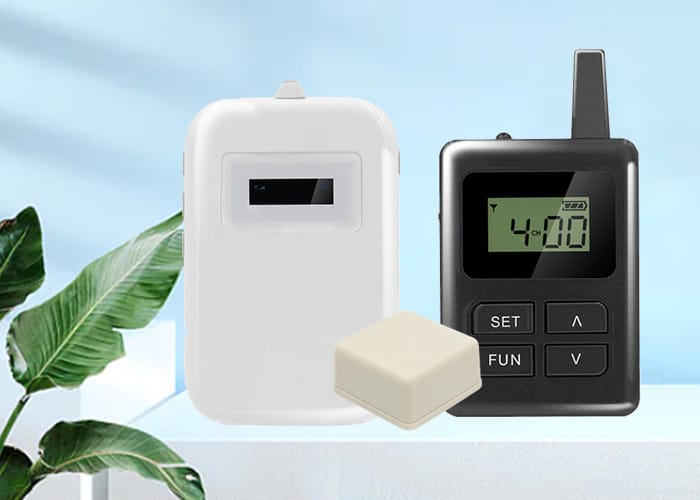
2.R8 Ear-mounted Tour Guide Device: A noise reduction tool for frequent use scenarios
If used in scenarios that require frequent use, such as business inspections and study tour teams, the professional noise reduction technology of the R8 Ear-mounted Tour Guide Device is outstanding. It is of non-in-the-ear design, weighing only 22 grams, and won’t feel tired even after wearing for a whole day. Moreover, it has dual-microphone adaptive noise reduction algorithms, which can precisely separate human voices from environmental noises. Even in factory workshops or large exhibitions with noisy environments, the sound quality is still very pure.
It supports 790-830 MHz high-frequency transmission, can avoid interference from mobile phones and radio stations, and even when multiple teams are using it simultaneously, there will be no interference. The transmitter’s battery life can reach more than 15 hours, and the receiver’s battery life is also 7-8 hours, fully covering the reception needs for a whole day. In addition, it is wear-resistant and dust-proof, and can withstand complex environments such as cross-national long-distance inspections.
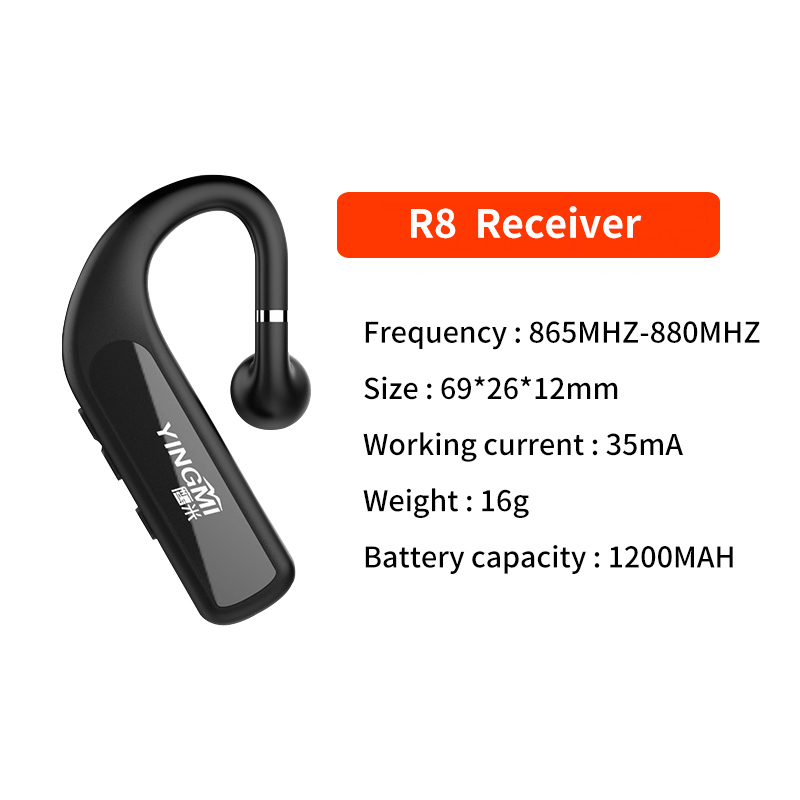
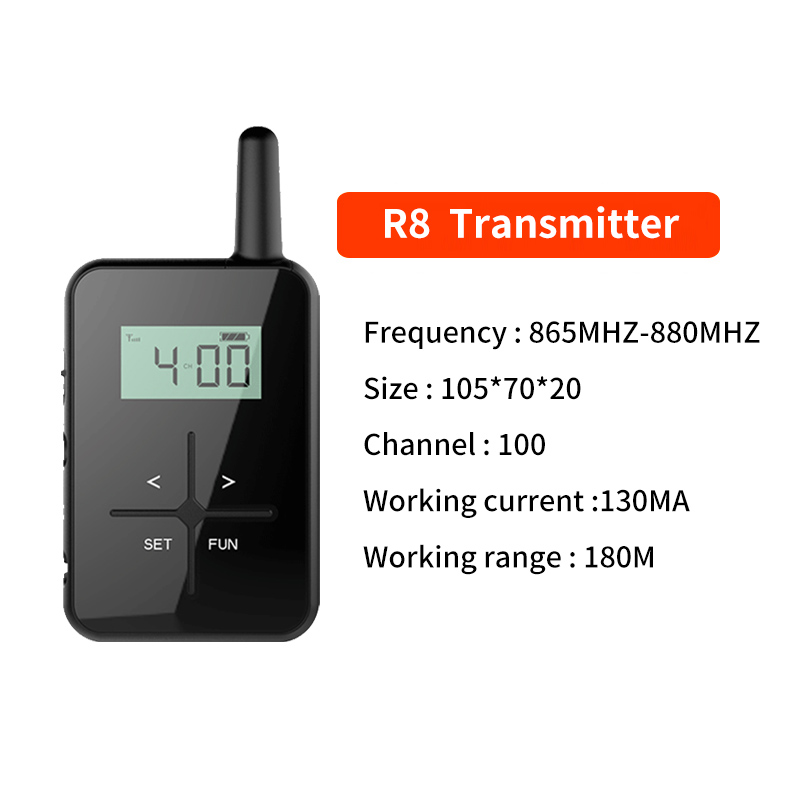
Product Comparison for Noise Reduction
| Feature | M7C Self-Guided Audio Guide System | R8 Ear-mounted Tour Guide Device |
| Best For | Cultural Tourism (Museums, Heritage Sites) | Business & Frequent Use (Factory Tours, Study Groups) |
| Core Noise Reduction Tech | SOC Embedded Digital Filtering | Dual-Microphone Adaptive Algorithm |
| Key Features | – Filters ~80% low-frequency noise – RFID auto-triggered playback – 8 languages, auto-recall – Touch mode for dense exhibits | – Precise human voice separation – Lightweight (22g), all-day comfort – Anti-interference high-frequency transmission – Multi-team, multi-channel support |
| Battery Life (Typical) | Varies by model (Designed for all-day use) | Transmitter: >15 hrs / Receiver: 7-8 hrs |
| Ideal User | Visitors at museums/scenic spots, self-guided tours | Tour guides, business delegations, students in noisy environments |
III. Solutions for optimizing noise reduction effect
Of course, choosing the right equipment is only one aspect. Using the right method can also make the noise reduction effect more effective. When using outdoors, remember to turn on the wind noise resistance mode of the device, so that the sound quality won’t be affected by strong winds. If multiple teams are using it at the same time, plan a dedicated channel in advance, and take advantage of the multi-channel design of the Yingmi to ensure that each team’s signal is independently transmitted and will not interfere with each other. When wearing it, position the microphone of the transmitter close to the sound source and keep it within 30 centimeters. This will reduce the ambient noise from being captured. You can also update the noise reduction algorithm through the device’s backend regularly to make the device adapt to the noise characteristics of different scenarios. For the need of cross-border use, it is recommended to choose products with international certifications such as CE and RoHS. Not only will the customs clearance be smooth, but the noise reduction technology will also be more in line with international standards, making you feel more at ease.
IV.Noise Reduction Selection and Trust Assurance for Cross-border Scenarios
Yingmi has been in the tour guide industry for 18 years, and its noise reduction technology has been verified through many real-world scenarios globally. From the cross-border installation service in Xiangkun Temple in Vientiane, Laos, to the multilingual reception at the Shanghai International Expo, many foreign customers have given positive feedback after using it. Moreover, the product supports customized languages, and if there is a need for minor languages, audio can be recorded according to the requirements, along with precise noise reduction technology. Cross-border communication will have no barriers at all.
Yingmi’s “9G Full Lifecycle Service” is also very complete. It responds within 90 seconds before sale and can provide free sample testing. After sale, there is remote technical guidance, and even for cross-border use, coordination services can be provided, eliminating the worry of long-distance issues.
If you are currently troubled by the noise reduction issues in international exhibitions, cross-border investigations, or cultural tourism receptions, you can really take a look at Yingmi’s products and check their noise reduction parameters and scene compatibility.
FAQ
1.Q: How effective is the noise reduction of these devices in very loud places, like factories?
A: Extremely effective. For instance, the recommended R8 device uses dual-microphone adaptive noise reduction algorithms to precisely separate speech from intense background noise like machinery, ensuring clear audio even in loud industrial workshops.
2.Q: What if there are multiple tour groups using devices at the same time? Will they interfere with each other?
A: No. Devices like the R8 operate on dedicated high-frequency bands (790-830MHz) to avoid interference from phones or radios. Their multi-channel design ensures independent transmission for each group, preventing cross-talk.
3.Q: Which device is better for outdoor cultural sites with wind noise?
A: The M7C self-guided system is ideal. It features digital filtering that eliminates up to 80% of low-frequency environmental noise and includes a specific wind noise resistance mode for clear audio in outdoor conditions.
4.Q: How do you handle multilingual tours with these devices?
A: Both systems support multiple languages. The M7C allows free switching between 8 languages and remembers the last choice. For less common languages, Yingmi offers custom audio recording paired with precise noise reduction.
5.Q: Is the after-sales service reliable for international buyers?
A: Yes. Yingmi offers its comprehensive “9G Lifecycle Service,” including pre-sale consultation with free samples, remote technical support, and coordinated services for cross-border use, ensuring reliable long-distance assistance.